VERUL
TYPES : SHAIV/BUDDHIST/JAIN CAVES
DISTRICT : AURANGABAD
This information has been taken from the Marathi Encyclopedia. The site in India, famous worldwide for the Verul (Ellora) caves, is located in Maharashtra, 29 km northwest of Aurangabad. The Ila River flows near this village. Generally, the construction of these caves progressed gradually from the 6th century AD onwards. After the decline of the Vakatakas, the caves were carved during the period of conflict between the Chalukya and Kalachuri dynasties. The unstable political conditions of the time and the geographical location of these caves reveal the mixed art forms and regional traditions of the Verul caves.
In the Rashtrakuta dynasty copper plates (8th century), this place is mentioned as “Elapur,” which also refers to the carved caves here.
...
The art tradition of Ajanta ended after the death of Emperor Harishena of the Vakatakas, i.e., at the end of the 5th century, and hundreds of artists who left there began working on the Verul caves under the patronage of the new rulers—this is one opinion. Considering the style of Verul sculptures, this opinion seems largely acceptable. Work probably began under the patronage of the Kalachuris in the early 6th century. The Kalachuri coins found in front of the Rameshwar cave support this theory.
The founder of the Mahanubhav sect, Shrikrachadhar, resided in the Verul caves in the 13th century, according to local records. Verul also appears to have been a center of technical Yoga practice for a long time. Later historical information indicates that Maloji Bhosale, the grandfather of Chhatrapati Shivaji Maharaj, administered the Patilki of Verul. In the 18th century, Ahilyadevi Holkar built the Grishneshwar Jyotirlinga temple on the banks of the Ila River. She also renovated the Mankeshwar temple (Kailasa cave) and constructed a varshasan for the incense lamp. Medieval frescoes are still visible on the temple. Recently, remains of Satavahana-period structures (2nd–3rd century BCE) have been recorded in the area.
The caves were excavated from the hills of Balaghat, to the west of the present village, along the Aurangabad–Verul route, in a south-to-north direction, totaling 34 caves. Many smaller caves, unnumbered by the Archaeological Survey, are scattered across the hills. In the main group, the southern part has 12 Buddhist caves. Following them, there are 17 Hindu caves, and in the northern section, there are 5 Jain caves.
The Buddhist caves of Verul appear to have begun on a large scale in the early 6th century. However, many projects may have stopped around 600 AD due to lack of resources. Several caves left incomplete by the Buddhists were later converted into Hindu caves. The first phase of Hindu sculptural activity is mainly associated with the Pashupata Shaiva sect, from the early 6th century until the decisive victories over the Kalachuris under the Chalukyas, i.e., until the early 7th century. The second phase, under the flourishing Rashtrakuta dynasty, shows influences of devotional sects. The third phase, consisting mainly of Jain caves, appears to have been completed by the late 10th century, during the later Rashtrakuta period. Some minor work may have continued during the Yadava period as well. The architectural peak occurred in the 8th century, producing the finest creations.
Thus, the Verul caves are categorized as follows:
• Caves 1–12: Buddhist
• Caves 13–29: Hindu
• Caves 30–34: Jain
The famous Cave 16 is the Kailasa Cave.
Buddhist Caves:
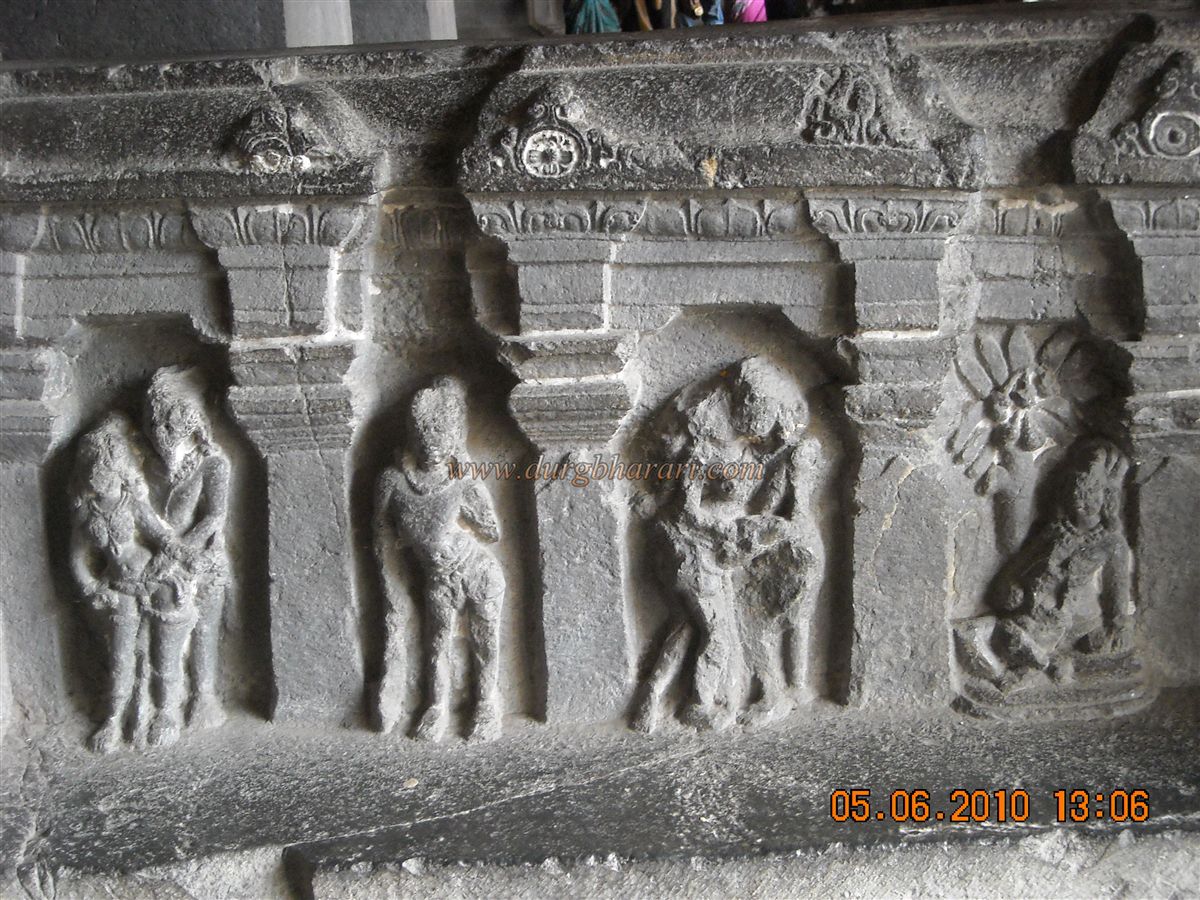
Most of these are viharas, with only one chaitya hall. Some viharas are decorated with sculptures and ornate pillars, while some multi-storied ones appear grand. They are mainly Mahayana sect caves. Some caves also show the beginnings of Vajrayana images.
Cave 1: An undecorated vihara. Eight rooms for monks. Excavated without pillars. No sanctum or images. This is the oldest cave in Verul, very primitive in form.
Cave 2: Likely used both as temple and residence, but only two rooms for living. The back wall has a sanctum and side walls with Buddha images. The Buddha in the sanctum is seated on a throne in Dharmachakra Pravartana Mudra. To the left is Avalokiteshvara Bodhisattva; on the right, another Bodhisattva with a stupa in the crown. Above the Buddha are Gandharvas holding flower garlands. Outside the sanctum are two guardian deities: left – Akshobhya with lotus, right – Vajrapani Avalokiteshvara with ornate headgear. Some believe this to be Bodhisattva Manjushri. The cave features carved round pillar capitals. Inside the entrance, on the left wall, is a large female deity sculpture. The seated Buddha in the sanctum rests on a lotus throne with lion motifs. On both sides are Bodhisattvas holding fly-whisks. There was likely an entrance mandapa, which no longer exists. It contains a remarkable Jambhala (Kubera) sculpture with attendants holding fly-whisks. Inside, a 12-pillared square mandapa, with five large Buddha images on each side.
Cave 3: Features sculptures, sculptured panels, and decorated pillars. A north wall panel shows Avalokiteshvara protecting against fire, war, and floods, also depicting lions, snakes, elephants, and demons. Buddha and Bodhisattvas are shown in changing, worldly-leaning forms. The central mandapa has 12 pillars with carved kalash and leaf motifs. Both side walls have eight rooms; the sanctum has two rooms on either side or a Buddha image. The left guardian deity is Avalokiteshvara. The north wall depicts Buddha in pralambapadāsana with Dharmachakra Pravartana Mudra and Avalokiteshvara panel. The right wall shows star and Vajrayana deity sculptures.
Cave 4: A two-story vihara, with a Buddha image on the upper floor and two small rooms. To the left of the Buddha is Avalokiteshvara holding a lotus. Female attendants stand beside the Bodhisattvas. Also, sculptures of Tara holding a lotus and Bhṛkuti holding a water pot.
Cave 5: The largest cave (35.66 × 17.67 m), popularly called Maharwada, probably derived from Mahavihara. Comprises sanctum, hall, main mandapa, and verandahs on both sides. Two rows of ten pillars form narrow verandahs. The front has four pillars; the back hall contains a Buddha image. Two rooms beside the hall and a total of seventeen rooms beside the mandapa. The layout is similar to a chaitya hall but the sanctum is not semicircular. Roof flat. No stupa or circumambulatory path. Buddha in the sanctum seated in Dharmachakra Pravartana Mudra. Outside, the left Avalokiteshvara holds lotus and Akshobhya; the other guardian is crowned and adorned.
Cave 6: Architecturally, this cave is divided into three parts. The pillars in the front area were adorned with beautiful Salabhanjika sculptures, as indicated by their remaining forms. In the middle section is the mandapa, behind it an open hall (antarala), and beyond that the Buddha temple (garbhagriha). On both sides are two large mandapas, and along the sides are nine rooms. The main mandapa’s ceiling had collapsed, and traces show that a wooden roof was later installed. The pillars are carved with ghatpallava (kalash with emerging leaves) and bear Sharadul-hasta brackets at their tops. In the antarala, there are grand statues of the guardian deities Vajrapani and Avalokiteshvara, with celestial beings (vidyadharas) holding garlands above. On the left wall is a sculpture of Tara Devi, and on the right wall, Mahamayuri. Beneath the peacock mount is a monk reading a manuscript, with vidyadharas depicted above in the open space. The door frame of the sanctum is remarkable for its ornamentation. The small statues of Ganga-Yamuna are extremely delicate.
Cave 7: This cave is undecorated and incomplete.
Cave 8: The distinctive feature of this cave is the provision of a circumambulatory path around the sanctum. Separate sanctum with statues of Bodhisattvas (Avalokiteshvara, Vajrapani), Jambhala (Panchik), and Hariti (a deity) are found here. The sanctum houses a Buddha in pralambapadāsana, flanked by Vajrapani and Manjushri. Manjushri’s crown bears a carved stupa. The female attendant of this sculpture is notable for her distinctive hairstyle. On the right wall of the antarala is a sculpture of Mahamayuri. In front of the sanctum is a mandapa with sculptures of Tara, Jambhala, and Hariti.
Cave 9: Features include the finely carved front area, proportionate pillars, and a prayer panel of deities Padmapani and Tara.
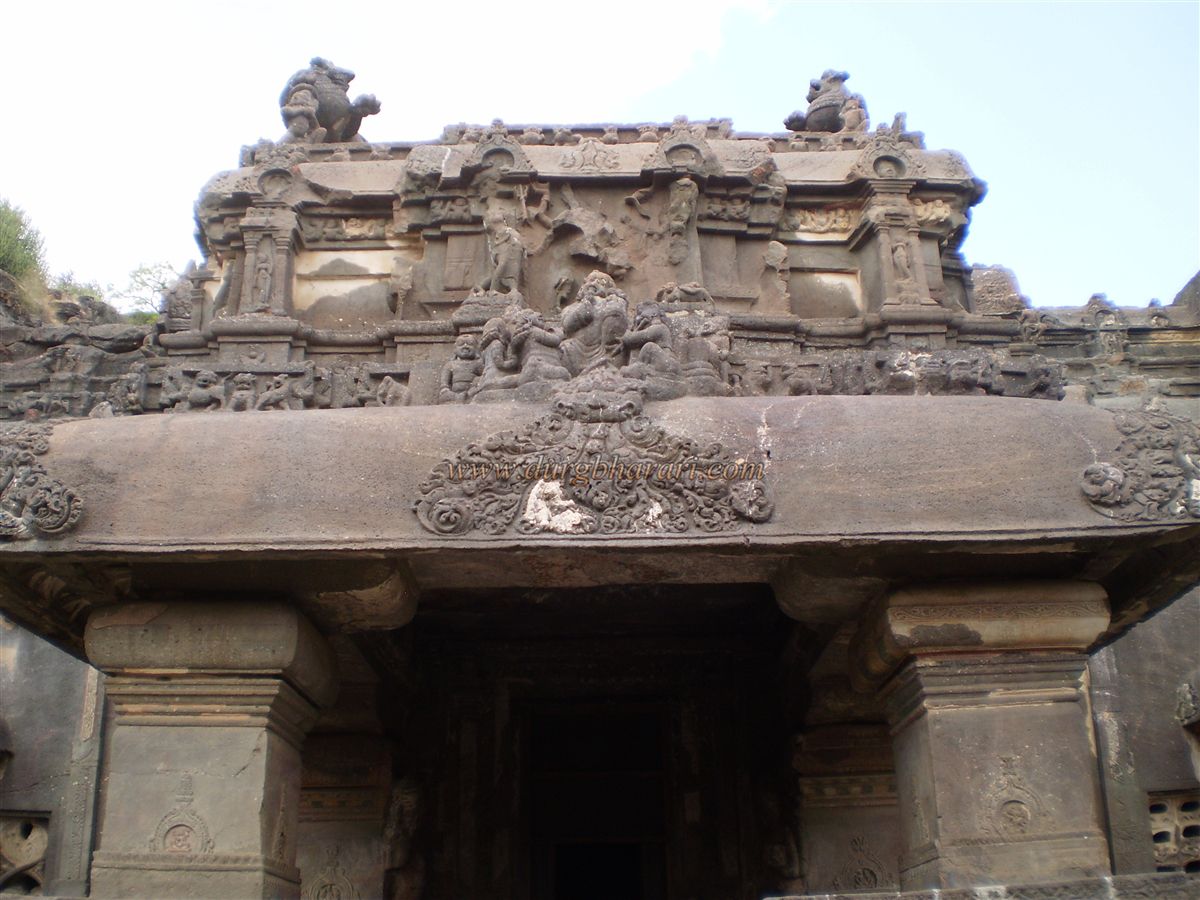
Cave 10: This cave is famous as the Vishwakarma Cave or Sutar (Carpenter) Cave, likely named so because traces of a wooden-built chaitya hall are visible. Although this cave belongs to the chaitya hall type, its tri-partite front façade and layout differ from earlier chaitya halls. Earlier chaitya arches (e.g., at Karle, Bhaje) are scarcely found here. As this chaitya is considered the “final artistic creation in Indian rock-cut architecture,” one can observe differences in the construction of chaityas by examining it. The tradition of woodwork is maintained even in rock carvings here; for instance, the south veranda features carved beams and brackets directly in the rock.
The beauty of this cave is revealed only when viewed from the doorway. Inside, a spacious courtyard with simple pillars on both sides and a verandah at the front. All three sides’ pillars are adorned with ghatpallava and support the upper floor. From the door behind the entrance hall, one can access the chaitya hall. This chaitya is elephant-back-shaped with a large carved stupa. On the façade of the stupa is a Buddha seated in pralambapadāsana, under the Bodhi tree, in Dharmachakra Pravartana Mudra (height 4.87 m). On either side are Bodhisattva sculptures, and celestial couples (gandharva-mithuna) shower flowers on the Buddha. Near the ceiling, there are panels with Buddha and Bodhisattva sculptures, below which are rows of dwarf and giant figures. Further above, naga deities are carved. Outside, concentric circular arches are depicted.
The front façade of Vishwakarma Cave is distinct and artistic compared to other caves. Inside the upper floor wall is a central doorway leading to the chaitya hall. Around this door, in roughly triangular panels, are main torana and gavaksha, with pot, half-pillars, and scrolling foliage forming a grid. Above the door are pillar capitals and nearly circular gavakshas, integrating three levels into one unique design. On both sides are miniature spires, and the open space of the gavaksha features celestial couples. Avalokiteshvara is on one side of the door, Vajrapani on the other. In each corner, couples are carved; rows of mithuna and ganas (attendants) are also depicted.
The pillars of the chaitya hall are simple but bear yaksha sculptures on their capitals. On the left corner of the façade is an inscription in Brahmi script, likely a Mahayana mantra carved later. This cave is a chaitya hall with an upper floor containing a carved sajja (beam). Many small sculptures are carved on the beam. Inside, a wall shows a dancer performing Bharatanatyam. The main arch of the chaitya features three semi-circular arches called Tridali Bilvatoran.
By not limiting themselves to purely religious representation, the artists express aesthetic taste, making Vishwakarma Cave architecturally superior to other early caves. In front of this cave is a large courtyard, with entrance doors carved into the surrounding stone walls. On one corner wall by the entrance, a two-line Brahmi inscription is carved. The courtyard has verandahs on all three sides, rooms on both sides, and a sanctum in the center. The stupa is at the back; its umbrella has been destroyed. In front of the stupa, the Buddha sits on a throne in pralambapadāsana.
Cave 11: This cave is also famous as “Do-Tal” (Two-Storey). The adjacent cave, being three-storeyed, is referred to as “Teen-Tal” (Three-Storey). These two caves represent the final phase of the Buddhist caves here. By 1876, the lowest floor of the Do-Tal cave had filled with soil, making its existence unclear. The combination of monk cells (vihara rooms) and a sanctum with a Buddha image gives this cave a dual character of both temple and vihara.
The front section of the cave has eight carved pillars, with a narrow veranda behind them. Behind this veranda, five more caves are carved into the wall. The first cave is incomplete; the second contains a grand Buddha image, seated in dhyanasana (meditative posture) with bhumisparsha mudra (earth-touching gesture). The throne of the Buddha is supported by attendant figures (ganas), and nearby is a sculpture of Sujata offering rice pudding to the Buddha. As usual, Avalokiteshvara and Vajrapani are present on either side as Bodhisattvas.
The side walls of the sanctum feature multiple Bodhisattva sculptures, including Maitreya (holding a flower with a stupa on the crown), Sthirachakra (sword in hand), Manjushri (lotus and book), and Jnanaketu (banner). Additionally, sculptures of Jambhala (Kubera) and Tara (holding a lotus) are present. Jambhala’s left hand holds a bag of wealth, and below stands a figure carrying a pot filled with coins.
In the central part of the hall, behind the main mandapa, is a seated Buddha in dhyanasana with bhumisparsha mudra. A distinctive feature of this cave is that on the right and front walls of the mandapa, Hindu deities—Mahishasuramardini, Ganesha, and Kala—are also carved, reflecting the period after Buddhist influence had declined.
Although called Do-Tal, this cave actually has three floors. Stone-carved steps lead to the upper levels. The first floor has no particularly noteworthy sculpture, but the sanctum at the center houses a Buddha seated on a square throne in padmasana with yogamudra.
The second floor contains four sanctums:
• The first sanctum has a Buddha with the right hand in bhumisparsha mudra and the left in yogamudra on the lap.
• The second sanctum is smaller, also containing a Buddha image.
• The third sanctum is below the previous one, requiring descending two or three steps.
• The fourth sanctum contains a Buddha seated in dhyanamudra (meditative gesture).
The third floor is a large, spacious vihara. Traces of unfinished excavation are visible in various spots, but much of the work remains incomplete.
Cave 12: Adjacent to the Do-Tal cave, this three-storeyed cave is known as Teen-Tal. Its distinctive feature is the abundance of sculptural sequences on otherwise simple pillars, creating a majestic effect. This is considered the last phase of Mahayana Buddhist cave construction. A spacious courtyard lies in front of the cave. All three floors have rows of eight carved pillars, mostly square in cross-section. Simple elements are used to create a sense of grandeur.
The ground floor is broad. Two of the front pillars are fully ornamented, while the rest are simple and square. There are nine rooms for monks. The antarala is significant, with the back wall on the right featuring a sculptural panel of nine figures: Buddha in the center, Padmapani Avalokiteshvara on the right, Vajrapani on the left, and three figures above them. On the left rear wall, Buddha is carved with Avalokiteshvara and Manjushri.
At the back, the sanctum houses a seated Buddha in dhyanasana, with four Bodhisattvas—Maitreya, Manjushri, Sthirachakra, and Jnanaketu—on the walls. Near the entrance of the sanctum, on the left side is a Buddha, in front a meditative Tara, and on the right, Chunda, a female Bodhisattva. On the upper floor, Buddha is in bhumisparsha mudra. On the right wall are sculptures of Jambhala (Kubera), Avalokiteshvara, and Tara, while the left wall features a panel of nine sculptures.
The top floor is characterized by sculptural abundance and systematic architectural planning. The walls have Buddha images, some in dhyana mudra, others in Dharmachakra Pravartana Mudra. On both sides of the main temple, fourteen Buddha images are carved in two rows of seven each. These seven Buddhas are seated in dhyana mudra, with distinct tree branches carved above their heads.
The sanctum entrance is flanked by guardian figures (dwarapalas). Inside the temple, a Buddha in bhumisparsha mudra, 3.35 m high, is placed, with a circumambulatory path around the figure. Traces of lime plaster on the statue indicate it was painted, with some ceiling paint remnants as well, dating to the 9th century.
The unique features of the Verul Buddhist caves include the divergence from traditional gavaksha design, grand scale of layout, multi-storey excavations, and sculptural richness. Near the entrance are two lion statues. Inside is a spacious square courtyard. Pillars on the verandah are square. The first floor is supported by many pillars. Rooms on this floor have stone platforms and stone cushions for resting heads. At the back lies the sanctum, with a Bodhisattva carved to the right of its entrance, holding a lotus with a book in the left hand. The sanctum houses a Buddha seated on a throne in Dharmachakra Pravartana Mudra.
Hindu Caves: Caves numbered 13 to 29 belong to Hindu religious traditions. These are generally dated to the 6th to 8th centuries CE. Among them, Shaiva sculptures and panels depicting episodes from the life of Shiva are more numerous, whereas Vaishnava sculptures are comparatively fewer. Chronologically and artistically, the caves can be divided into two groups: those before the rule of the Rashtrakuta king Dantidurga, and those contemporary with or after his reign. Accordingly, caves 14, 17, 18, 19, 20, 21, 22, 25, 27, 28, and 29 belong to the pre-Rashtrakuta period, likely dating to the early 6th century.
From the perspective of style and design, Cave 29 (Sita’s Bath) shows striking similarities with the Gharapuri caves. Sculptures of Lakulisha-Shiva (Caves 18, 21, 29) reflect the influence of the Lakulisha-Pashupata sect on the Ellora caves. Remains of wall paintings from the 8th, 10th, and 12th centuries are found in the Kailasa Cave, Jain caves, and the Ganesha caves on the hilltop.
Cave 14: This cave is popularly known as “Ravana Ki Khai” (Ravana’s Pit), probably due to the sculptural panel depicting Ravana attempting to lift Mount Kailasa. Its floor plan is almost identical to that of Buddhist Cave 2. Half-pillars along the side walls frame the sculptural panels. The front pillars are square at the base, with full-pot ornamentation at the top.
• The north wall predominantly features Vaishnava panels:
o First niche: Durga holding a trident.
o Second niche: Gajalakshmi seated on a lotus, with four elephants sprinkling water from above.
o Third niche: Varaha panel, remarkable for the grandeur and energy of Varaha and the proportional figure of Bhudevi (Earth goddess).
o Next niche: Vishnu seated in Vaikuntha with Bhudevi and Sridevi.
o Following panel: Vishnu-Lakshmi under a Makara Torana.
Near the main temple doorway, female guardians (dwarapalas) are present, flanked by Ganga on a Makara and Yamuna on a Kurma, along with imposing dwarapalas. A circumambulatory path (pradakshina path) runs along the walls, decorated with panels and sculptural ensembles.
• On the north wall, Saptamatrikas with attendants are carved, positioned between Veerabhadra and Ganesha.
• The south wall features additional panels:
o First: Shiva slaying Andhaka, with exquisite depiction of rage and energy.
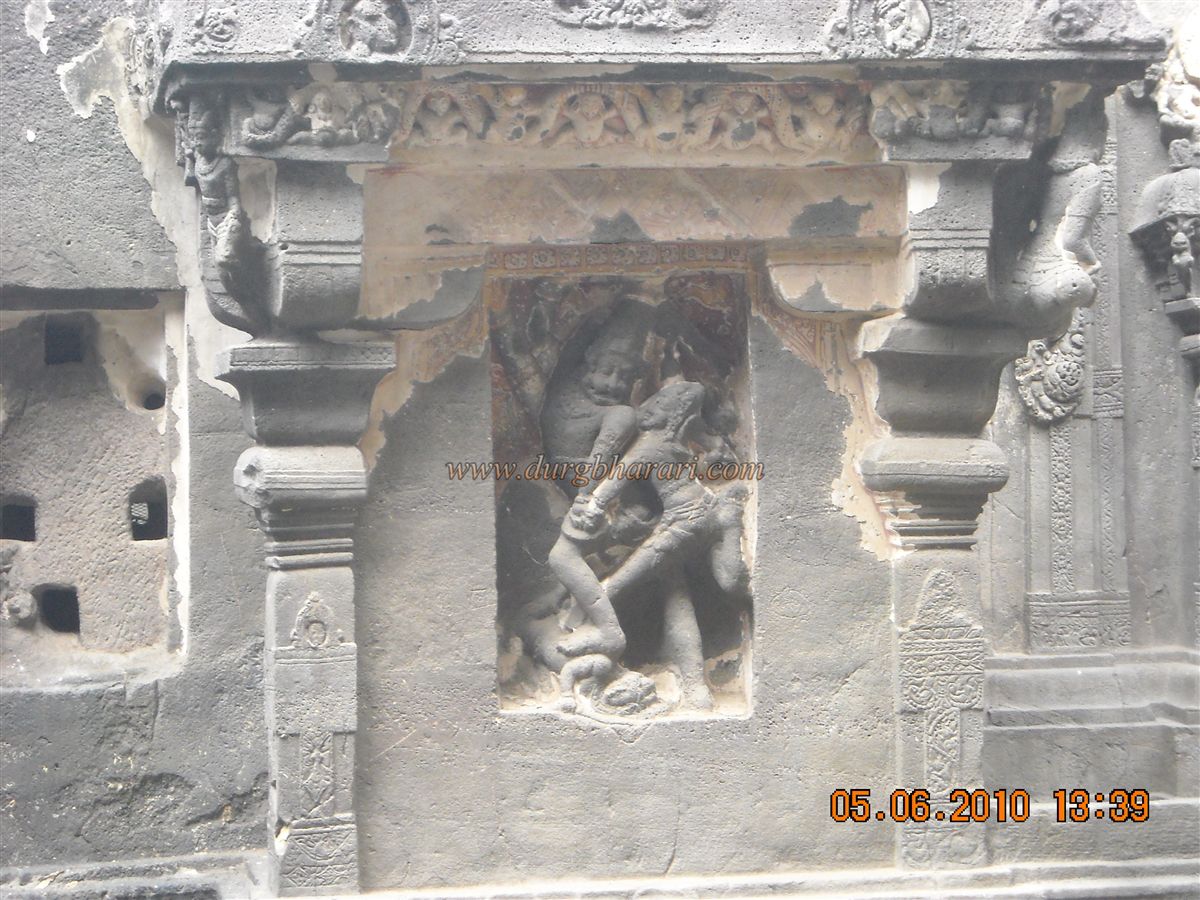
o Second: Shiva and Parvati on the mountain, obstructing Ravana’s Pushpaka Vimana. Ravana’s fury and determination, Shiva’s calm posture, and Parvati clinging to him in fear are rendered realistically.
o Next: Shiva’s Tandava dance, attended by Parvati, Brahma, Vishnu, Indra, and Agni.
o Another panel shows Shiva and Parvati playing a game: Shiva, inattentive to the game, causes Parvati to turn her face away in displeasure; he gestures to continue, and the sculptor captures her pout and his coaxing masterfully.
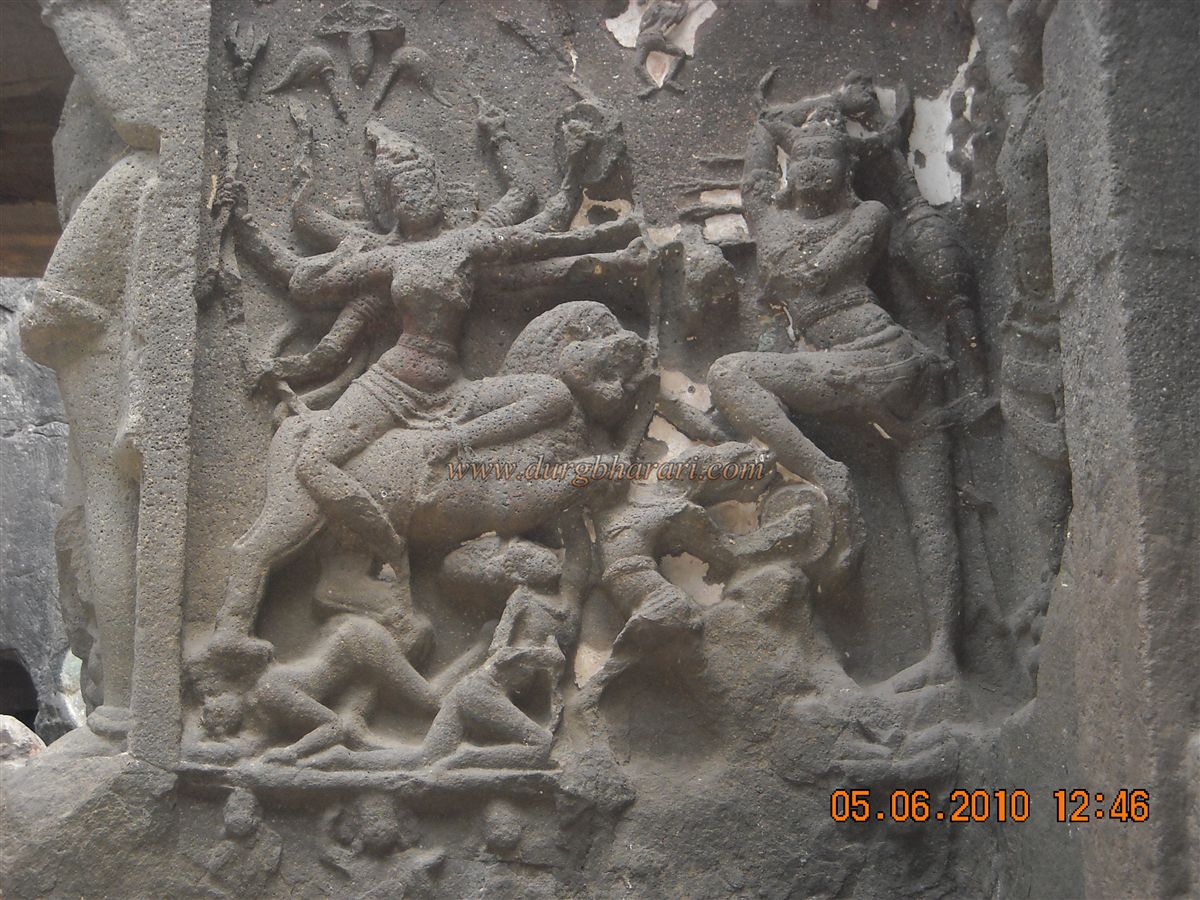
o Adjacent niches: Nataraja and, in the last niche, Mahishasuramardini.
Cave 15: This cave is famous as the “Dashavatara Cave”. Its features include dynamic sculptures, an inscription of Rashtrakuta king Dantidurga, and panels depicting Puranic stories. It is a two-storeyed cave.
• On the outer pillars, there is a carved Buddha in bhumisparsha mudra (earth-touching gesture).
• A spacious courtyard lies in front, with a central mandapa.
• On the rear wall of the mandapa, a long inscription records the Rashtrakuta lineage, and mentions that King Dantidurga visited this cave with his army.
The mandapa features lions, yakshas, shrines, Ganga-Yamuna sculptures, and latticed windows. Sculptural panels are continuous throughout the cave.
• North corner niches contain steps leading to inner sanctums.
• Sculptures include Ganesha, Shiva-Parvati embracing, Surya, Mahishasuramardini, Ardhanarishwar, Uma the ascetic, Kali, and others.
• The sanctum houses linga worship. The outer pillars feature amalaka, full-pot, and pranali motifs, along with yaksha figures.
• North wall: Shaiva sculptures; south wall: Vaishnava sculptures.
• First north niche: Andhaka slaying Shiva, eight-armed, holding weapons including sword, damaru, and Nila-asura’s head. Parvati stands stunned, Kali holding Naraka-pala, and a fainting man under Shiva. Shiva wears a Rudramala, impales Andhaka with a trident. Owl near Yogeshwari; Rahu’s head near Andhaka’s feet.
• Second niche: Shiva in Tandava.
• Third niche: Shiva Linga with traces of vine decoration on the ceiling.
• Fourth niche: Shiva-Parvati playing a game.
• Another niche: Kalyanasundara, depicting Shiva’s marriage to Parvati.
• Other panels: Ravana Anugraha (Ravana’s failed attempt to lift Kailasa and Shiva’s subsequent grace), Markandeya Anugraha, and Ganga Avatarana.
o Markandeya, though short-lived, worships Shiva; when Yama casts his noose, Shiva kicks Yama back, granting Markandeya immortality. Yama is also called Kala, giving the sculpture its name “Kaalari”.
o Ganga descent panel: Shiva restrains Ganga in his matted locks, with the ocean sculpted below.
• Left wall of antarala: Ganesha; right wall: Kartikeya.
• Right of sanctum: Gajalakshmi; left: Saraswati.
• Damaged Shiva Linga in the sanctum.
• Pillars of antarala: Mithuna couples.
• Rear wall: Lingodbhava Shiva and Tripurantaka Shiva, showing cosmic manifestations.
o Lingodbhava: central luminous linga, with Vishnu on the right and Brahma on the left seeking the origin of the linga.
o Tripurantaka: Shiva on chariot, Sun and Moon wheels, Brahma, Meru Mountain as bow, Vasuki as bowstring, Vishnu as arrow, and four Vedas as horses.
• Right wall: Vaishnava panels—Govardhandhari Krishna, Sheshashayi Vishnu, Gajendra Moksha Vishnu, Bhudeva Varaha, Trivikrama Vishnu, and Narasimha slaying Hiranyakashipu. These are proportionate, dynamic, and express varied gestures.
• In front of sanctum: freestanding Nandi.
• North wall of courtyard: one cave with sanctum housing Shiva Linga and Trimurti (Aghora, Tatpurusha, Kamadeva).
The sculptural style and quality of this cave are irregular, suggesting different teams of sculptors from various traditions worked here. It seems that before attempting a grand project like Kailasa Cave, sculptors from across India were tested here, and only the selected teams were employed. One team from Andhra Pradesh may have later worked on Pataleshwar Cave in Pune.
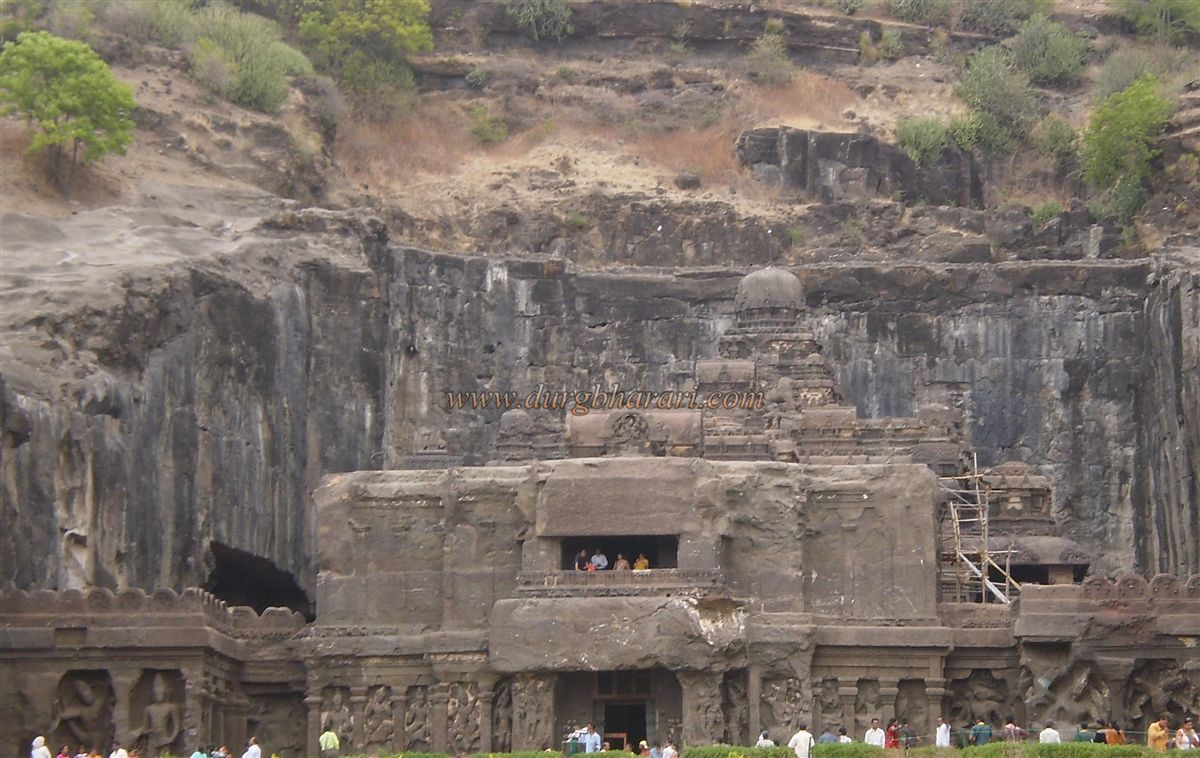
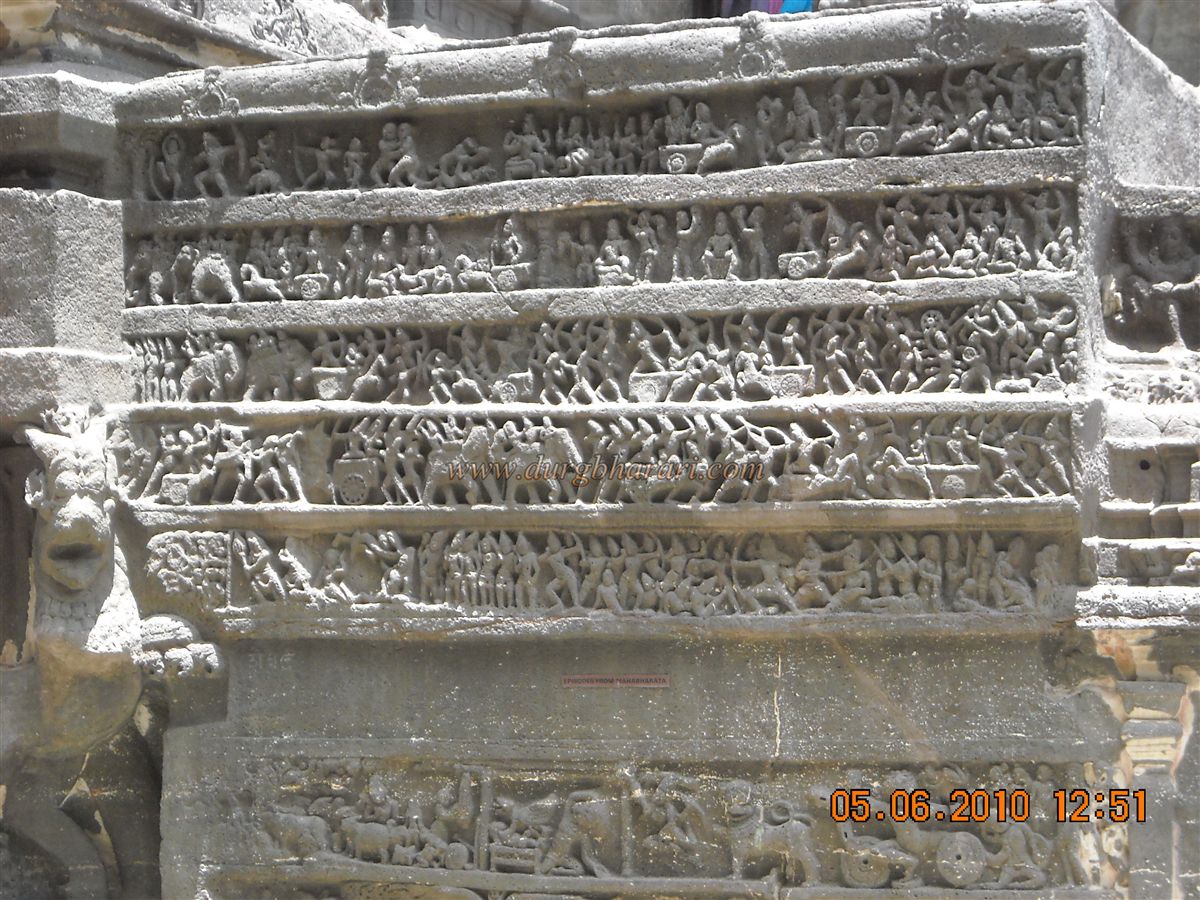
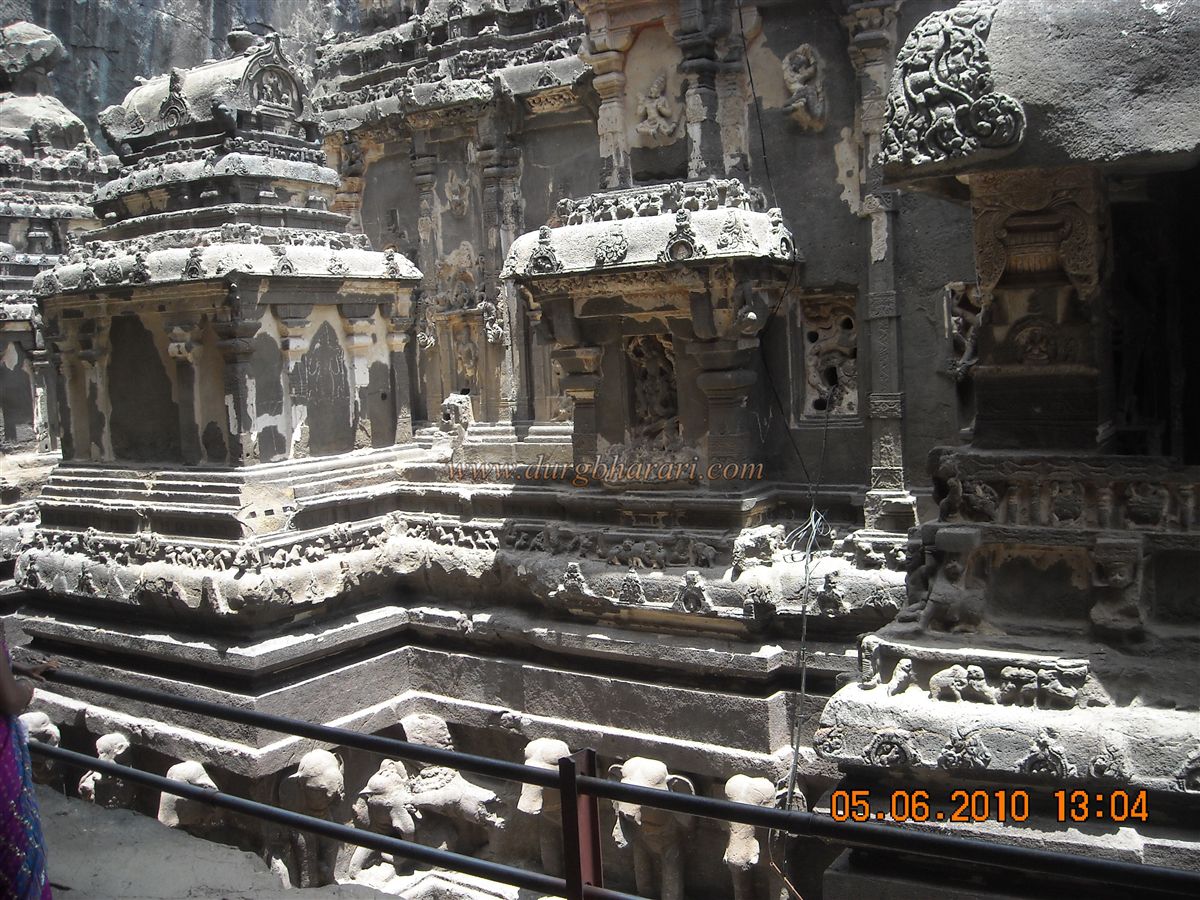
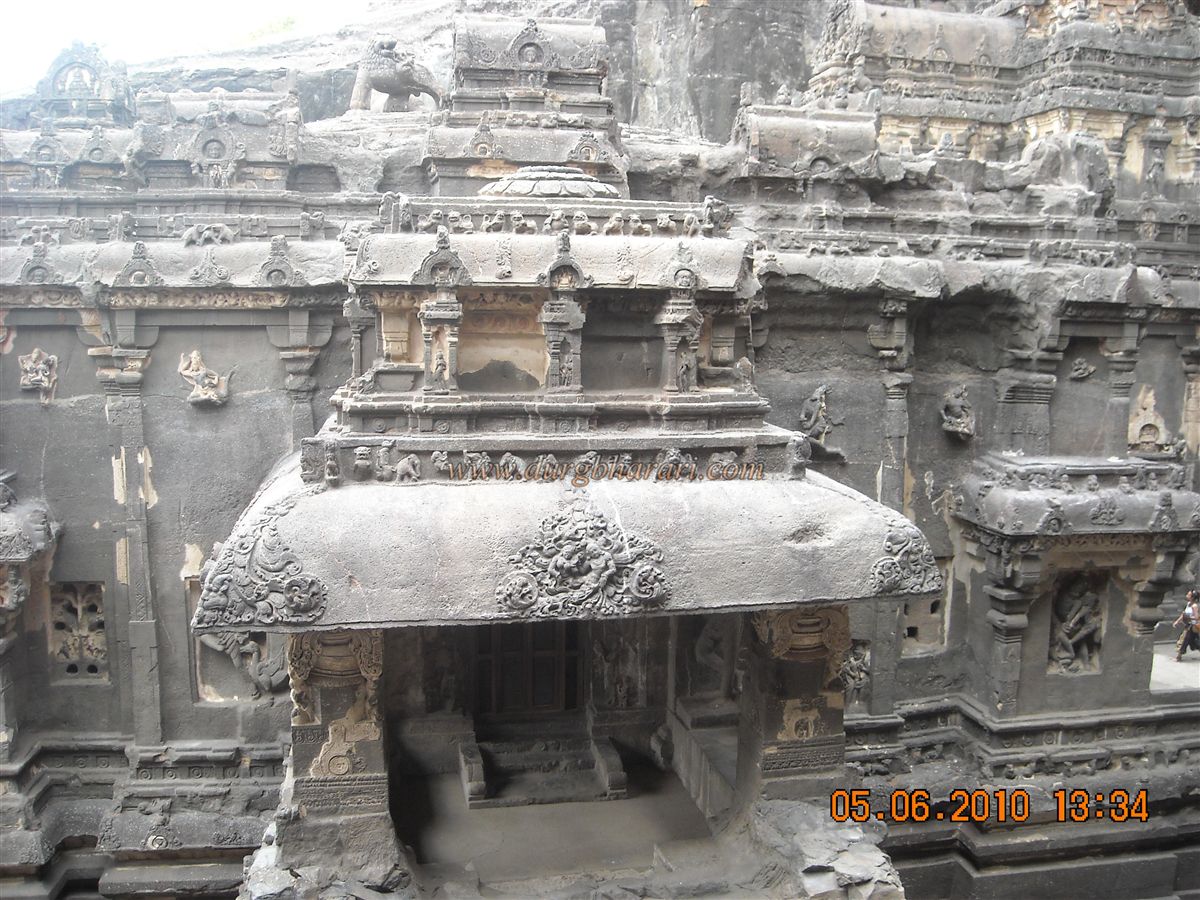
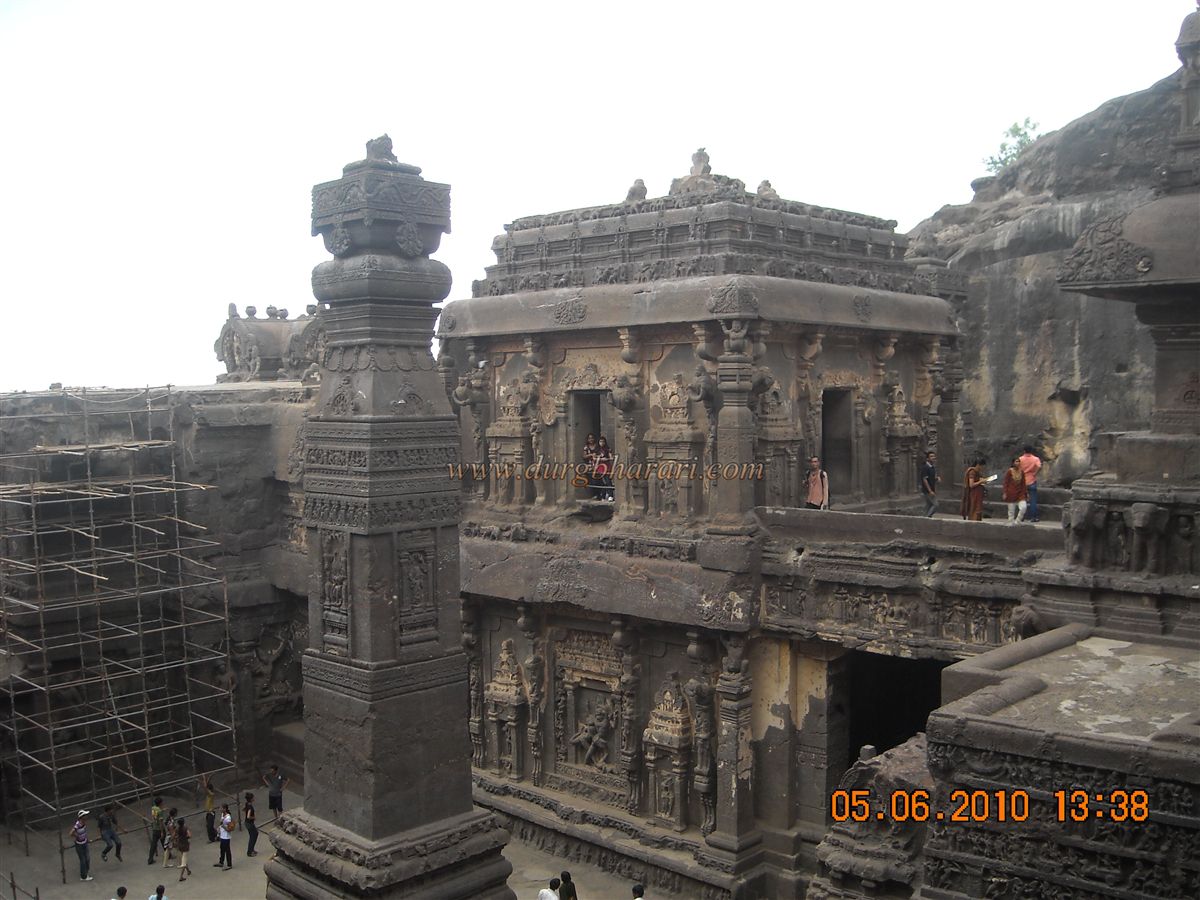
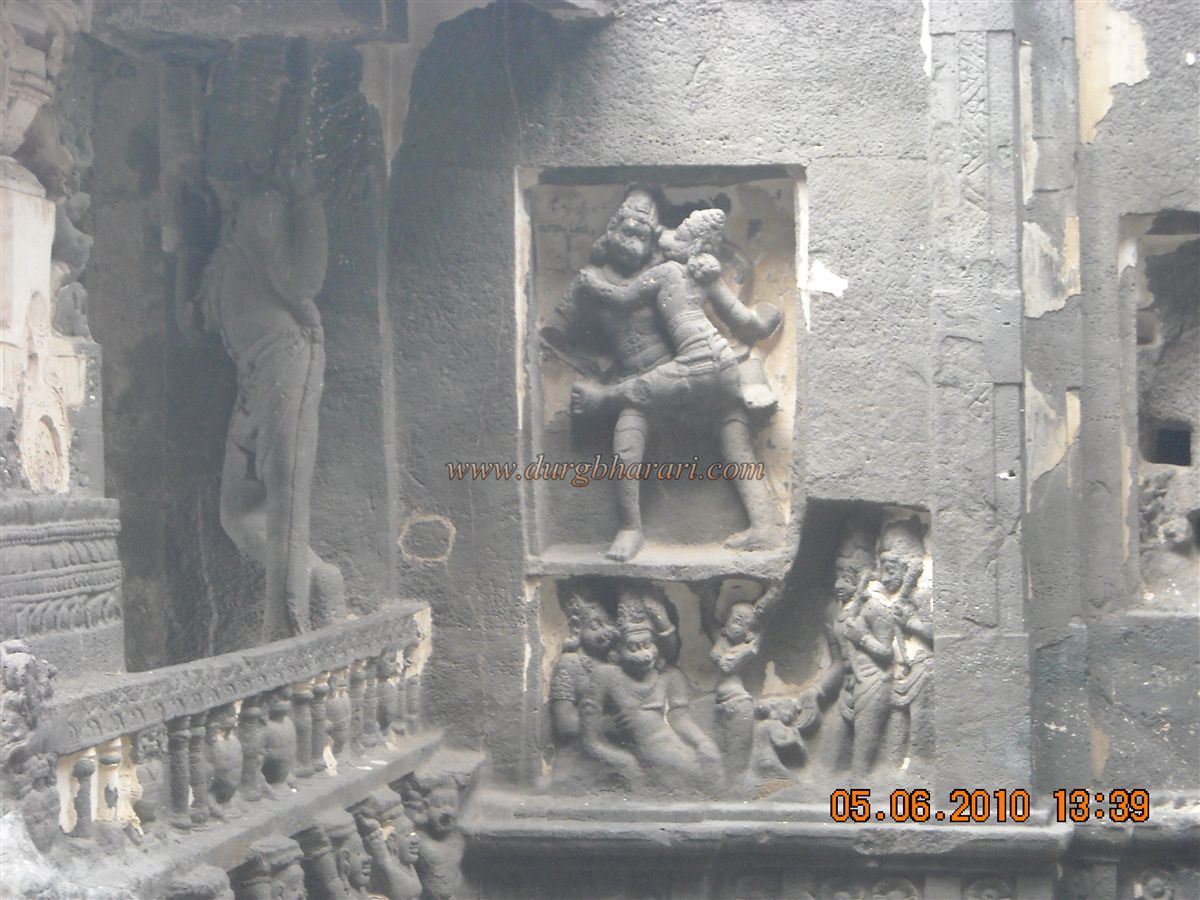
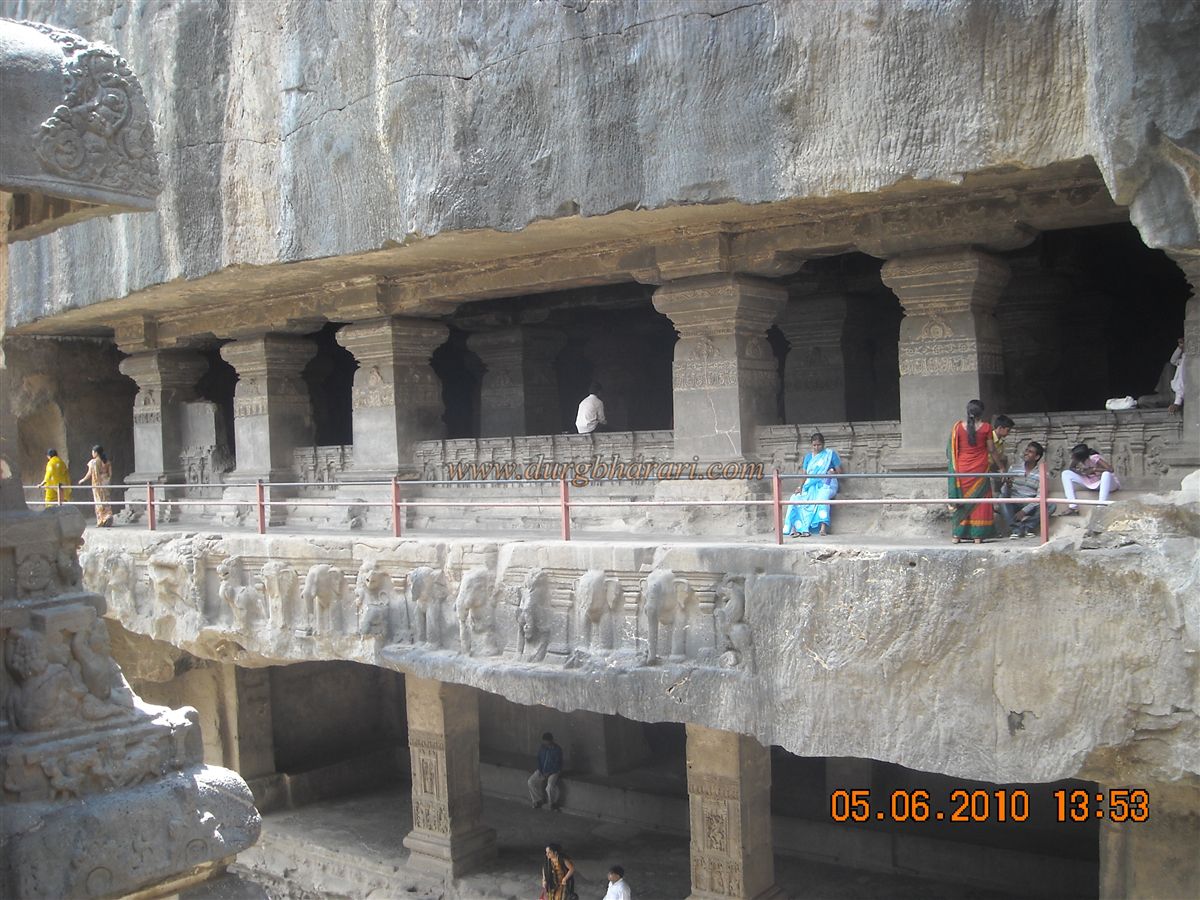
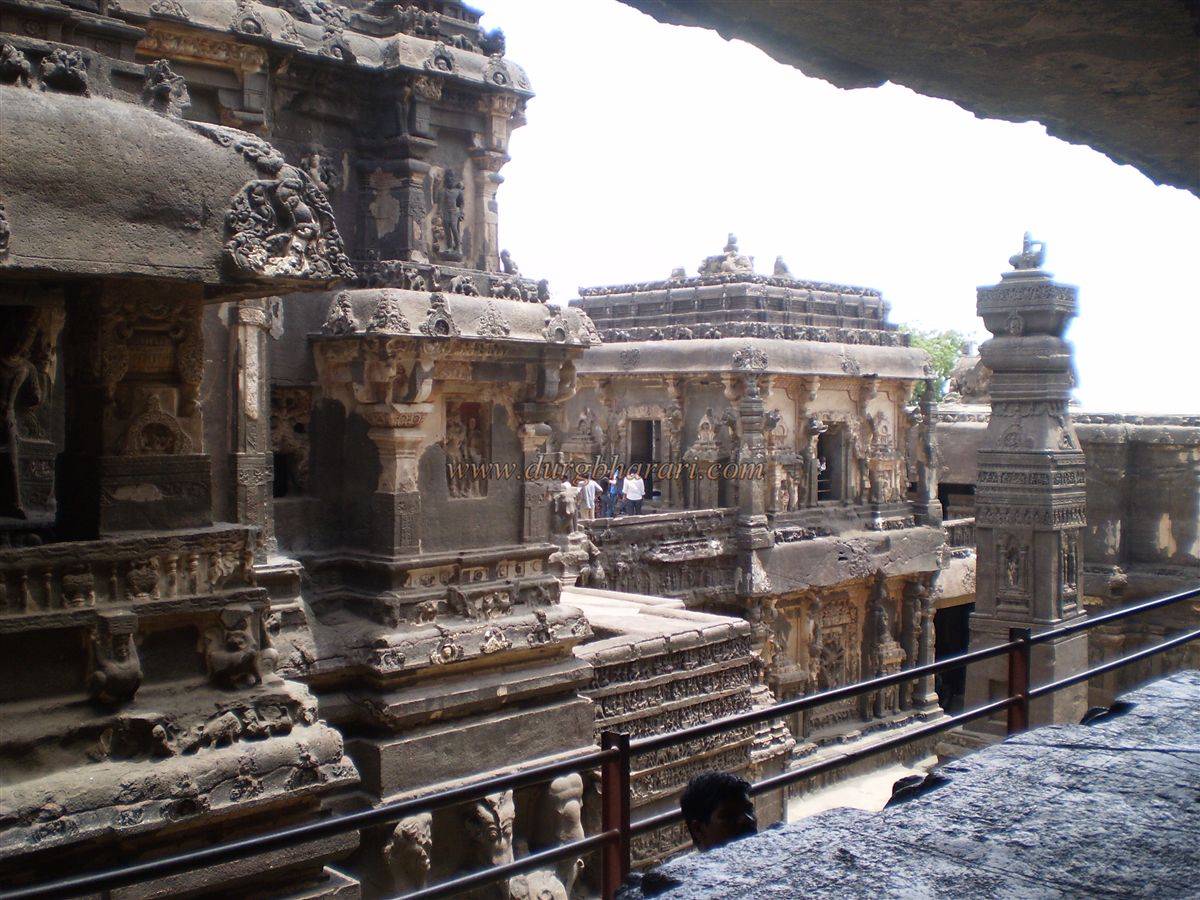
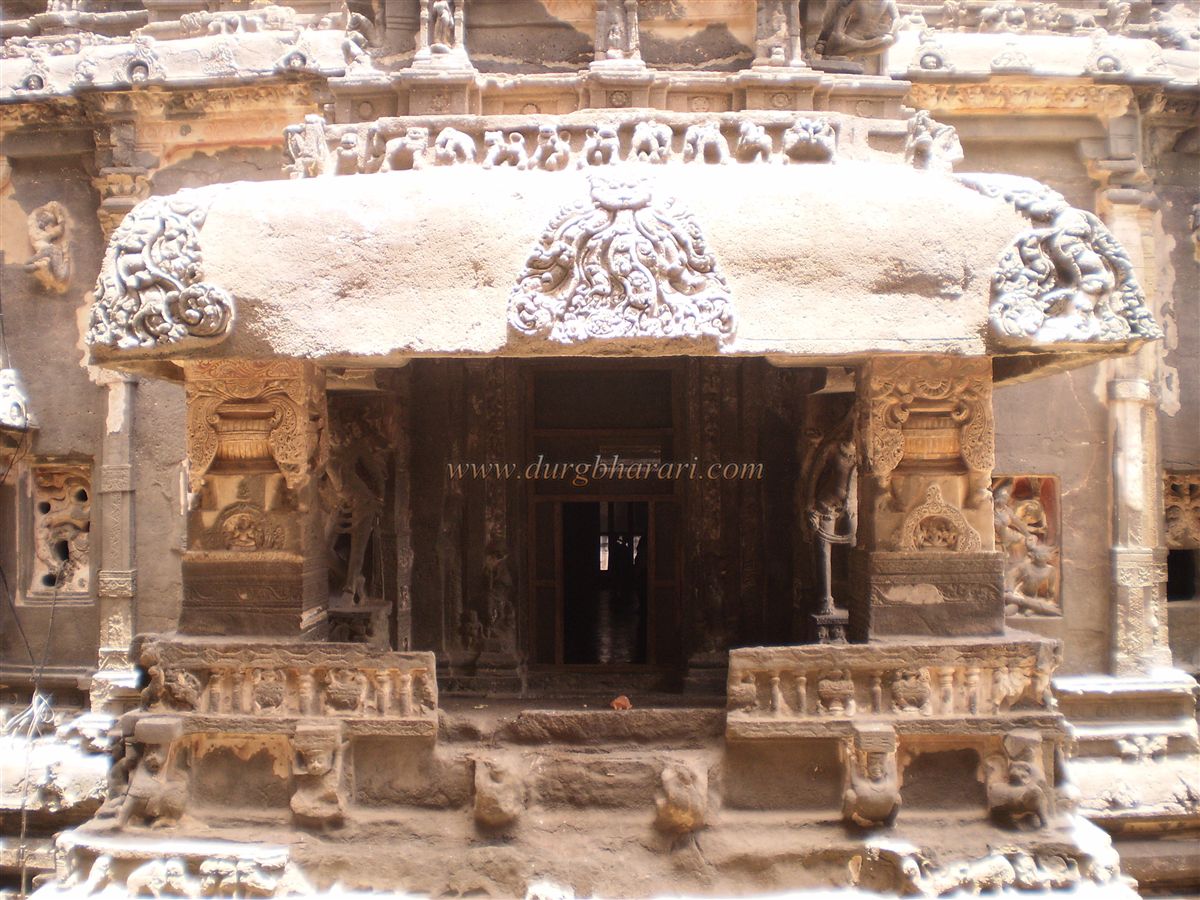
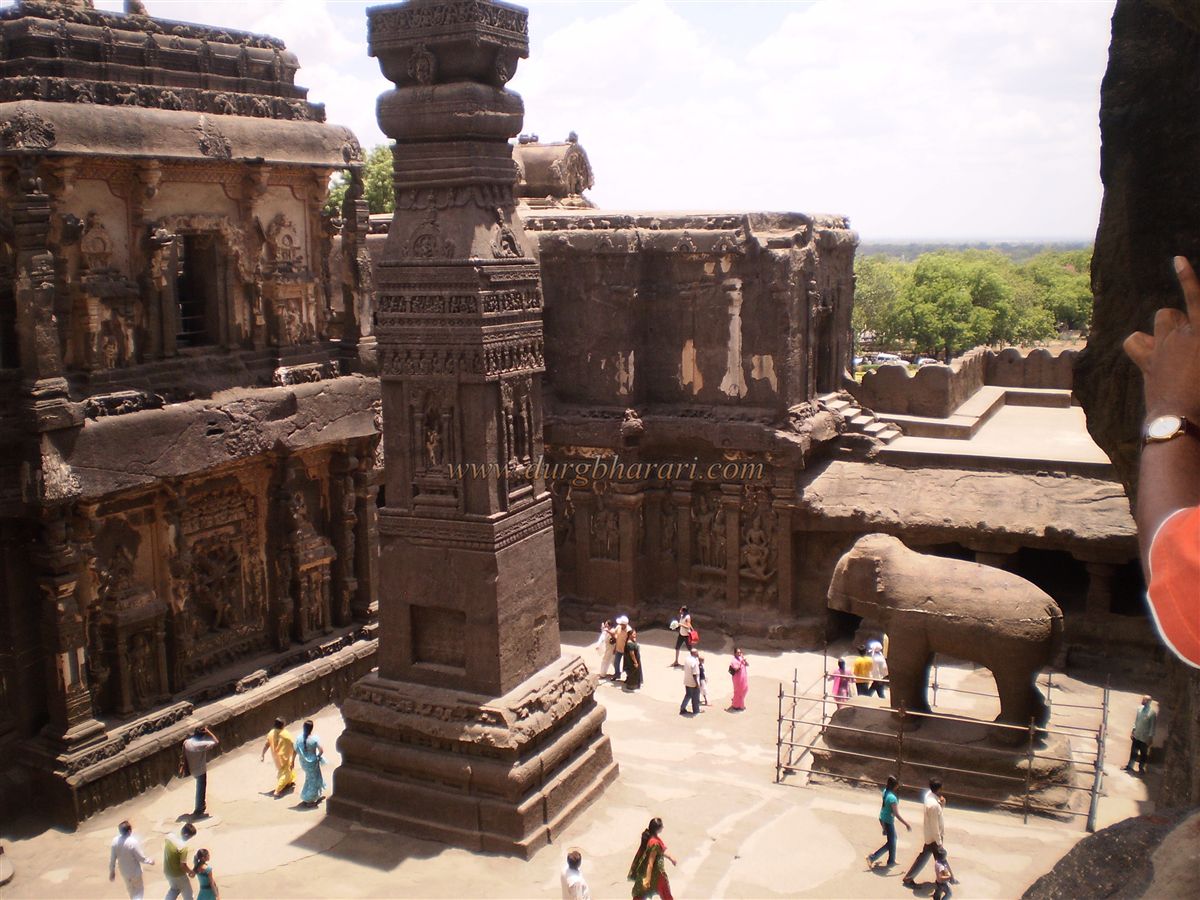
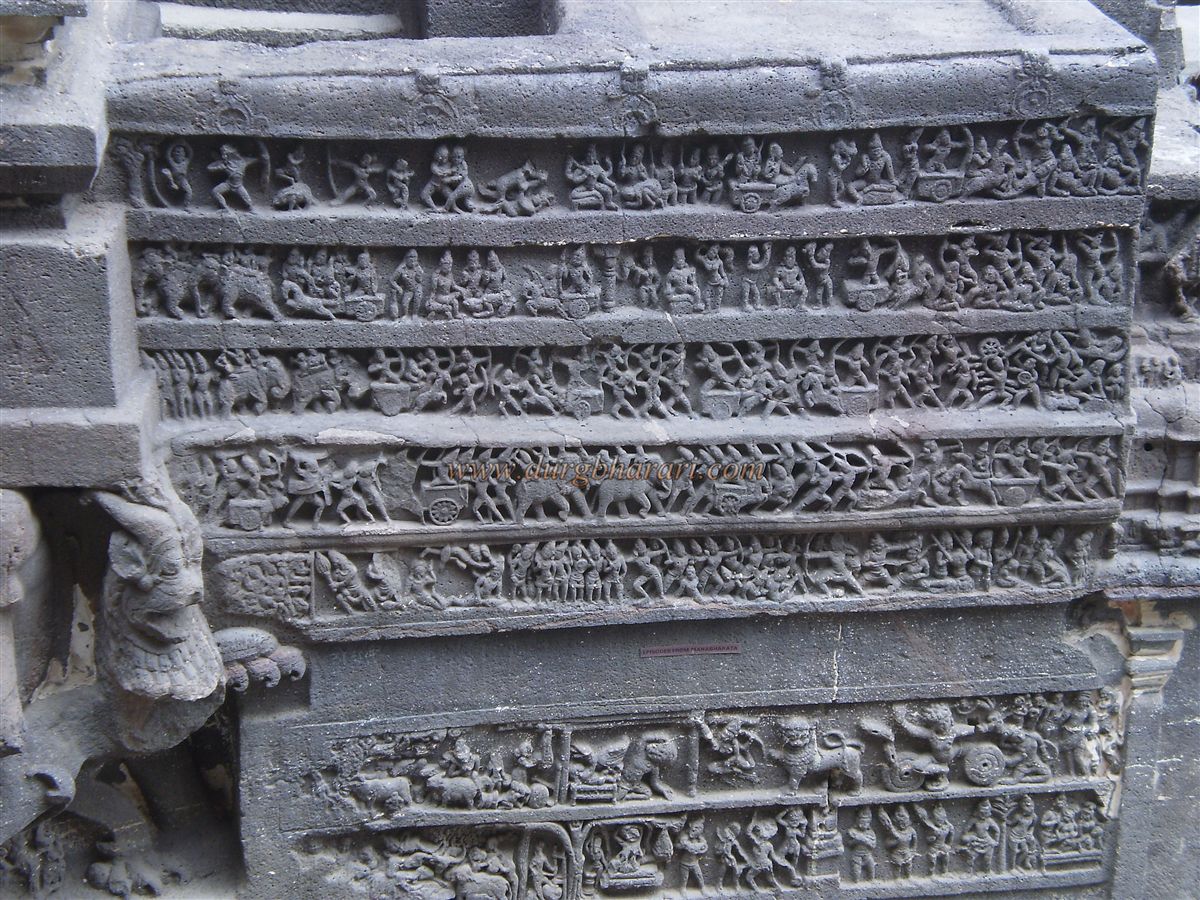
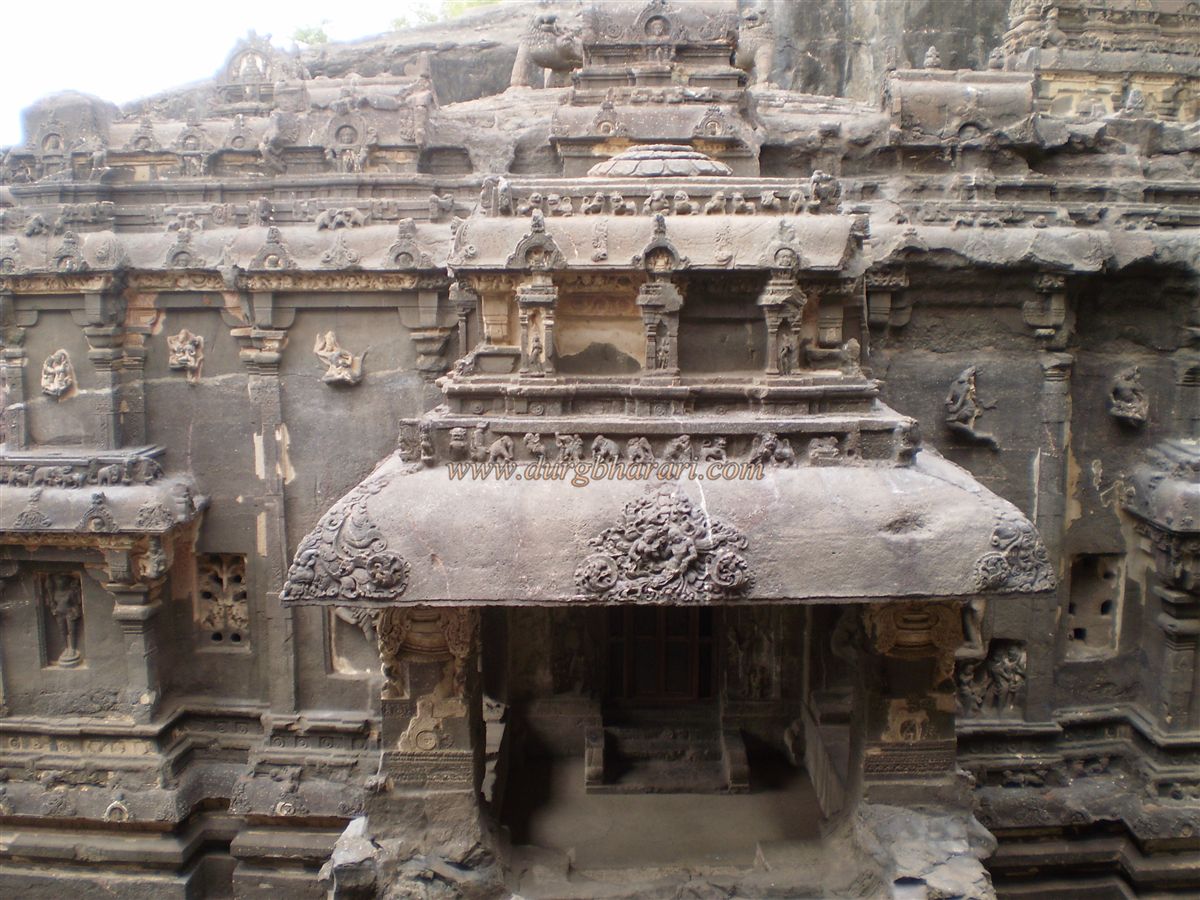
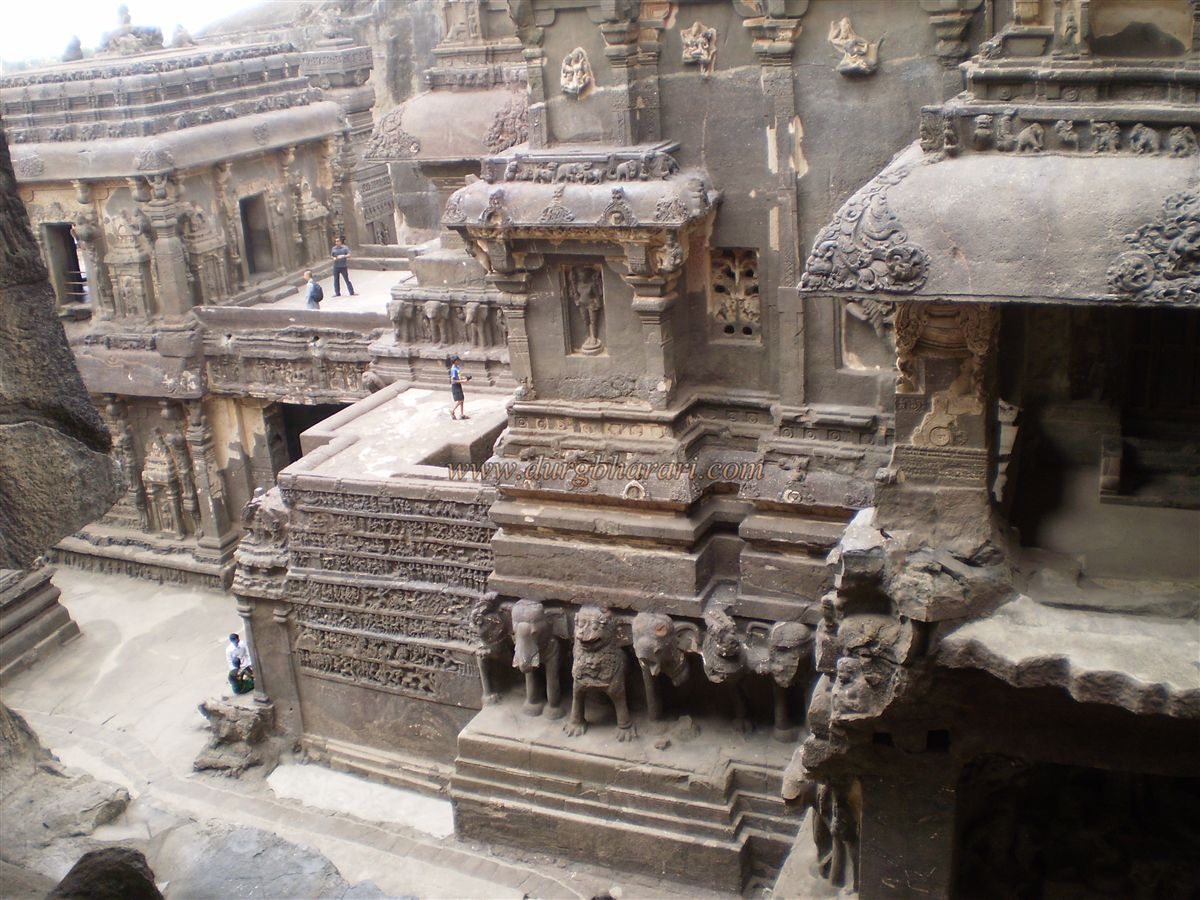
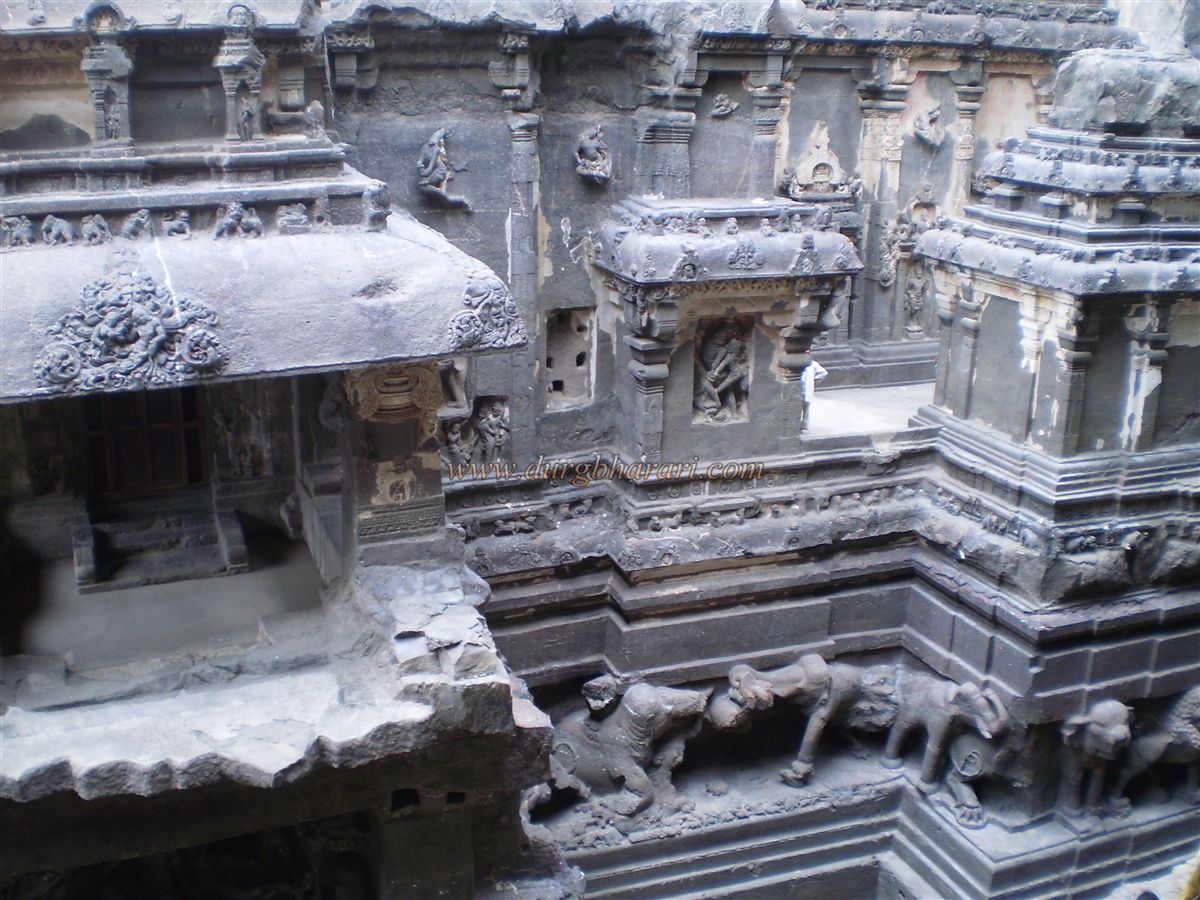
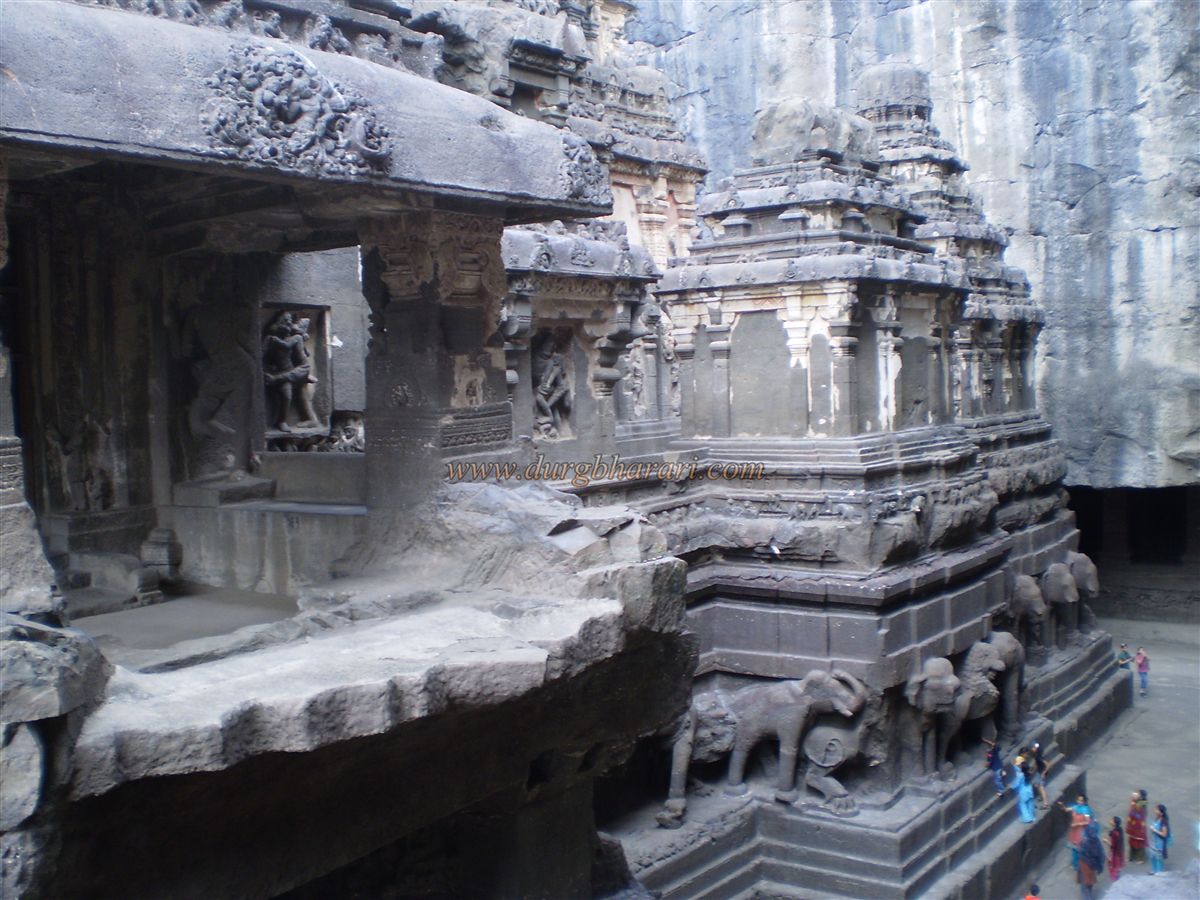
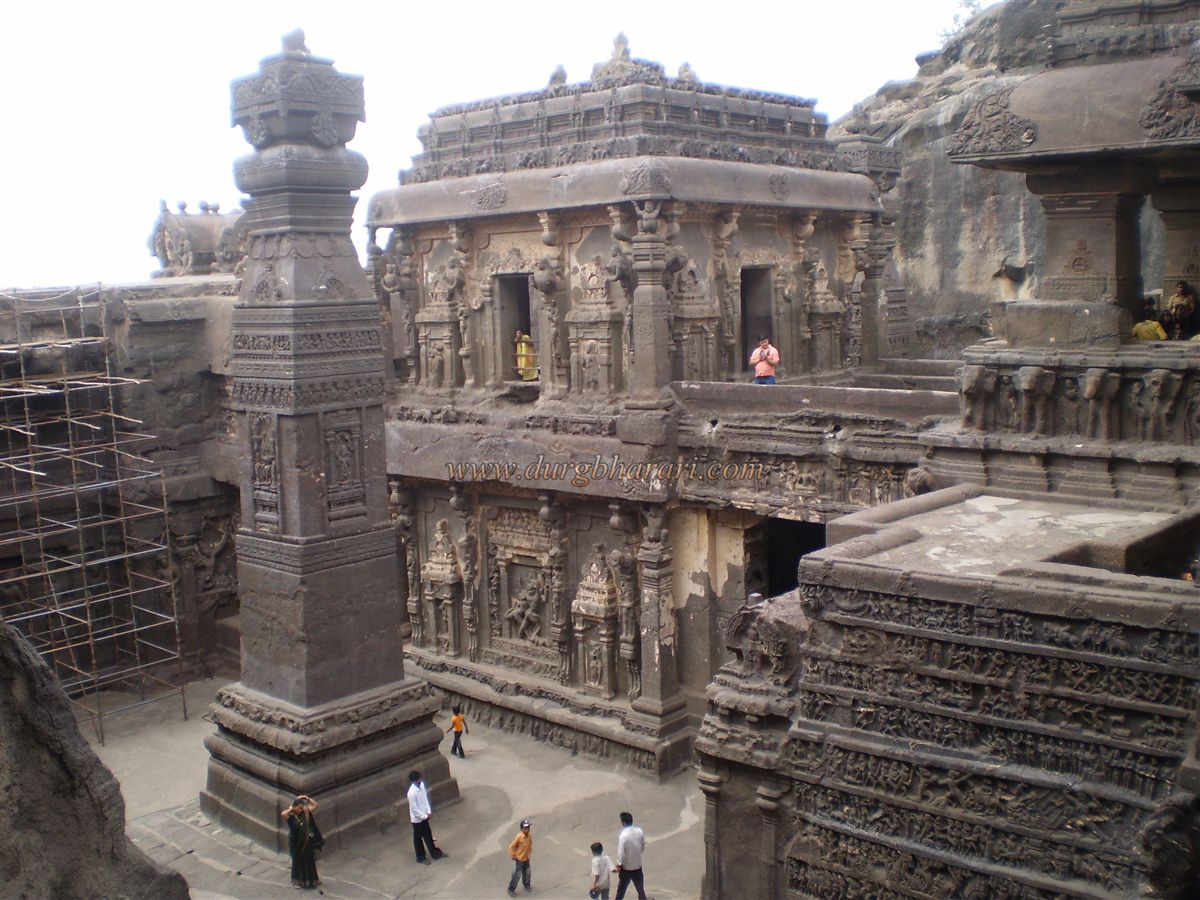
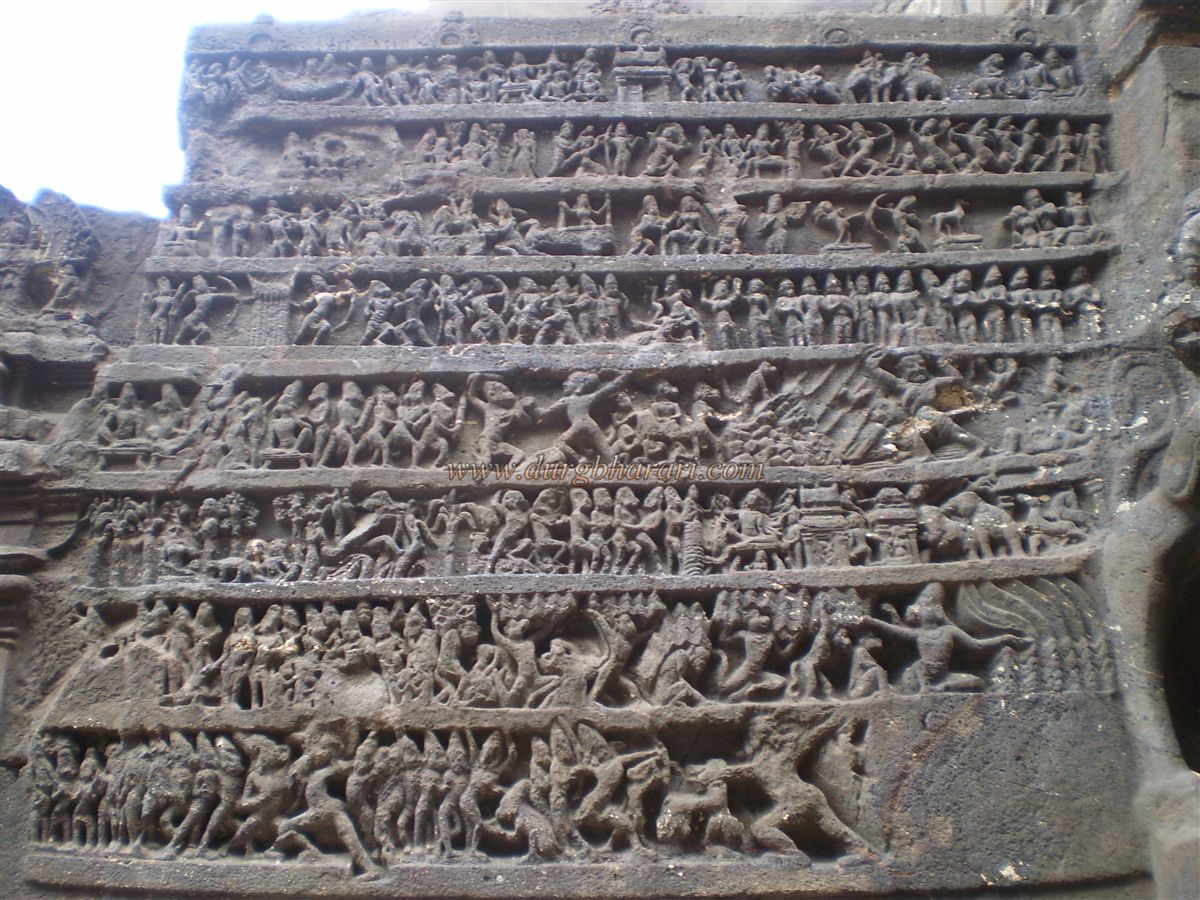
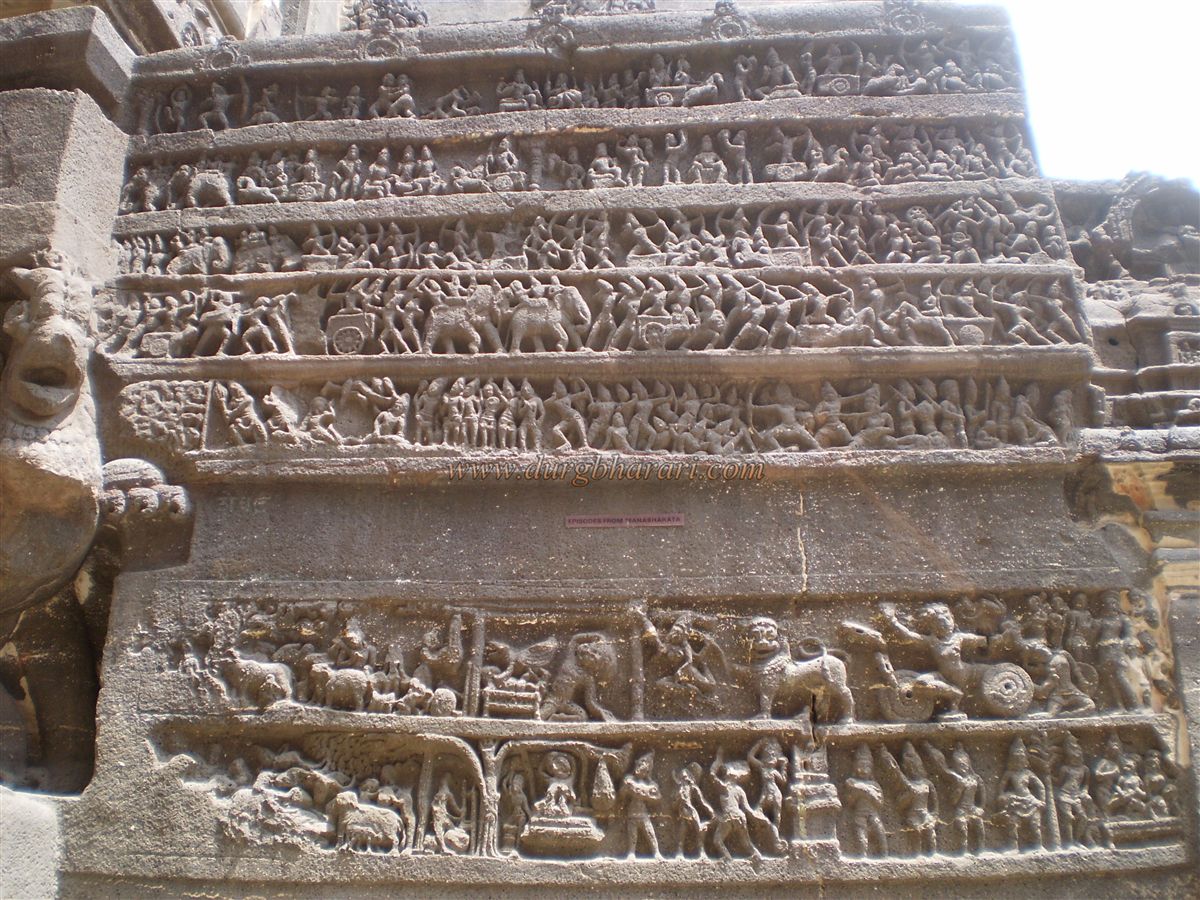
Cave 16 – Kailasa Cave-This cave is known as the Kailasa Cave, and is also referred to as Manikeshwara in some records. In every respect, it is a magnificent and grand structure, often called the crown jewel of Ellora. The architecture follows the principle of “first the shikhara (spire), then the base”, revealing a clear hierarchical design.
The construction of this cave began during the reign of Rashtrakuta king Dantidurga and was completed by Krishnaraja I (c. 756–773 CE). Subsequent kings added nearby excavations such as the Ovi shrine, Sarita temple, Lankeshwara cave, and Matrika temple.
Kailasa Cave is essentially a rock-cut temple of sublime aesthetic beauty. Its artistic expression shows a blend of Pallava and Chalukya styles, while elements like vimana (tower) and gopura (gateway) clearly reflect Dravidian influence.
Cave 17: This cave is remarkable for its layout, pillars, and sculptural panels. The figures of Ganas, Shalabhanjikas (feminine decorative figures), attendant women, and Gandharvas are highly attractive.
• The cave is very beautiful but incomplete, possibly because the rock here was not ideal for carving.
• The pillars are exceptionally elegant, adorned with finely sculpted Shalabhanjika figures, and burden-bearing Yakshas are carved at various places.
• Near the doorway, a perpetually eating Ganesha is carved, holding an axe, lotus, rosary, and bowl of sweets, which he eats with his trunk.
• On the wall opposite Ganesha is a Mahishasuramardini (Durga slaying the buffalo demon).
• One wall features Brahma with Vidyadharas (celestial beings) and attendants.
• Inside the cave, ornate pillars with exquisite carvings are present; the arches resemble those found in Buddhist chaitya halls, showing remarkable similarity.
Caves 18–20: These caves are ordinary, without any notable artistic features.
• Near the entrance, there is a Kubera sculpture holding a money bag.
• Inside, the sanctum houses a Shiva Linga, and the doorway is flanked by dwarapalas (guardian figures).
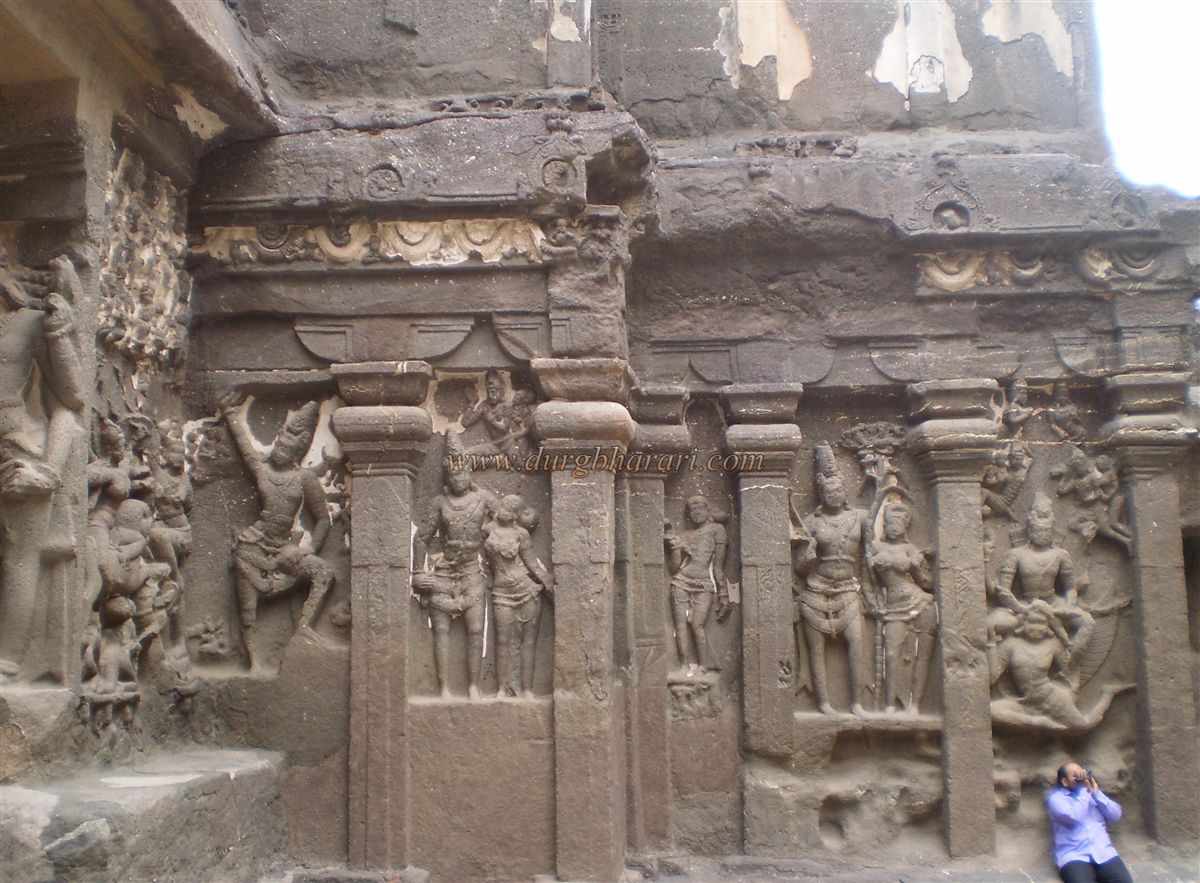
Cave 21 – Rameshwar Cave This cave is known as the “Rameshwar Cave”. The front pillars, adorned with charming Shalabhanjika figures, make it noteworthy.
• On the side walls adjoining the pillars, a relief features fourteen Mithuna (couple) figures.
• Adjacent walls: Ganga on one side, Yamuna on the other. The tribhanga posture of Ganga, her well-proportioned body, and her intricate hairstyle are captivating.
• On high pilasters of the assembly hall, two small subsidiary panels show:
o Shiva-Parvati wedding (Kalyanasundara)
o Uma performing the Panchagnisadhana
o Brahma taking Parvati to Mount Himalaya for Shiva’s proposal
The expression of Parvati at the wedding scene is particularly exquisite.
• Additional sculptures: Mahishasuramardini, Kartikeya on a peacock, with attendants indicating his fiery nature.
• Near the sanctum: a panel of Shiva granting boons to Ravana (Ravana Anugraha).
• In the southern hall: panels of Saptamatrikas, Nataraja, and skeletal Kali.
o Near the Saptamatrika panel, a Shiva-Parvati game scene is carved.
• The courtyard houses a large seated Nandi, with the courtyard, recess, and carved mandapa divided into multiple sections.
• A beautiful sculpture of Ganga stands on a Makara, with an elephant trunk emerging from its mouth, lion-like legs, and water flowing in her arms. Attendants support the balance, while celestial Gandharvas are carved nearby.
• Opposite Ganga: Yamuna on a tortoise, partially damaged.
• The pillar carvings in the recess feature Shalabhanjikas in elegant poses, each accompanied by attendants.
• Inside the cave: two side niches.
o Left niche: Shiva-Parvati wedding shown in three panels, detailing the ceremony.
o Right niche: Shiva-Parvati game scene (Akshakrida), Saptamatrika panel, and sanctum with Rameshwar Shiva Linga.
Wedding Scene Highlights:
• Upper right: Parvati performing penance.
• Nearby: Shiva, disguised as a mendicant, demands her hand.
• Upper left: Brahma brings Parvati from her father, Mount Himavan.
• Middle: Shiva-Parvati marriage ritual; deities like Lakshmi, Vishnu, Shachi, Indra are present.
• Below: Shiva’s attendants, Kartikeya standing upright on his peacock with two attendants ready to obey him, and Mahishasuramardini holding Vishnu’s chakra and Shiva’s trident, slaying the buffalo demon.
• Surrounding attendants carry weapons, and celestial beings watch the ceremony.
Game Scene (Akshakrida):
• Lower level: Nandi with playful Shiva attendants.
• Upper level: Shiva-Parvati playing a game, Parvati pretending to leave in irritation, Shiva gently restraining her, indicating only one move is left.
• Attendants watch the playful scene with delight.
Tandava Scene:
• Adjacent hall: Shiva performing Katisammandra posture dance.
• He stands with left leg slightly raised, arms around the waist, Parvati holding a child, and attendants and musicians surrounding them.
Saptamatrika Panel:
• Flanked by Veerabhadra, seven mother goddesses: Varahi, Indrani, Vaamani, Narasimhi, Maheshwari, Kaumari, Chamunda, and Ganesha at the end.
• Each Matrika is accompanied by her child and a vehicle (Varaha, Swan, Peacock, Owl).
• Symbolizes the life force of the mother, with the cycle of birth and death depicted alongside Asitang Bhairava-Kala Kali, a skeletal figure of death with weapons, showing the cycle of life and mortality.
Cave 22 – Neelkanth Cave:This cave is known as Neelkanth.
• In the mandapa to the right of the Nandi pavilion, sculptures of the Saptamatrikas are carved, along with figures of Ganesha, Kartikeya, Gajalakshmi, and Kamalasana Devi.
• The sanctum houses a Shiva Linga.
• In the courtyard, a Nandi sculpture is carved on a plinth; inside the hall are Veerabhadra, Ganesha, and the Saptamatrikas.
o Varahi is depicted with a boar face, Brahmani with a three-faced form, each accompanied by a child.
• Both walls of the entrance are adorned with Dvarapalas in Jaya-Vijaya style.
• Nearby are sculptures of Gajantalakshmi and Saraswati.
Some of the following caves are large but contain no significant sculptures, though most have a sanctum with a Shiva Linga and pillared recesses.
Caves 23 & 24: These are not particularly remarkable.
• Cave 24 contains four Shiva temples, each with a yoni-pedestal, and is also referred to as “Teli ki Ghani”.
Cave 25: A spacious cave, with sculptures of Kubera, Shalabhanjikas on pillars, Gajalakshmi on the ceiling, and Surya on the inner ceiling.
• Two dvarapalas guard the sanctum, and the sculpture of Surya is artistically executed.
Cave 26: The design is similar to Cave 21.
• The exterior features columns with bud-and-leaf motifs, two half-pillars, and elephant heads at the entrance.
• Two large dvarapala sculptures flank the entrance.
Cave 27 – Janvasa Cave:
• Also called “Janvasa Ghar”.
• Near it is Cave 29 (Sita ki Nahani), which depicts the Shiva-Parvati wedding, possibly explaining the name “Janvasa”.
• Near the doorway: large reliefs of Balarama with plough, Krishna in a partial form, and on the other side, Brahma, Vishnu, and Mahesh.
• Also sculptures of Vishnu in reclining pose (Sheshashayi) and Varaha.
• Windows on either side of the doorway show Mahishasuramardini.
• The sanctum contains only a pedestal, no idol.
• Some residential or rest rooms are carved, suggesting the original structure was a Buddhist cave, later converted to Vaishnavite use.
• Likely constructed during the Yadava period, not the Rashtrakutas.
• Sculptures are damaged due to heavy rainfall and the coarse rock in this area.
Cave 28:
• Picturesque during the monsoon due to a nearby waterfall.
• Near the doorway: damaged sculptures of Ganga and Yamuna.
• In the mandapa: an eight-armed Shakta goddess in yogasana, guardian figures near the sanctum, and yoni-pedestals in the sanctum.
• Goddess holds sword, serpent, trident, and human skull, among other attributes.
Cave 29 – Sita ki Nahani:
• Known as “Sita’s Bath”, measuring 45.11 × 45.41 m.
• Large sculptures, though somewhat unfinished.
• Front mandapa pedestal: massive lion sculptures.
• Walls feature Ravana Anugraha and Andhakasura Vadha panels.
• Rear sanctum: houses a Shiva Linga.
• South hall: Shiva-Parvati wedding, Shiva-Parvati in Akshakrida (play).
• North hall: Lakulisha Shiva seated on a lotus in padmasana; right hand in Vyakhyanamudra, left holding Linga staff; adorned with jata-mukuta, forest garland, and sacred thread.
• Nataraja sculpture (unfinished) opposite.
• These caves are notable for architectural grandeur, dynamic sculpture, and expressive faces.
• Shakta, Shaiva, and Vaishnava imagery is visible. Some caves have wall paintings.
• Three entrances: main in front, a left-side entrance cut into rock, and a right-side rear entrance connecting to the next cave. Lion sculptures flank the entrances.
Andhakasura Vadha Panel:
• Eight-armed Shiva slays the enraged Andhakasura with a sword, blood collected in a vessel to prevent it from touching Parvati.
• Shiva’s eyes wide, third eye blazing, teeth clenched, and showing intense fury.
• Parvati sits nearby, admiring Shiva’s valor.
• The weaponry and elephant-skin shield are particularly striking.
Ravana Anugraha Panel:
• Shiva and Parvati seated calmly atop Kailasa; Ravana, with 20 arms, tries to lift the mountain.
• Shiva’s attendants show fear or prayerful gestures.
• Upper panels: Saptamatrikas, Kala (time), and Vidyadharas.
• Shiva presses Kailasa with his right foot, holding Parvati with his left.
• Both faces are carved calm and composed, indicating divine control and serenity.
Interior Pillars:
• Large mandapa with carved pillars.
• One pillar: Nataraja, unfinished.
• Other pillars: Kalyanasundara Shiva, while Lakulisha, an incarnation of Shiva, is also depicted.
Lakulisha Shiva Panel (Continuation of Cave 29 – Sita ki Nahani):
• Shiva is seated on a lotus, with serpent attendants holding the lotus stem firmly.
• Shiva is shown with only two arms: the right hand in Vyakhyanamudra (teaching gesture), while the left holds a wooden staff (lagud or danda).
• He wears a serpent necklace, and a faint third eye is visible on his forehead.
• This represents Shiva in his yogic form, and the Lakulisha Shiva image resembles a Buddha; it is likely that this form was inspired by Buddhist iconography. Many Mahayana Buddhist caves feature similar Padmapani-like figures.
• On the left wall of the mandapa, there is a sculpture of Yamuna standing on a tortoise.
o She holds a conch or lotus in one hand, the other hand rests freely near her waist.
o She is clad in flowing garments, creating a sense of movement.
o Nearby is a serving attendant, and above them celestial Gandharvas are carved.
• Lions are carved on both sides of Yamuna.
• Descending four steps leads to another small cave, possibly a storehouse or treasury, which contains a sanctum with a Shiva Linga, but no other sculptures.
• Four grand dvarapalas flank the sanctum. Alongside them, female attendants and celestial Gandharvas are depicted above.
o Such grand dvarapalas are unparalleled even in the Kailasa temple.
• Behind the sanctum, on the right wall, there is a beautiful Shiva-Parvati wedding panel:
o Shiva stands holding Parvati’s hand; Parvati turns toward him.
o To the left of Parvati: her parents, Himalaya and Maina.
o To Shiva’s right: Brahma officiating the wedding, with Vishnu standing nearby.
o Above Vishnu: Indra riding Airavata, and Ganga on Makara, with apsaras and Gandharvas.
o To the upper left: the Ashtadikpalas (Yama, Vayu, Agni, Nirrti, Kubera, Varuna, etc.) on their respective vehicles participate in the wedding festivities.
• On the outer wall of this panel, a standing Saraswati sculpture is carved.
• Another relief nearby shows a post-wedding scene in two levels:
o Lower level: offerings in mangalghat, with Vishnu and Brahma on sides, Nandi in the center, and Shiva’s attendants teasing Nandi.
o Upper level: Shiva and Parvati chatting joyfully; Shiva holds Parvati’s hand playfully, with a mischievous smile, while Parvati’s gesture is shy.
o The attendants and celestial beings observe the wedding with admiration.
• A narrow path from this panel leads to the next cave.
Jain Caves (Caves 30–34)
• These are primarily Digambara Jain caves.
• Caves 30–34 are carved contiguous to each other.
Cave 30 (Small Kailasa, 39.62 × 24.38 m):
• A Dravidian-style temple, reminiscent of the Kailasa temple.
• Sculptures on the right and left walls of the gopura:
o Left: Yakshini Chakreshvari of Tirthankar Rishabhanatha, with Garuda as her vehicle, holding lotus, discus, conch, mace, and sword.
o Right: Three well-proportioned Tirthankar figures.
• Architectural elements: front mandapa, main mandapa, sanctum.
• Rear wall of front mandapa: two dancing Yaksha figures of Saudharmendra.
• Walls of the assembly hall feature Gandharva couples.
• Flanking the door: Shankhnidhi and Padmanidhi.
• Sanctum: main Mahavir image, flanked by other Tirthankars, including Parshvanath and Gomateshwar.
• North wall: an eight-armed goddess in yogasana, holding trident, noose, sword, varada, bell, and one hand in abhaya mudra.
• Front mandapa: mace-wielding dvarapala; traces of ceiling murals remain.
• Nearby: unfinished cave.
• Features include: Chaturmukha Tirthankar, lotus carvings on ceiling, fully sculpted pillars, room seating in front mandapa, elephant on joti.
• A small temple carved from one rock, surrounded by a decorative sub-mandapa, forming an integrated structure.
• Sanctum houses Mahavir, with mandapa and upper southern-style shikhara.
• Pillars and arches are curvilinear, similar to Buddhist caves, though Jain caves show more delicate carvings and lack rest rooms.
• Right side: a pillar like Kailasa’s with Chaturmukha Brahma Yaksha; left side: elephant sculpture in one stone.
• Surrounding walls depict life stories of Mahavir and Parshvanath, including Parshvanath’s confrontation with the demon Kamatha, protected by Yaksha Dharanendra and Yakshini Padmavati, with Dharanendra sheltering him with his seven hoods and coiled body, resembling Buddhist protective legends.
• Sculpture work is extremely fine, and the cave’s inner section represents the outer hall of Indrasabha.
• These five caves are so interconnected that they can be considered sections of one large complex, rather than separate caves.
Cave 31:
• Caves 31–34 are contiguous, forming one continuous structure.
• Exterior of Cave 31: four pillars.
• Assembly hall (sabhamandapa):
o Gomateshwar standing in Karanyasa mudra, with Parshvanath Tirthankar opposite.
• Sanctum: Mahavir in dhyana mudra, surrounded by flying Gandharvas holding flower garlands.
• Left outside the sanctum: Matanga under a Banyan tree; right side: Siddhayika on a throne under a mango tree.
In Jain tradition, Matanga is Mahavir’s attendant Yaksha, while Siddhayika is the ruling deity. Cave 32 – Indrasabha (Hall of Indra)
• This cave is popularly known as Indrasabha.
• In the courtyard, at the center, is a high pedestal (chowthar) housing a Tirthankar image.
• The front mandapa has two pillars on each side.
• The temple features a Dravidian-style shikhara, and the construction technique is top-down, similar to the Kailasa temple.
• Three sides of the courtyard have two-storied caves carved into the rock.
• The pillars in these caves feature elephant heads resembling Kailasa motifs.
• South and north walls display sculptures of Parshvanath, Gomateshwar, Siddhayika, Matanga Yaksha, and other Tirthankars.
• Front mandapa pillar evidence: Red ochre outlines of Tirthankar images indicate how the sculptures were planned before carving.
• Inscriptions on other pillars:
o “Nagavarmakrit Pratima” under a Tirthankar image.
o “Shri Sohil Brahmacharini Shantibhattarak Pratimeyam” beneath Shantinath Tirthankar.
• The Devanagari inscriptions likely date to the Yadava period, post-Rashtrakuta decline.
• Lower floor sanctum houses Mahavir, while the upper floor’s pedestal includes images of Mahavir, Parshvanath, Gomateshwar, Siddhayika, and Matanga Yaksha.
• Upper mandapa: large statues of Matanga and Siddhayika facing each other.
• The mandapa is adorned with lotus-carved ceilings, pillar reliefs, and murals, though faded.
• Matanga Yaksha (elephant rider):
o One foot rests on the elephant; adorned with crown, necklace, armlets, waist belt, and a necklace similar to a jaanvasa style.
o Elephant head decorated with pearl jewelry; two attendants stand nearby.
o Banyan tree carved above, with leaves, peacock, and monkey – a symbol of natural abundance.
o These features led viewers to mistake the image for Indra, hence the cave name Indrasabha.
• Siddhayika:
o Seated on a lion; one hand in blessing mudra, the other holding her child.
o Ornamented with jewelry; attendant ready to obey.
o Mango tree above with fruits and monkey, symbolizing maternal power.
o Like Matanga, she is a Yakshini, not a goddess.
• Some paintings remain, though mostly faded.
• Upper floor access: from Jagannath Sabha above, or via a stair from Indrasabha lower floor.
Cave 33 – Jagannath Sabha- Two-storied cave.
• Lower floor: outstanding Matanga and Siddhayika sculptures.
• Upper floor: mandapa with twelve pillars, Tirthankar images on walls and sanctum.
• Named Jagannath Sabha likely because the Mahavir image was mistaken for Jagannath.
• Decorated with ornate carved pillars, half-walls externally, and relief sculptures on columns.
• Similar to other caves, the lower and upper floors mirror each other, featuring Tirthankars, Yaksha, and Yakshini images.
• Walls include painted depictions from Mahavir’s life, though primarily carvings of musicians, dancers, and animals are present.
• Ceilings contain well-executed paintings reminiscent of Ajanta murals.
Cave 34 – Final Jain Cave
• Composed of front mandapa, assembly hall, antarala (vestibule), and sanctum.
• Contains images of Tirthankars and Gomateshwar, mostly uniform and schematic, with little variation.
• Sanctum: Mahavir.
• Elephant-mounted Matanga Yaksha and Siddhayika also carved, along with attendants, flying Gandharvas, and finely carved pillars.
• Ceiling features lotus motifs.
Other Small Caves around the Main Complex
• Near Teli Ki Ghani (Cave 24): Two small caves
o Sanctum: Trimurti, mandapa: Uma performing Panchagnisadhana, and Ganesha image.
• Above Cave 29 (Sita Ki Nahani): Group known as Ganesh Caves
o One sanctum: Shiva Linga, mandapa ceiling: Lingodbhava and Samudra Manthan murals.
o Another cave: Ganesha sanctum, others have Mahesh images.
• Yogeshwari group: Small caves with Shiva Linga and Mahesh images.
• These smaller caves and their murals are believed to date to the 11th–12th centuries, a period when architectural and sculptural vigor had declined.
© Suresh Nimbalkar
GALLERY