VASAI
TYPE : SEA FORT
DISTRICT : PALGHAR
HEIGHT : 0
GRADE : EASY
Vasai Fort is a coastal fort located near Vasai in the Palghar district of Maharashtra. On 26 May 1909, the Government of India declared this fort a national protected monument. Being located on the Konkan coast, this fort must have been extremely useful for the rulers of the time to monitor the sea and keep watch over trade activities. When one thinks of Portuguese settlements on India’s western coast, the first name that comes to mind is Goa, which even after India’s independence remained under Portuguese control for some time, where Portuguese culture was retained and the native population was suppressed. However, the Portuguese settlement of Vasai, which is so close to Mumbai, often goes unnoticed and remains in neglect. Even today, old Portuguese-built churches in Vasai and its surrounding areas such as Manickpur, Papdi, Nirmal, and Remedy are still used for worship.
...
The nearby Sopara port was famous even before the time of Emperor Ashoka. After the Portuguese settled here, they started calling this region Basaim, derived from the original name Vasa. The British later anglicized it to Bassein, and over time it came to be known as Vasai. This fort has witnessed many significant events in Maratha history. This account presents the fort’s history beyond Portuguese rule. Geographically, the Konkan coast is divided into two regions, North Konkan and South Konkan. To protect Mumbai, the chief island in North Konkan, several forts were built in the surrounding areas, of which Vasai Fort was a major one. Historical references also describe bridges at Sopara and Gokharava associated with this fort. Controlling the Vasai port meant being able to dominate the coastal regions of Mumbai, Thane, and Sashti, making the fort extremely strategic.
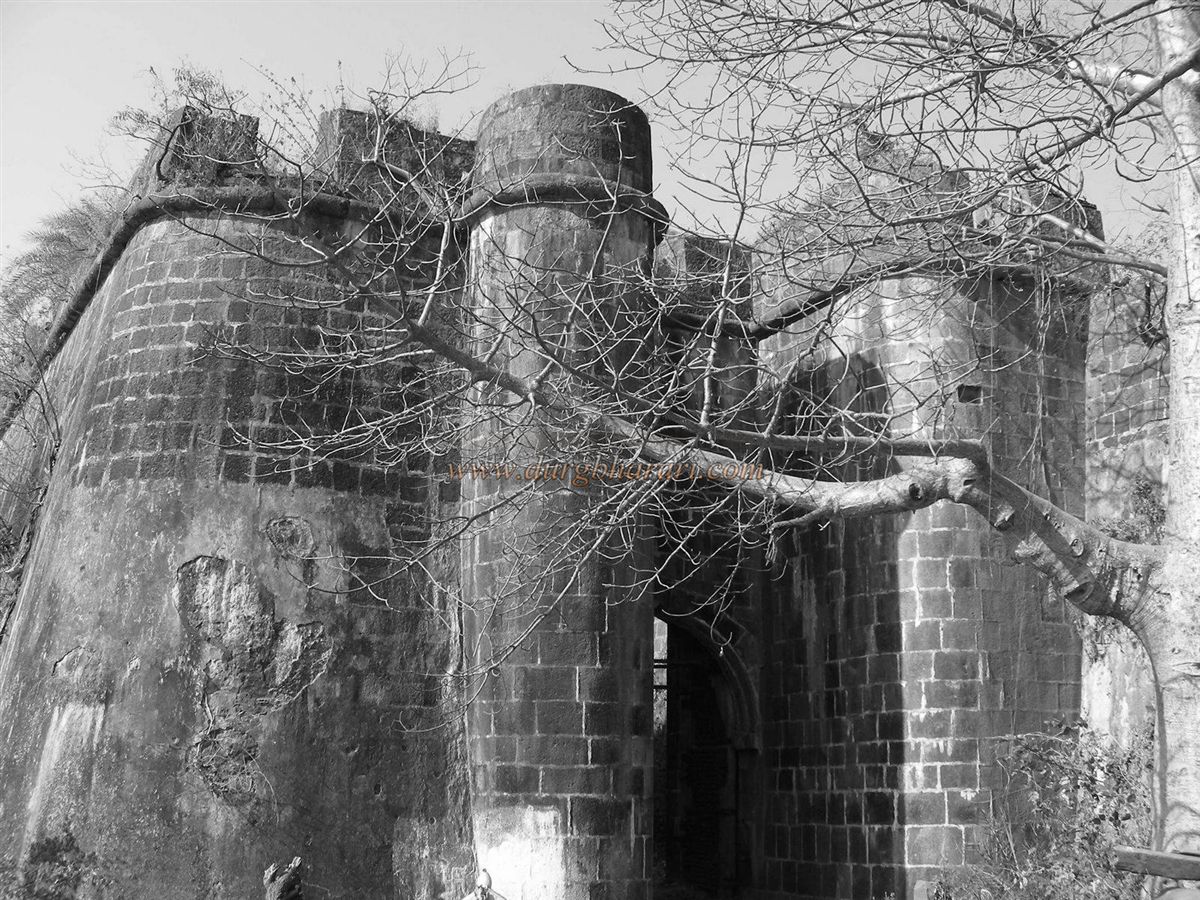
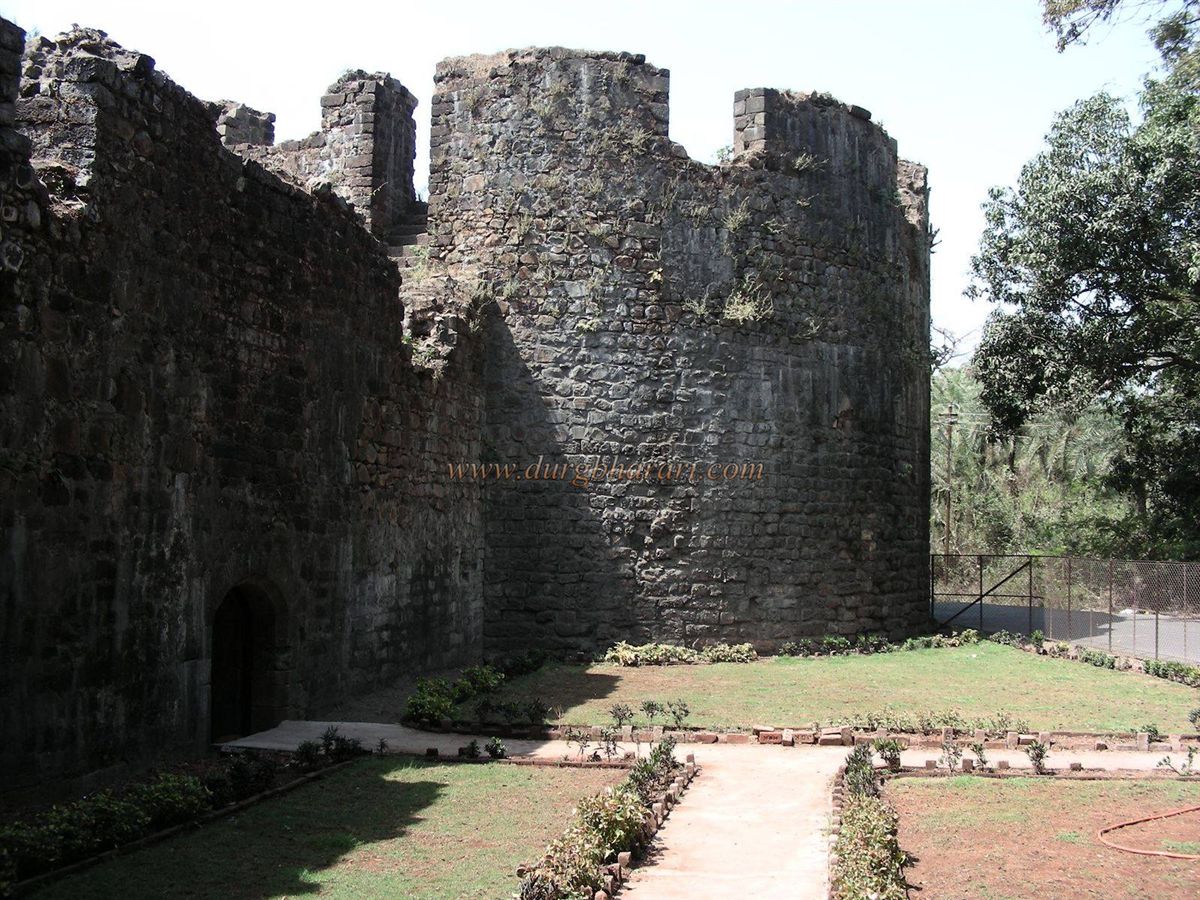
In 1414, a local chieftain named Bhandari-Bhengale constructed this fort as a stronghold. In 1530, it was captured by the Sultan of Gujarat. Recognizing its importance, the Portuguese took over the fort in 1534 and began reconstruction. Although originally built in the Islamic architectural style, the Portuguese extensively modified the fort using European architectural principles. The shape of its bastions—broad and flattened like the tip of an arrow—is a unique feature found only at Vasai among Portuguese strongholds in Maharashtra, although a partial form of this design is also seen at Worli Fort. Similar bastions are also present at the Portuguese fort in Daman, Gujarat.
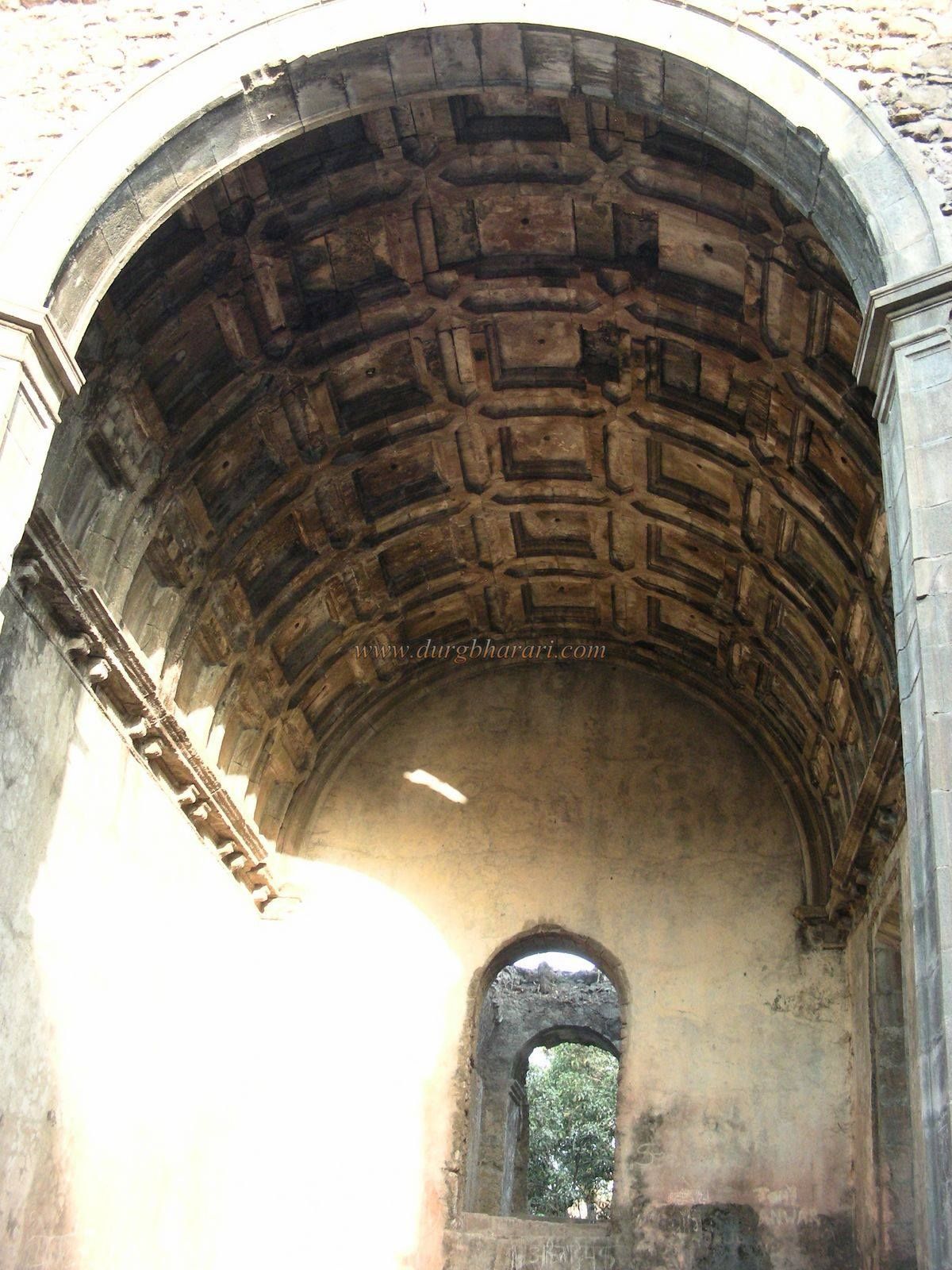
The gates, windows, balconies, and bastions built with semicircular arches clearly exhibit Roman architectural influence. After the British captured the fort, its upkeep declined drastically. Marshlands and wild vegetation contributed to its ruin. In 1860, the British leased the fort to Colonel Littlewood, who attempted to cultivate sugarcane and set up a sugar factory there. To finance this project, he began selling the fort’s stones to locals, causing further damage. Even after independence, the fort’s ruins and its management received little attention. For decades, much of the fort was inaccessible due to dense overgrowth. In recent years, the installation of Chimaji Appa’s statue and memorial, along with the Archaeological Survey of India’s restoration and clearing work, has brought some attention to this long-neglected fort. However, more robust efforts are needed to develop this historically important site near Mumbai into a major tourist destination.
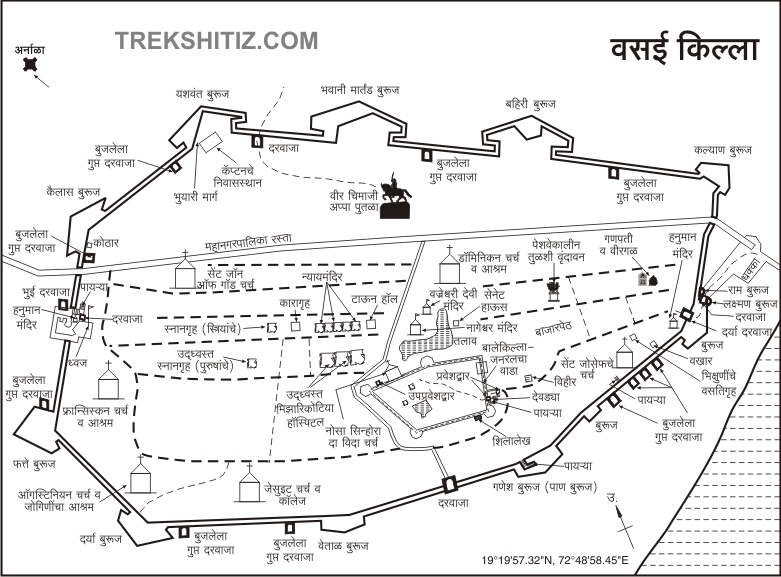
It takes about fifteen minutes to walk from the village to the fort’s walls. A tarred road leads to the fort, where the main entrance lies to the right. Inside, steps lead up to the ramparts, from which the entire fort layout becomes visible. The fort is roughly decagonal in shape, covering about two square kilometers. The main gate is protected by double walls, making it almost impregnable. The fort is surrounded by the sea and marshland on three sides and by Vasai village on the fourth. It has two main entrances—one facing the land and the other toward the harbor. The ramparts are very strong, about thirty to thirty-five feet high and five feet thick.
It took the Portuguese ten years to complete the construction of Vasai Fort. Its decagonal shape includes ten bastions, each named: Nossa Sinhora Doremédia, Reis Magos, St. Gonsalo, Madradeo, St. John (after which lies the Darya Darwaza, leading to the harbor), Elephante, St. Pedro, St. Paul, St. Sebastian, and St. Sebastian Cavaliero. Each bastion was armed with cannons and manned by a team of eight soldiers led by a commander. During the Maratha siege, it is said that the St. Sebastian bastion was blown up with explosives, enabling the Maratha forces to enter. After capturing the fort, the Marathas renamed the bastions Bahiri Buruj, Kalyan Buruj, Fateh Buruj, Kailas Buruj, and Darya Buruj.
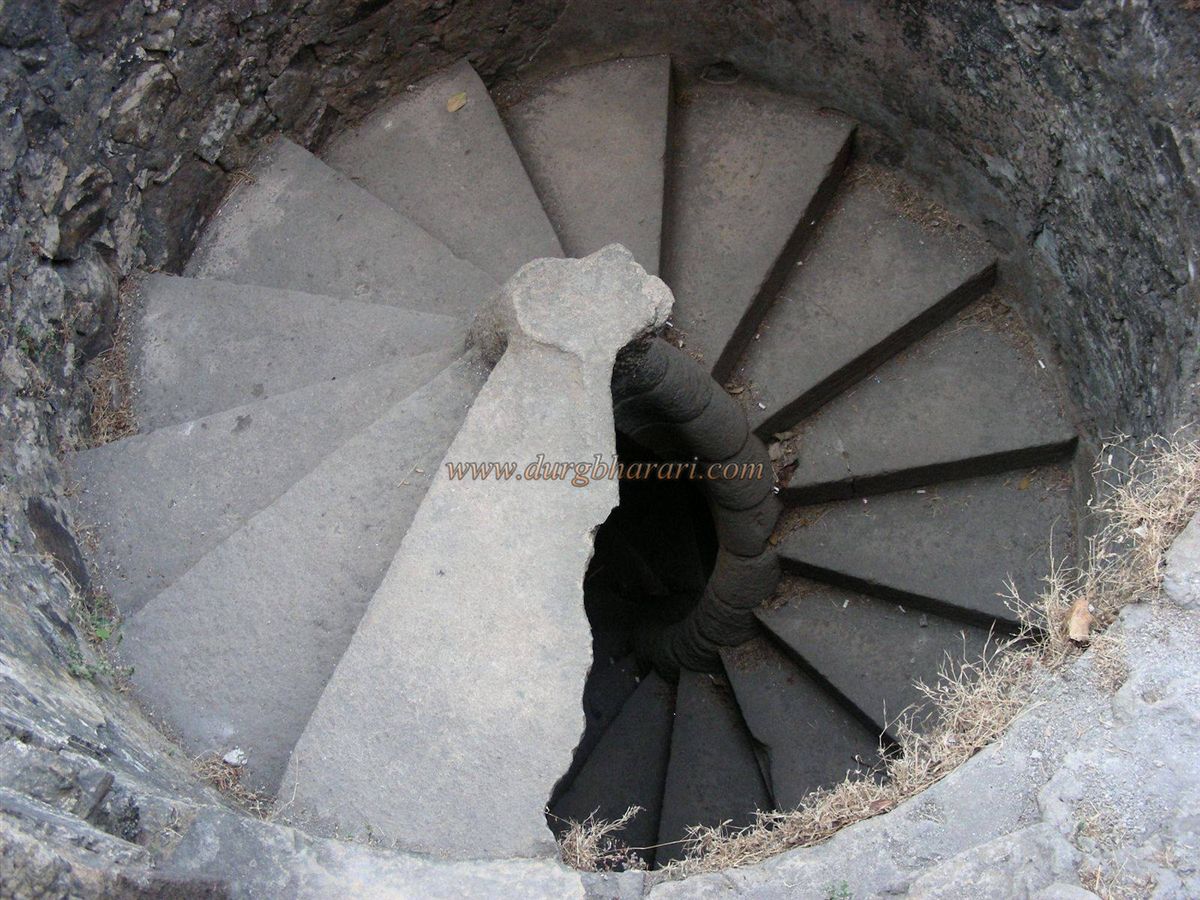
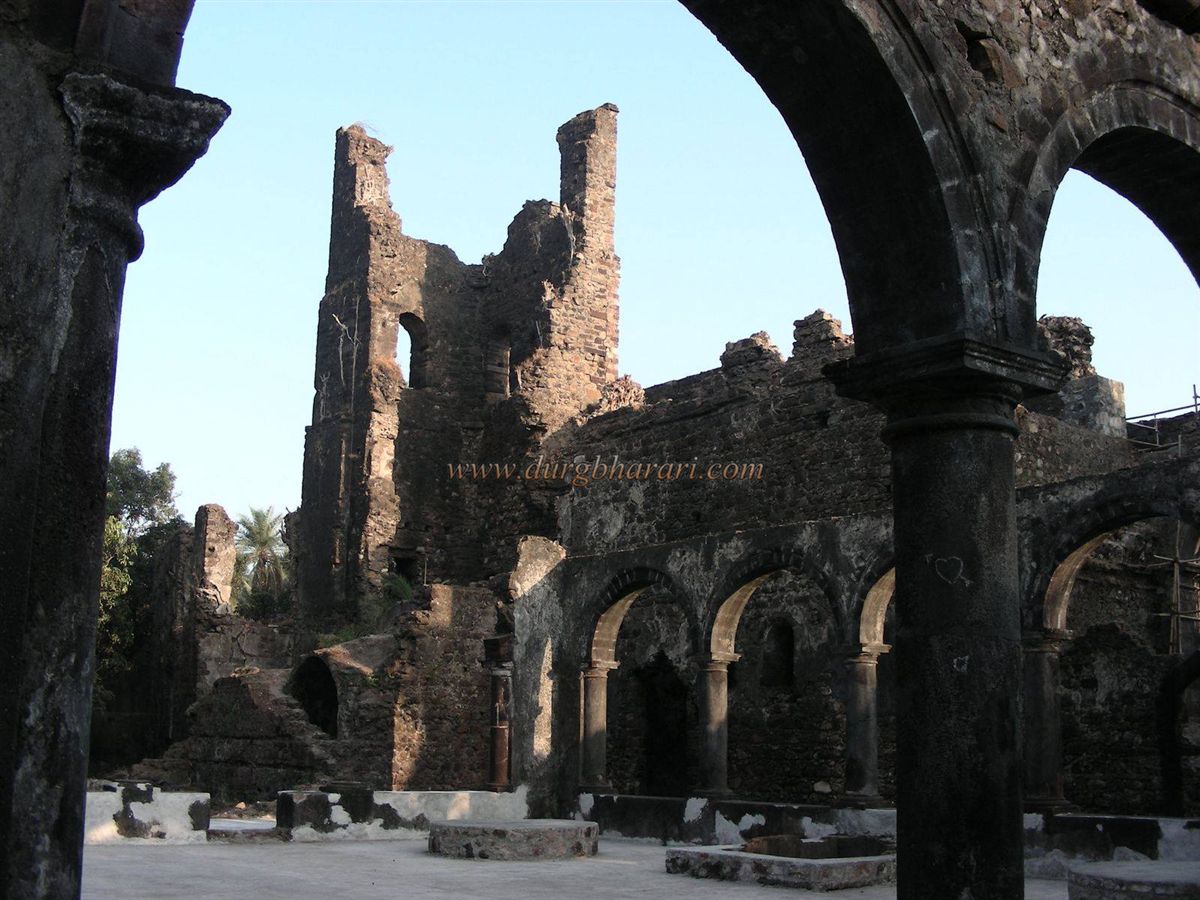
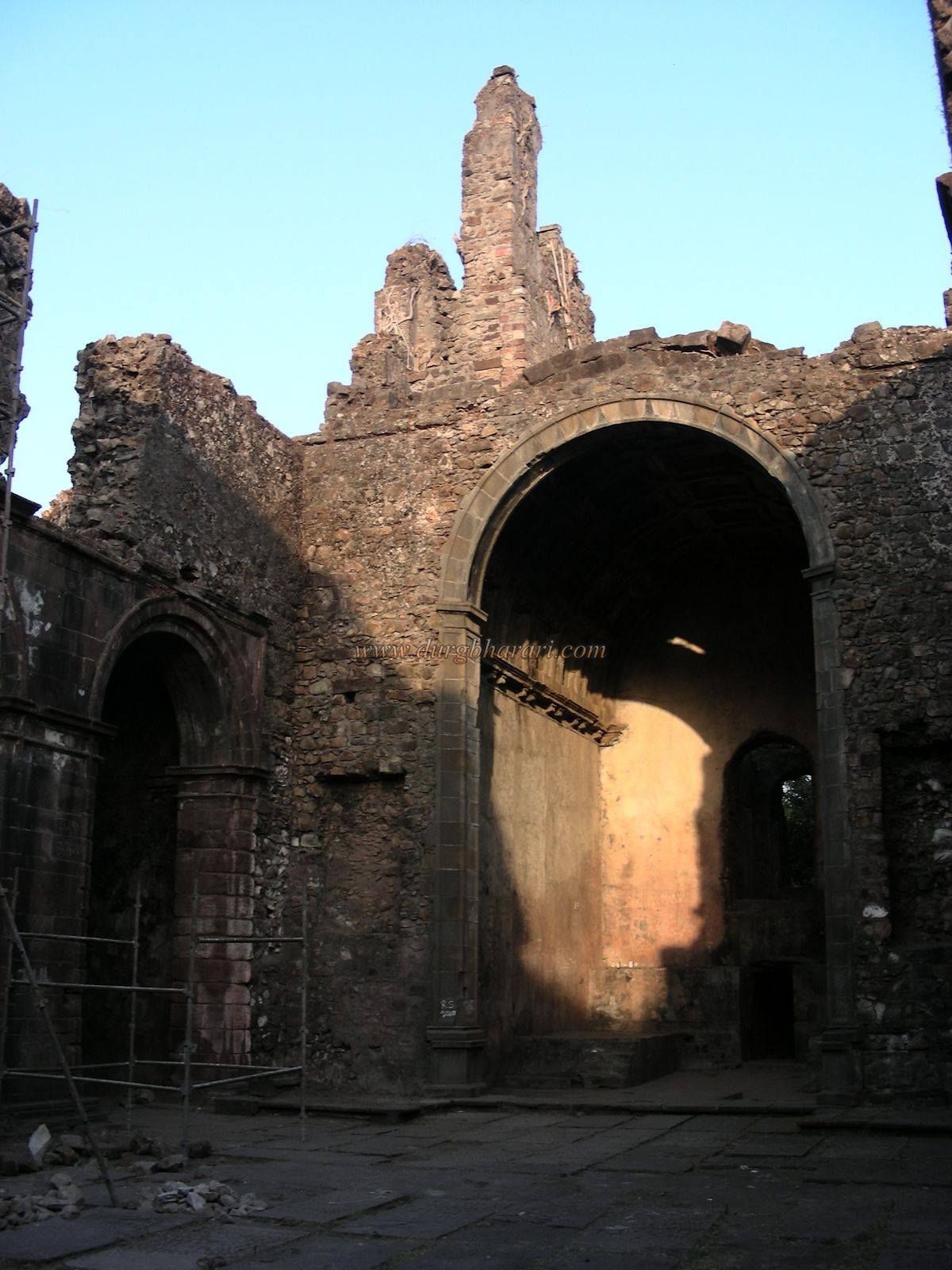
On the way to the citadel, three churches are encountered. Among them, St. Joseph’s Cathedral, built between 1546 and 1601, is the most significant, also known as the Cathedral. This church has the highest number of Portuguese-era inscriptions in the fort. Its arches are awe-inspiring. The tower once had four decorative urn-shaped pinnacles, of which only two remain. A spiral staircase with sixty-three steps leads to the tower’s top, offering a panoramic view of the Vasai creek. It was atop this very tower that, after defeating the Portuguese, the Marathas hoisted their saffron flag on 16 May 1739.
Near the citadel lies the courthouse, a hospital, and a two-arched Town Hall. Beyond these are a prison and the Vajreshwari Temple. Before marching on Vasai, Chimaji Appa vowed to build a temple for Goddess Vajreshwari if victorious. This temple was constructed in 1739. Nearby stands the Shri Nageshwar Temple, which had been destroyed during Portuguese rule but was rebuilt after the Maratha conquest. Adjacent is the ancient Nagesh Mahatirtha pond. Further along, on the right, stands the statue of Chimaji Appa.
The citadel has three circular bastions and one square bastion. Within are remnants of a gunpowder magazine, soldiers’ quarters, and mansions. Important administrative and military decisions were made at the Senate House, where an inscribed stone still survives. Outside the citadel is a courtyard with a well. On the way to the sea gate lies the Veer Hanuman Temple, consecrated on 27 July 1739. The idol here is unique for its carved moustache.
The Darya Darwaza was highly significant during Portuguese rule, as it was through this gate that their ships conducted trade and communication. Other remains in the fort include the arched mansion of a Portuguese-era college, red-plastered walls, and residences of clergymen. Entering through the Bhui Darwaza, the inner pathway curves sharply—a defensive design to delay enemy advances. Recently, a Hanuman temple has been built at this spot, with a large lamp tower at its entrance.
Though the ramparts are broad and walkable, loose stones and overgrown thorns make them dangerous. The Portuguese-built St. Sebastian bastion also has a 553-foot-long underground passage, with air vents along its course. However, this passage is dark, silt-filled, and infested with bats and other dangerous creatures, making it nearly impassable.
The fort once had five Christian religious institutions, built during Portuguese and later British rule. Near the St. Sebastian bastion lie the ruins of the Franciscan Church of Invocation of Santo Antonio, visited by St. Francis Xavier himself. The Church of St. Paul and the Jesuit Monastery, built in 1578, lie northeast of the Franciscan Church. Within the citadel is the Church of Nossa Senhora da Vida, while St. Joseph’s Church stands near the northeast ramparts. Originally a mosque, the Portuguese converted it into a church. The open space in front of it once served as a marketplace. Another structure, the Dominican Church and Convent, was built in 1583. Today, all these buildings lie in ruins.
An interesting feature of Vasai Fort is the intentionally open northern stretch of land. The Portuguese likely feared an attack from this direction. By keeping it open, they ensured that any intruding enemy would find no cover and remain exposed to their gunfire—a strategy that proved effective when the Marathas breached the ramparts during their siege.
Outside the fort, in an area called Galbawdi (or Godbaw), the Marathas had set up camp. A sati stone there commemorates the wife of a fallen commander who performed sati. Behind Vakil Rajni’s bungalow stands a memorial to Balajipant More, a fierce warrior who, according to legend, continued fighting even after being decapitated by the Portuguese.
Two hours are sufficient to tour the fort.
When the Portuguese began establishing their presence along the Konkan coast, their initial settlements were in places such as Thane, Kalyan, Mahim, and Vasai. To maintain control over these territories, they systematically constructed watchtowers and forts. After securing Vasai in 1534, they developed it into the headquarters of their northern settlements. From here, they administered Salsette (Sashti), Thane, and other nearby islands. They also constructed several churches and monasteries, making Vasai a major center for Portuguese culture and religion in India.
The Portuguese maintained strict discipline and heavily fortified the fort, as Vasai became their most important base after Goa. The Jesuits, Franciscans, and Dominicans all established churches and convents here, and the town around the fort prospered. The Portuguese name for Vasai, “Bassein,” was derived from “Basaim,” their version of the original name “Vasai.” Their presence, however, was marked by religious intolerance, and they demolished several Hindu temples while converting many locals to Christianity. Yet, Vasai grew into a flourishing town under their rule, with elegant European-style buildings, well-planned streets, and thriving trade through its harbor.
The prosperity of Vasai and its strategic location soon drew the attention of the Marathas. In the 18th century, after consolidating their power in Maharashtra, the Marathas under Peshwa Bajirao I began looking towards Vasai. The Peshwa’s brother, Chimaji Appa, led the campaign to wrest Vasai from the Portuguese. This campaign is considered one of the most challenging and significant sieges in Maratha history.
In March 1739, Chimaji Appa began his assault on Vasai. Before leaving for the campaign, he vowed to construct a temple for Goddess Vajreshwari if victorious. The Marathas captured surrounding Portuguese outposts one by one and finally laid siege to the main fort. The Portuguese defended fiercely, but Chimaji Appa’s forces gradually breached their outer defenses. It is said that the Marathas used mines to blow up parts of the fort’s bastions, particularly the St. Sebastian bastion, creating an opening for their troops. After months of intense fighting, on 16 May 1739, the Marathas captured Vasai. Chimaji Appa kept his vow by building the Vajreshwari Temple, which stands near the fort to this day. This victory dealt a major blow to Portuguese power in the region and marked one of the most glorious chapters in Maratha military history.
Under Maratha control, the fort’s bastions were renamed with Hindu names like Bahiri, Kalyan, Fateh, Kailas, and Darya. They also restored Hindu temples destroyed by the Portuguese, including the Nageshwar Temple inside the fort. However, the Marathas did not extensively modify the fort’s European-style architecture, allowing much of its Portuguese character to remain intact.
In 1780, during the First Anglo-Maratha War, the British captured Vasai. It was returned to the Marathas in 1783 under the Treaty of Salbai but came under British control again after the fall of the Maratha Empire. Under the British, the fort gradually declined. They made little effort to maintain it, and over time, the once-grand churches, administrative buildings, and houses fell into ruin. Adding to the destruction, British authorities leased the fort in 1860 to Colonel Littlewood, who used its stones for his sugarcane factory project. This caused irreparable damage to many structures within the fort.
After India’s independence, the fort continued to languish in neglect for decades. Thick vegetation and marshy surroundings made access difficult, and the fort became a haunt for wild animals and antisocial activities. However, in the late 20th century, efforts began to restore its dignity. The Archaeological Survey of India took over conservation work, clearing the overgrowth and partially restoring some walls and bastions. A statue of Chimaji Appa was also installed to honor his historic victory. Despite these efforts, much of the fort still lies in ruins, and its immense historical potential remains underutilized.
Today, Vasai Fort stands as a silent witness to centuries of history—of Portuguese colonial grandeur, of Maratha valor under Chimaji Appa, and of British neglect. Its decaying churches, crumbling bastions, and wide courtyards still echo the stories of the many communities and powers that once thrived here. Situated so close to Mumbai, this magnificent fort could become a major historical and tourist destination if proper restoration and development are undertaken.
© Suresh Nimbalkar
GALLERY