VARKHED
TYPE : GADHI
DISTRICT : JALGAON
HEIGHT : 0
GRADE : EASY
Exploring the truly lesser-known forts of Maharashtra has a charm of its own. You are unfamiliar with the structure you are visiting, and often even the locals know little about it. Sometimes these places have multiple names, and the search for them becomes an adventure in itself. This is exactly the experience we had while visiting the fort at Varkhed in Bhusawal taluka of Jalgaon district. Even today, I remain uncertain whether to call this fort Varkhed, Varkheda, or Varkhedi, as it is known by all three names, though no one seems to know much about it.
When asking for directions in this region, one must be patient. After you ask, people gathered at the village square often first discuss among themselves about the place you’re referring to, then ask you where you’ve come from, then explain at length how you’ve taken the wrong route, and only after that, if they know, they provide directions.
...
Otherwise, they suggest you go to the next village to inquire. Even Google searches for this name don’t easily lead to this fort; instead, it shows other villages. To make locating it easier, I’ve provided the fort’s coordinates here: 20.885034, 76.047420.
The most suitable route to reach Varkhed Fort is via Bodwad. Bhusawal to Bodwad is 33 km, and Muktai nagar to Bodwad is 22 km. From Bodwad, take the Malkapur highway to reach Varkhede Budruk, about 6 km away. As you enter the village, at the central square you will see an old deep well with a narrow mouth and two wooden-carved double-story wada. From there, a short distance away, on the banks of the village river, stands the Varkhed Fort.
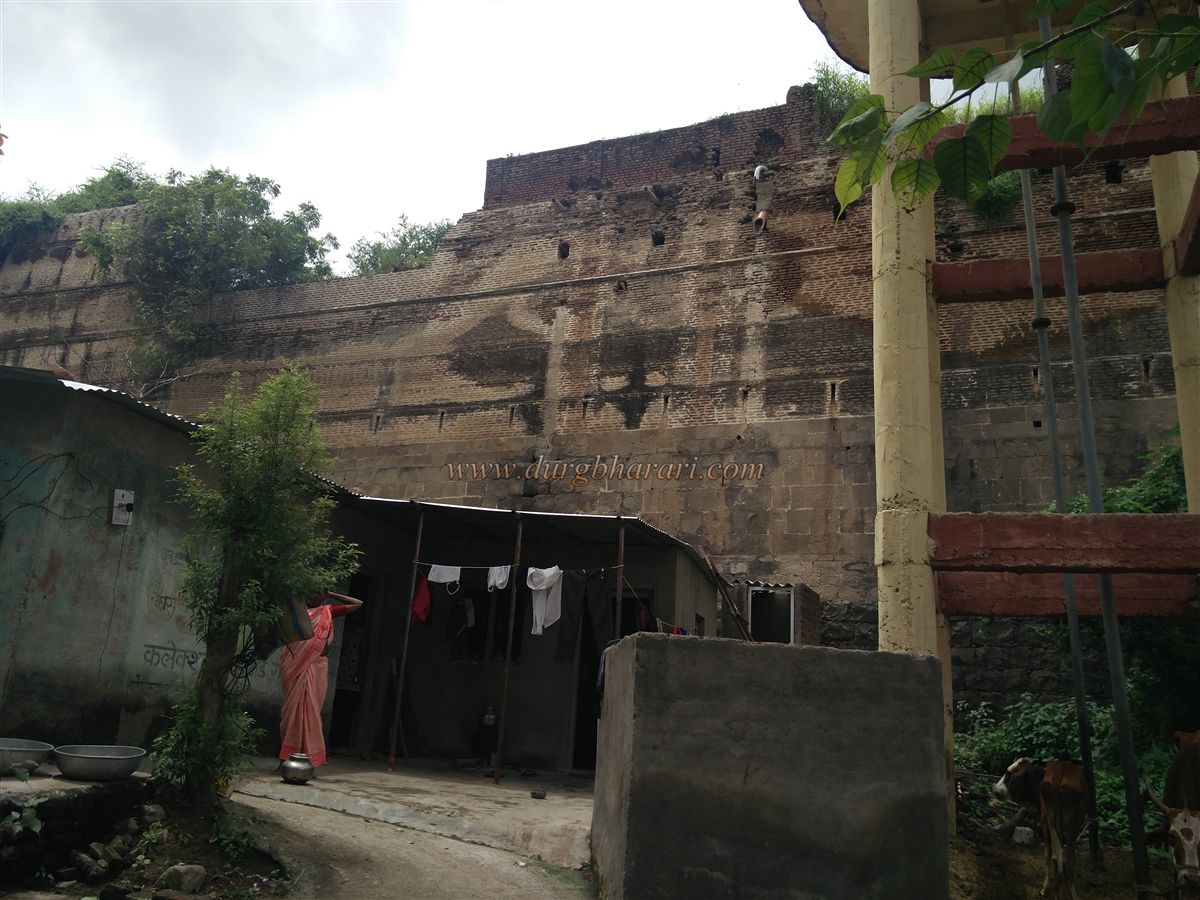
The lower 10–12 feet of the fort’s structure is built of stone, while the upper part is constructed with bricks. The fort, with its main northern entrance, occupies less than half an acre of land. It is roughly square in shape, with its walls still fully intact. Within the walls stands an octagonal bastion, which is taller than the adjoining ramparts. The fort walls have several loopholes for gunfire.
Entering the fort, you immediately see a square stone-built deep well, its inner circular lining constructed with bricks. The structures inside the fort have largely collapsed, leading the Bhose-Patil family, the current owners of the fort, to move elsewhere in the village in recent times. As a result, the interiors have fallen into severe disrepair. On the wall by the well is an arched niche, bordered with carved plasterwork in lime, within which sits a carved idol of Lord Ganesha.
Thick vegetation has overgrown much of the inside, making it difficult to explore fully. Some of the inner structures appear to have been two-storied, while others may have been three-storied. One of these ruined buildings still has a staircase that leads up to the ramparts. From the parapets, you can partially walk along the fort walls. An hour is sufficient to explore the entire fort and its surroundings.
This fort was originally built by the Holkar lineage. During the British era, it was purchased by the Leva Patil family, who later sold it to the Bhose family, its current owners.
© Suresh Nimbalkar
GALLERY