UMBARKHIND
TPPE : MEMORIAL/ BATTLE FIELD
DISTRICT : RAIGAD/ PUNE
GRDE : EASY/MEDIUM
One of the most important battles fought by Chhatrapati Shivaji Maharaj in his lifetime was the Battle of Umberkhind. Located in the lap of the Sahyadri Mountains, on the border of Pune and Raigad districts, this is where Shivaji Maharaj, with a small army of about 1,000 men, defeated a much larger force of around 20,000. This victory showcases his well-planned and daring military strategy.
When we hear the word khind (pass), we usually think of a narrow gap or gorge between two hills. However, at Umberkhind, there is no such physical formation — instead, the term here refers to a narrow, slippery footpath descending from the mountain pass into the Konkan region.
Before learning the history of Umberkhind, it is important to understand its geography. From Lonavala on the mountain plateau, a path descends from Kurvande village down to Umbre village in the Konkan.
...
This path drops sharply about 2,000 feet from the Sahyadri into Chavani village. The Amba River flows from Chavani village toward Thakurwadi. Between Chavani and Thakurwadi, the narrow trail runs beside the Amba River through dense forest. Hills on both sides make the trail resemble a tube. The exit point of this “tube” is the hill at Thakurwadi, beneath which the Amba River bends to the right.
The steep Sahyadri slope at the back, the hills flanking the path, the riverbed, and the Thakurwadi hill in front all restrict the movement of any army entering this “tube.” Taking advantage of this geography, Shivaji Maharaj defeated the large Mughal force with a much smaller army in very little time. The abundance of umber (fig) trees in the area and the nearby village of Umbre likely gave the place its name, Umberkhind.
If you wish to visit only the memorial at Umberkhind, you can go directly there by private vehicle. But to trek the actual pass, you must start from Kurvande village, 4 km from Lonavala. The trek from Kurvande on the plateau to Umberkhind in the Konkan takes about 5 hours, so carrying enough water is essential. Two trails descend from Kurvande to the Konkan, merging near Umberkhind. It is hard to say exactly which trail Maharaj used, but along the Ambenali route you can still see traces of the old mountain road — stone-cut steps, water tanks, and a stone-built reservoir.
From Kurvande, the path is well-trodden but has forks in places, so it is important to understand the route beforehand. After about half an hour, you reach the first fork. The right-hand path climbs to Nagphani, while the left descends toward Umberkhind. The Amba River, originating at the base of Nagphani peak, flows through Garmal hill, into Umberkhind, and finally meets the Nagothane creek. A visit to Nagphani takes about 1.5 hours round trip.
Descending toward Umberkhind, you encounter the iron fence of the naval base INS Shivaji. This has altered the original route, and now a new path runs along the fence. You’ll also see yellow signs marking the pipeline of the Gail Company along the way, and in some places, the trail has turned into a dirt road.
After a short distance, another fork appears, with the right-hand path descending toward the Konkan. This section is somewhat slippery and requires caution. From here, you can see the Amba River and Chavani village below. Following the route marked by the Gail company’s signs, you reach the base of the pass from Kurvande in about 2 hours (without visiting Nagphani). Another half-hour’s walk, crossing a stream, brings you to Chavani village. From there, a dirt road takes about 30 minutes to reach the Umberkhind memorial.
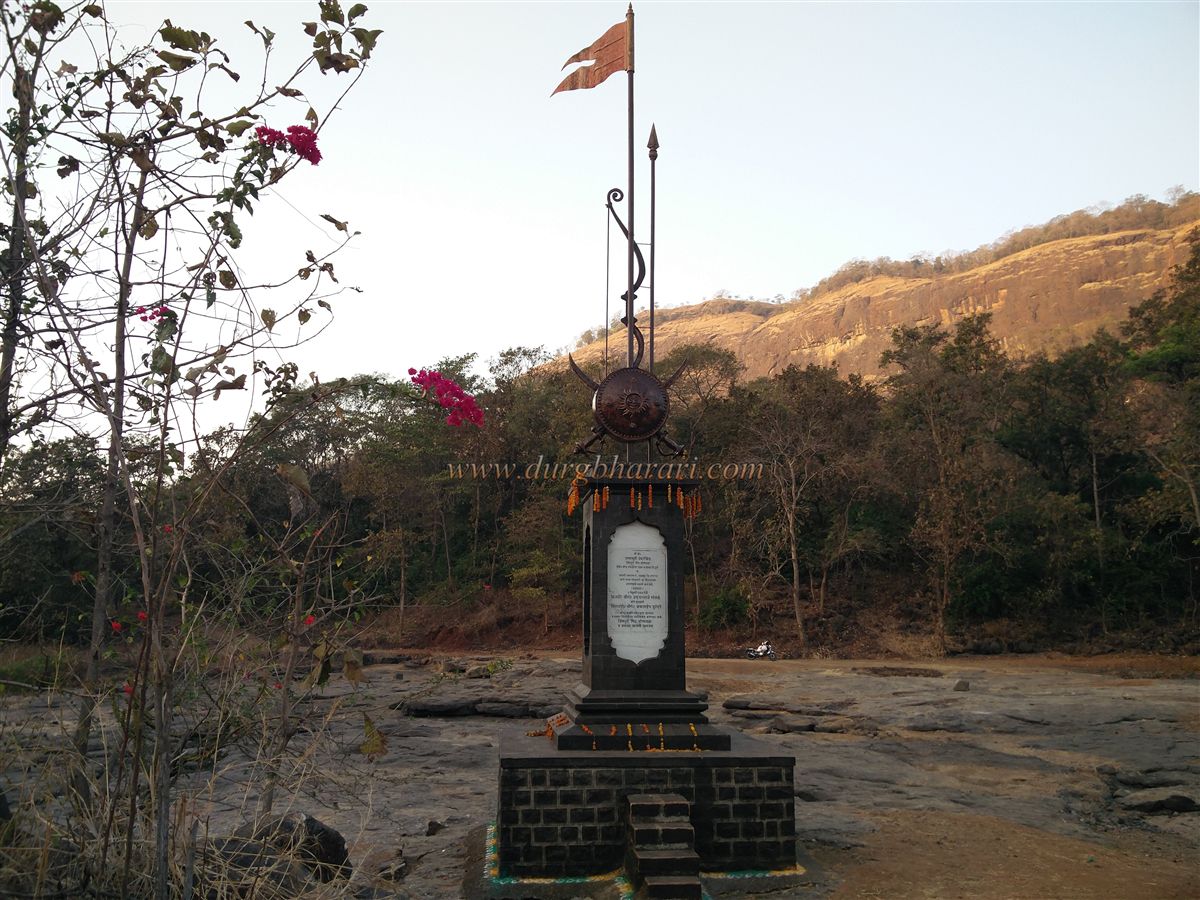
At the site, a board reads “Battlefield of Umberkhind.” Here, on a flat rock surface in the Amba riverbed, stands a fitting and beautiful memorial to the battle. This 40-foot-tall monument was built in 2001 by the “Shivdurga Mitra, Lonavala” organization and inaugurated on 2 February 2007 — Umberkhind Victory Day — by Udayanraje Bhosale, in the presence of Shivshahir Babasaheb Purandare.
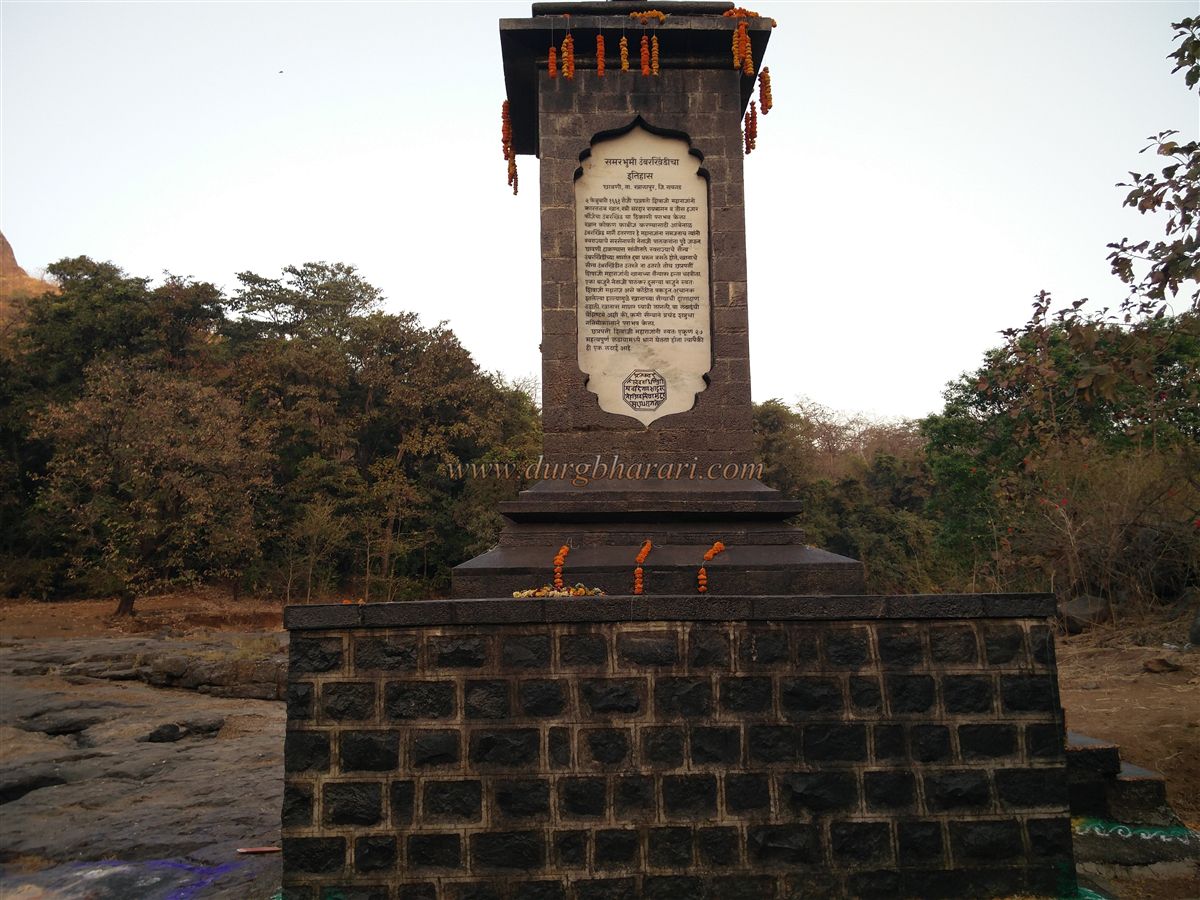
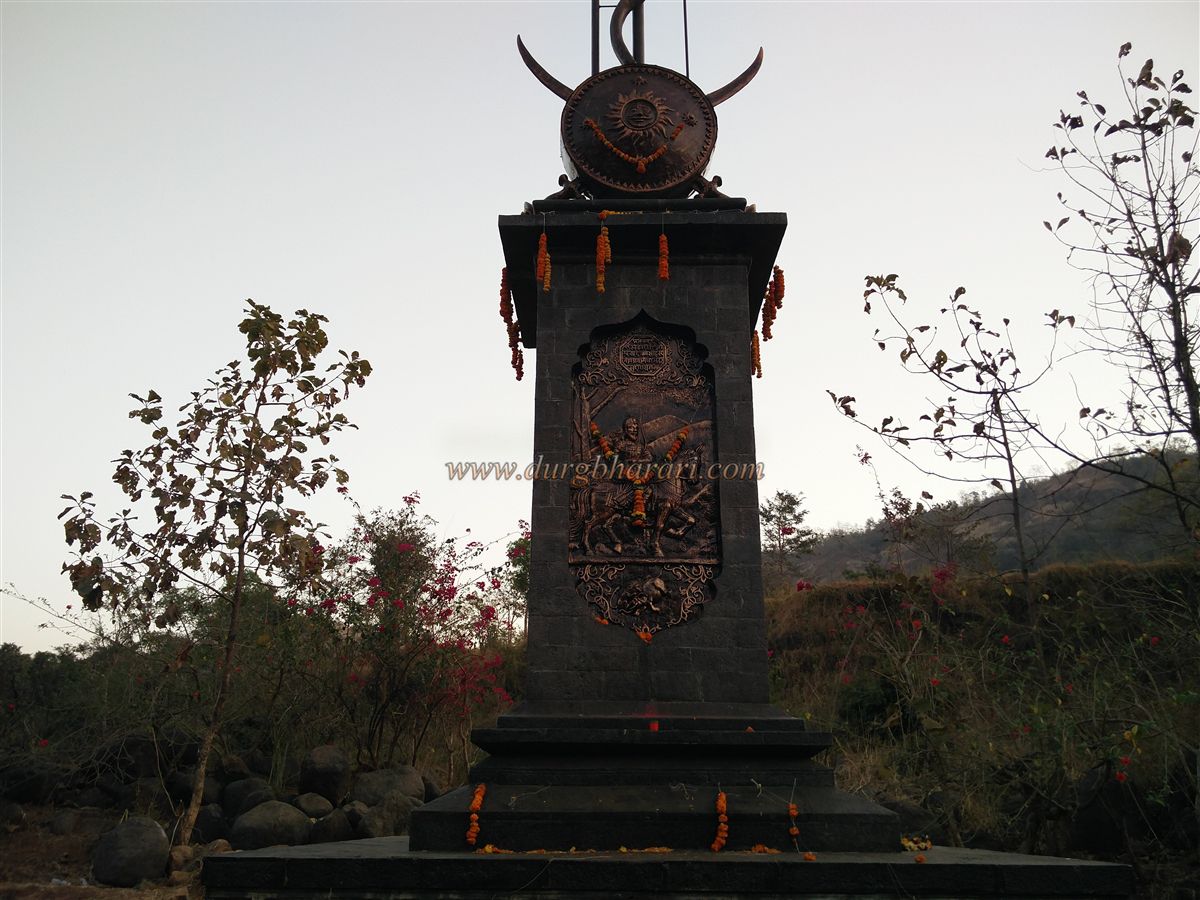
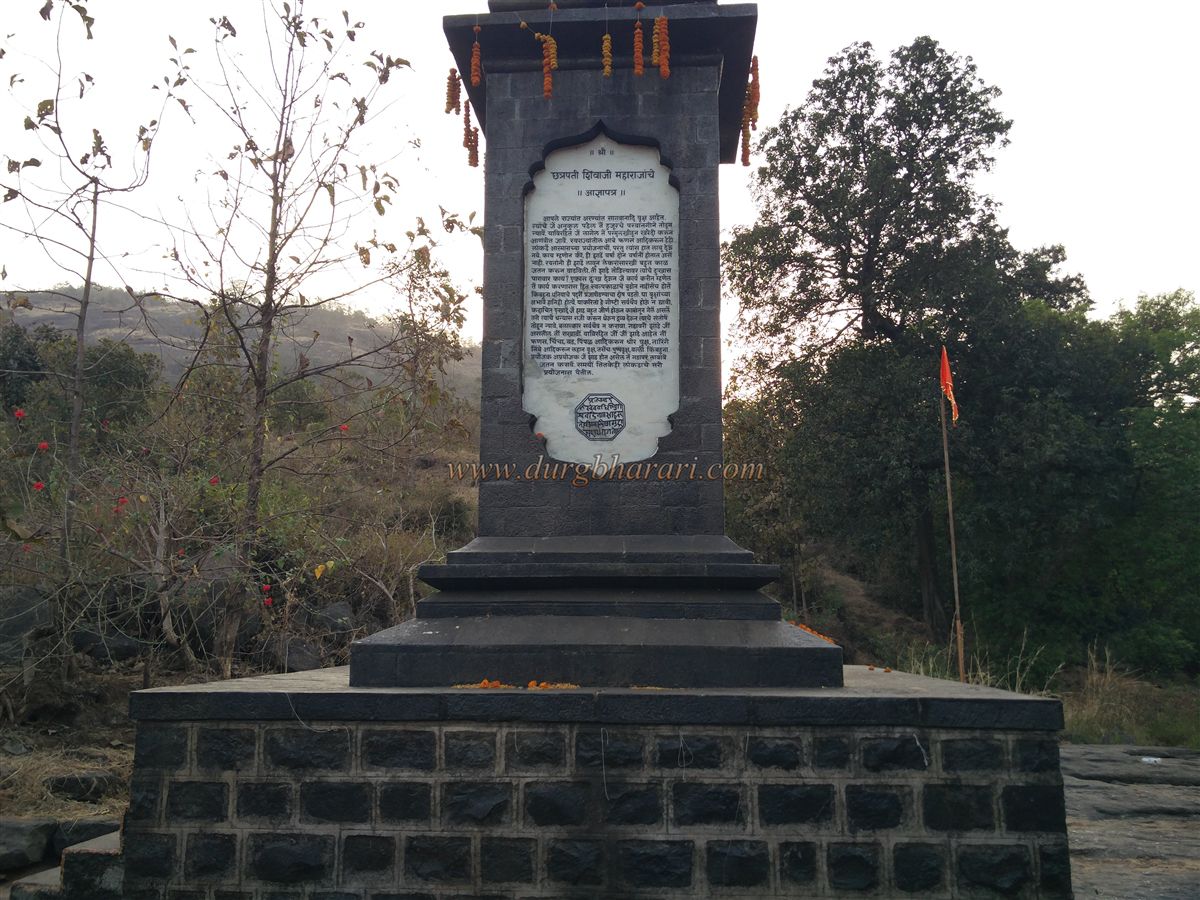
The memorial has a stone pillar on a platform, with Shivaji Maharaj’s royal order engraved on one side, his equestrian statue on another, and the history of Umberkhind on the third. The fourth side has the inauguration plaque. Above the pillar are iron replicas of a shield, sword, spear, bow, and flagstaff.
History records that Aurangzeb’s uncle, Shaista Khan, sent Uzbek commander Kartalab Khan and Raibagan with 20–30 thousand troops from Pune to capture the Konkan coast and navy. On 2 February 1661, in the Ambenali pass near Lonavala, Shivaji Maharaj himself, from one side, and Netaji Palkar from the other, routed the Mughal army with a handful of Mavlas. The Mughals surrendered, and after collecting ransom, Maharaj released them. Because Shivaji Maharaj himself was present, this battle holds special importance in Maratha history — a brilliant example of his guerrilla warfare.
After the victory, to guard against a possible Mughal counterattack, Maharaj stationed Netaji Palkar in the Umberkhind area (North Konkan) while he himself proceeded south to campaign toward Dabhol and Shringarpur.
Later, during the First Anglo-Maratha War (1781), to prevent the British from climbing to the plateau via the Kurvande Ghat instead of the Bhor Ghat, Peshwa commander Haripant Phadke stationed troops at Umberkhind.
© Suresh Nimbalkar
GALLERY