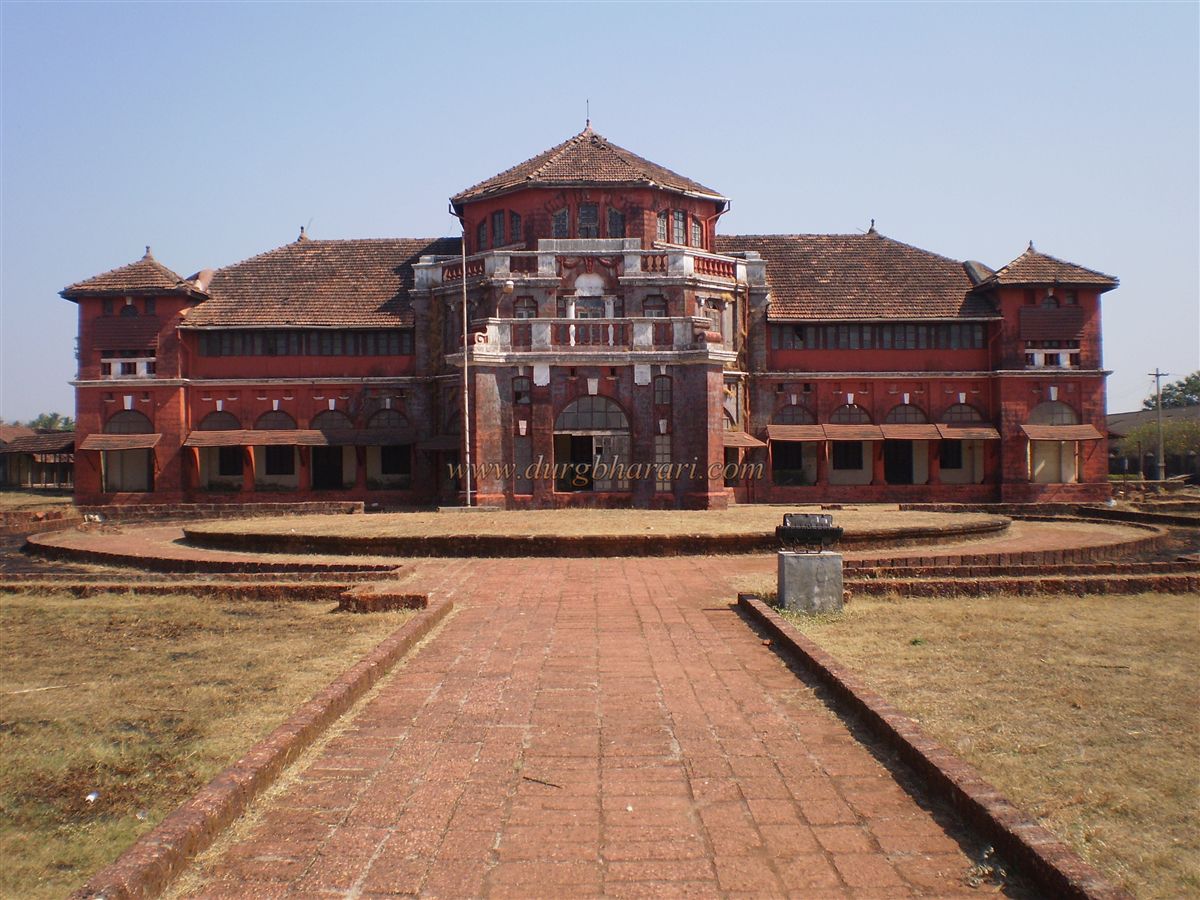
THIBA PALACE
TYPE : PALACE / MONUMENTS
DISTRICT : RATNAGIRI
Thiba Palace is a palace in Ratnagiri, built by the British to keep Thibaw Min, the king of Burma, under house arrest. Its construction was completed in 1910, and from then until 1916, the king and queen of Burma resided in this palace. At present, the palace is under the custody of the Archaeology Department, and a museum has been established inside it. Thiba’s bedroom, clothes, and some items used by him are still preserved here. Arriving at this location via Thiba Road, one sees a beautiful red structure with Mangalore tiles in a grand courtyard. The palace, situated on a wide rocky plateau, offers a magnificent view of the sea and the nearby Bhatye Creek. The area of this palace is 14,500 square feet. The construction shows the influence of both British and Burmese architectural styles—the arches of the outer verandas reflect the British style, while the sloping roofs remind one of pagodas.
...
The palace has two distinct sections: the front reception area and the rear bedrooms. These two sections are connected on the ground floor by a veranda and on the upper floor by a bridge. The royal seal of King Thiba’s Mindon dynasty can be seen adorning the door to the terrace on the first floor. Apart from the ground floor reception hall and the first-floor Durbar Hall, there are 14 other rooms in total.
On the ground floor, there is a marble-floored dance hall. The ceiling has beautifully carved wooden panels, and the semi-circular windows have colourful Italian glass panes. The most remarkable part is the Durbar Hall—two storeys high, with a wooden balcony, it reflects the grandeur of Thiba’s royalty. In addition, there are separate rooms for staircases, bathrooms, and corridors. The construction shows an abundant and creative use of teakwood along with laterite stone.
The first-floor bedroom has an attached bathroom with a bathtub. A fountain built in the central courtyard enhances the beauty of the palace, while behind the palace, there is a Buddha idol brought from Burma by King Thiba. The rear section of the palace now houses the antiquities museum. On the ground floor, there are various ancient idols found in Konkan and other parts of the country, while on the upper floor, there are photos of Thutu, old wooden chairs, and an exhibition of paintings of ancient temples in Konkan. Except for Mondays, this museum is open to tourists until 5 PM.
Construction of this spacious palace began in March 1907 and continued for about four years. Built on a large plot of 27 acres and 11.5 Guntha, the three-storey palace cost ₹1, 37,486 to construct. On 13 November 1910, King Thiba moved in with his family. Adjoining the palace were quarters for staff. Further along from here is Jijamata Garden at Thiba Point. From the tower here, one can see beautiful views of the Bhatye River, Rajivada Port, the vast sea, and the Bhagwati Fort.
There is a painful side to King Thiba’s stay in India. He was the last king of Burma. The British defeated him on 29 November 1885, bringing his kingdom to an end. Born in Mandalay in 1859, he died in Ratnagiri on 19 December 1916. He was the son of the Burmese King Mindon and became king in 1878 after Mindon’s death. Thiba was a man of religious inclination. When he ascended the throne, half of Burma was already under British control, leading to conflict between him and the British.
British officers would enter his court wearing boots, even though the custom required removing footwear. Thiba objected to this and, in an attempt to oppose the British, allied with the French and encouraged the public to fight for the liberation of British-occupied Burma. Ultimately, he could not withstand the British military and was captured, marking the beginning of Burma’s colonial period on 28 November 1885.
Thiba, his queen Supayalat, and their two daughters were arrested. To ensure he could not revolt again or maintain contact with his subjects, the British decided to keep him under house arrest in Ratnagiri. On 17 April 1886, Thiba and his family were brought to Madras by the Canning ship and then to Ratnagiri by the Clive ship. In Ratnagiri, they were first kept in the rented bungalows of Akkalkot Diwan Rao Bahadur Surve and Rao Saheb Vishnu Phadke. When these premises proved inadequate, the British built this palace on the southern side of Ratnagiri, at the edge of Bhatye Creek.
This palace was constructed according to Thiba’s preferences and under his supervision. He personally chose the timber and other materials, approved the design, and oversaw construction. The palace shows his keen sense of beauty. Since he received only a meagre pension from the government, Thiba sold the jewels he had brought with him to decorate the palace. Teakwood for the furniture was specially brought from Burma.
In 1910, Thiba came to live here and remained under house arrest until his death on 19 December 1916. Even after his death, the British government denied permission to send his remains back to Burma. King Thiba’s life was full of drama and reflected the cruel games of fate. After his death, the British took over the palace and sent the queen and their three daughters back to Burma. It is said that the tombs of Thiba and his family are located in the Shivajinagar area of Ratnagiri.
© Suresh Nimbalkar
GALLERY