SINHAGAD
TYPE : HILL FORT
DISTRICT : PUNE
HEIGHT : 4314 FEET
GRADE : EASY
Sinhagad Fort holds an important place in the Maratha kingdom established by Chhatrapati Shivaji Maharaj. It is etched in the hearts of every Marathi person as the site where Subhedar Tanaji Malusare attained martyrdom while capturing the fort – an incident that immortalized both the fort and Tanaji’s sacrifice. Because of this, the fort has a special emotional connection for devotees of Shivaji Maharaj and fort enthusiasts, who frequently visit it. However, in recent times, under the pretext of tourism, the fort has acquired a rather unpleasant and unkempt appearance. Since vehicles now reach directly up to the fort gate, Sinhagad overflows with tourists during weekends and especially in the monsoon. If one wishes to properly explore and experience the fort, it is advisable to avoid visiting during these peak times.
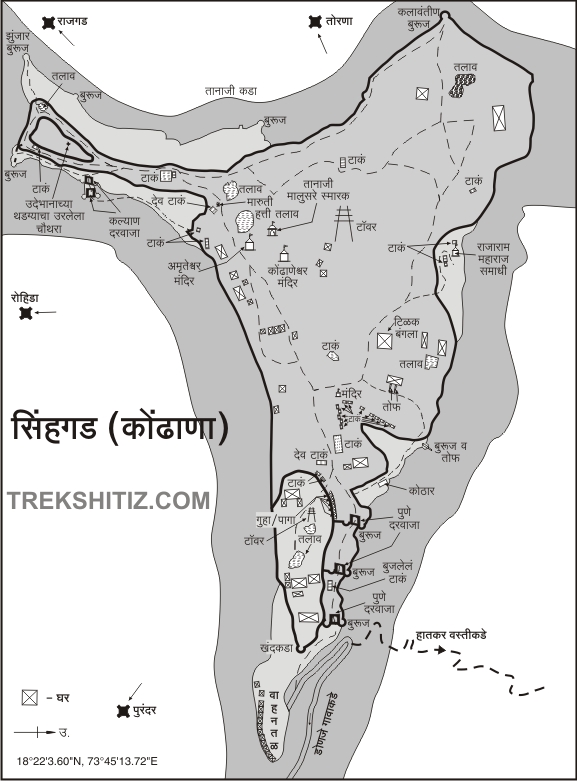
There are two main entry routes to the fort – Pune Darwaja (Pune Gate) and Kalyan Darwaja (Kalyan Gate).
...
Private vehicles usually approach the fort through Donje and enter from the Pune Gate, making this the most commonly used route by both tourists and fort enthusiasts. If your plan is to explore the fort in a single day, entering through the Pune Gate is the most convenient option. As per the new forest department regulations, private vehicles are now parked at the foothill, and visitors are ferried up to the Pune Gate by electric buses – a measure taken to avoid crowding and accidents on the fort road.
Located in Haveli taluka of Pune district, within the limits of Donje village, Sinhagad is about 27 km from Pune city. From Swargate bus stand, bus number 50 runs every hour to Atkarwadi, the village at the base of the fort. From Atkarwadi, it takes about two hours to climb to the fort on foot. For those coming by private vehicles, the route is Pune–Anand nagar–Vadgaon–Khadakwasla–Sinhagad. The fort is part of the Bhuleshwar mountain range, which is a branch of the Sahyadri spreading southwest of Pune, and along this range stand both Purandar and Sinhagad forts. Historically, this area was called “Athgav Ghera” (circle of eight villages), as eight villages lay within the fort’s defensive periphery. In its heyday, the approach to the fort passed through four outposts – Kalyan Met, Kalki Met, Amri Met, and Sadke Met.
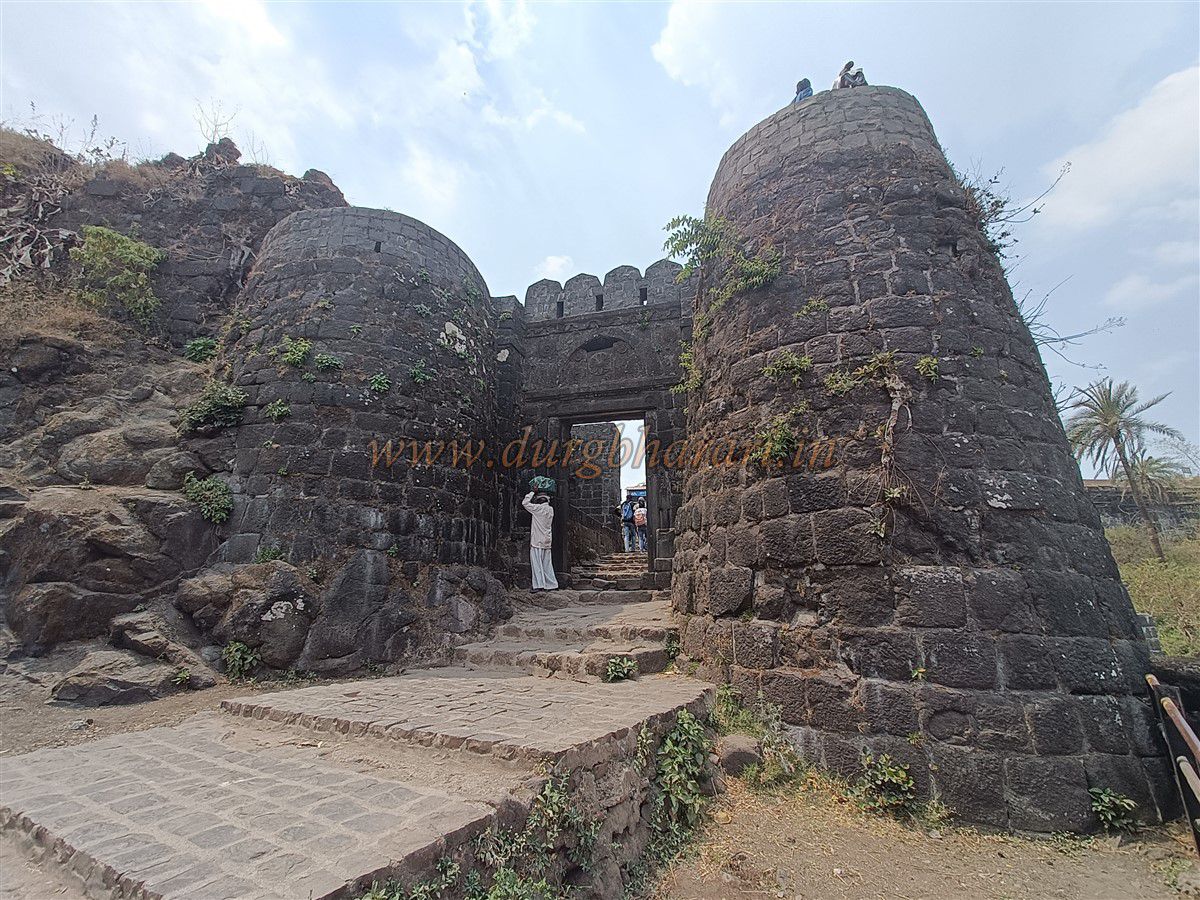
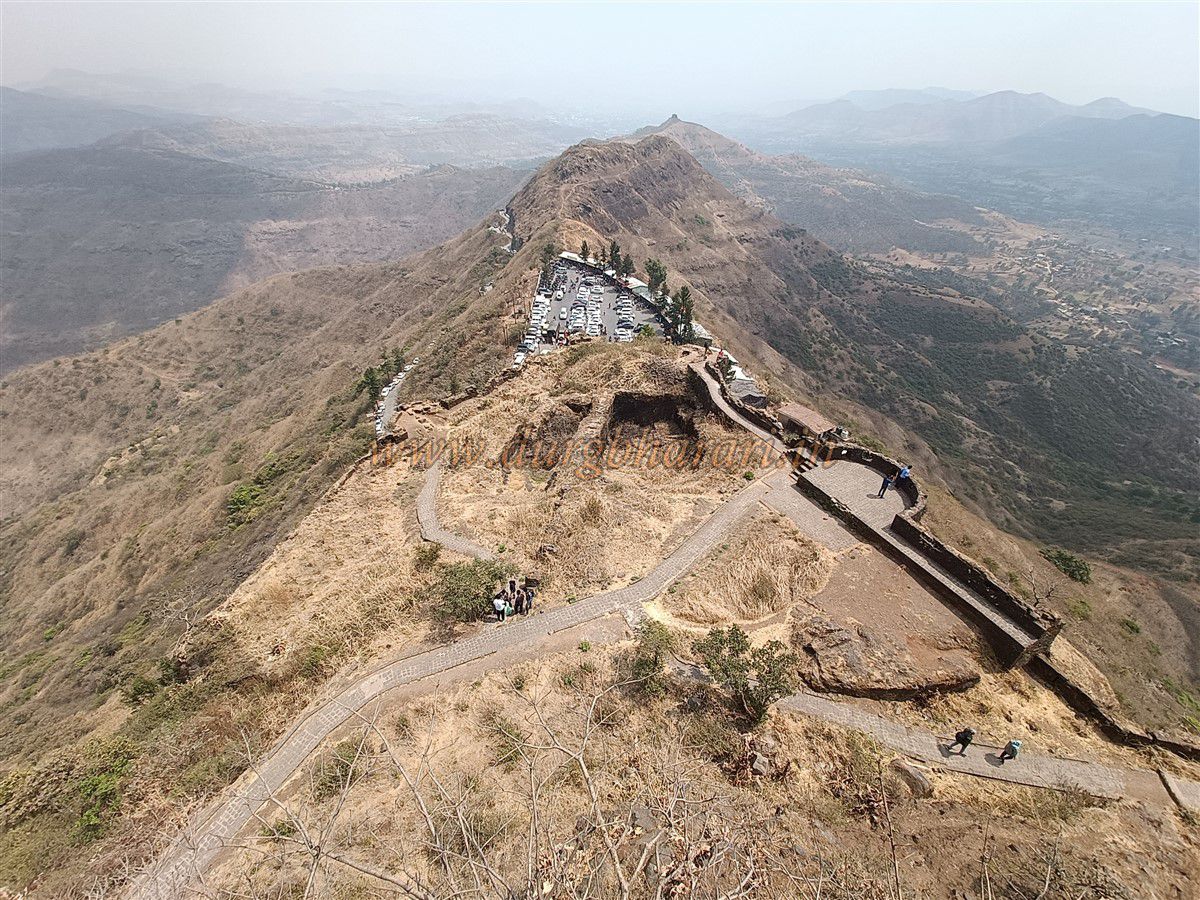
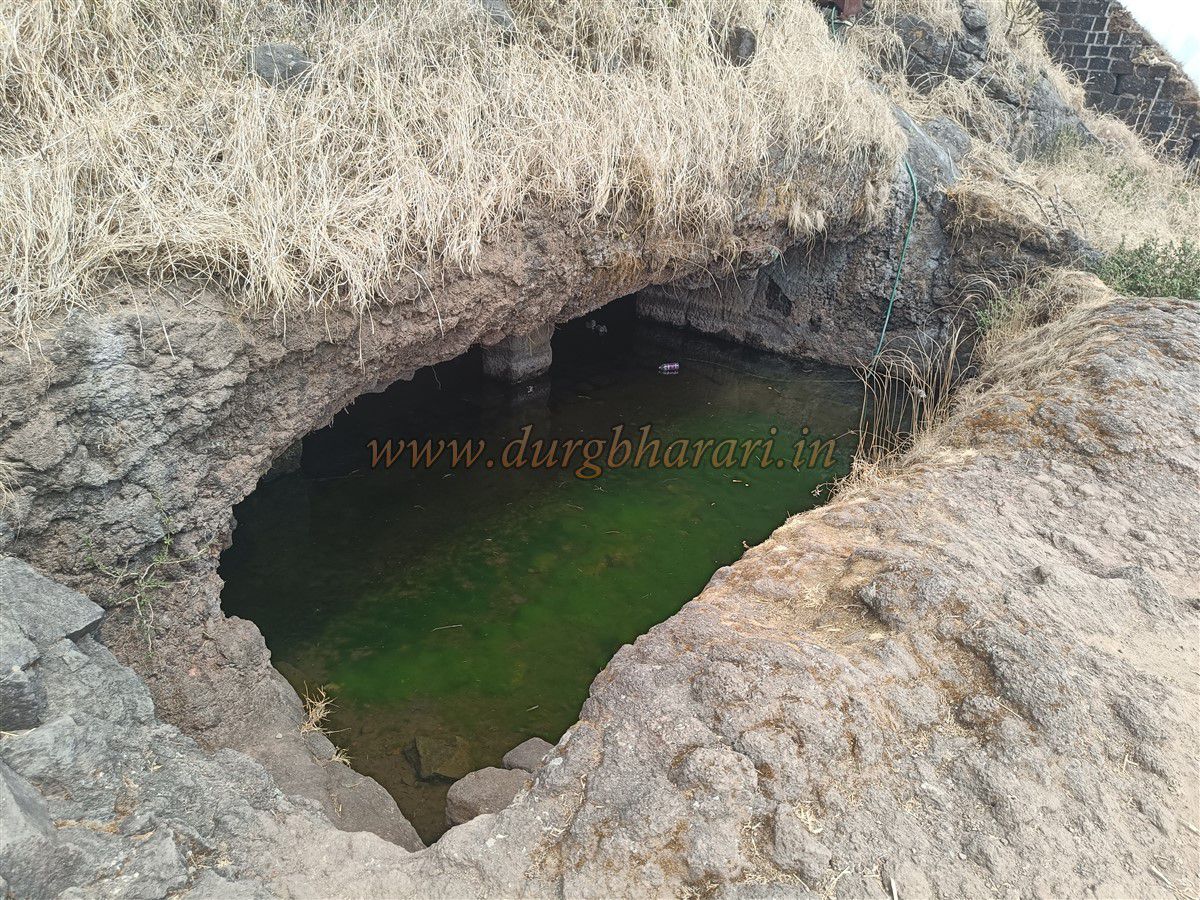
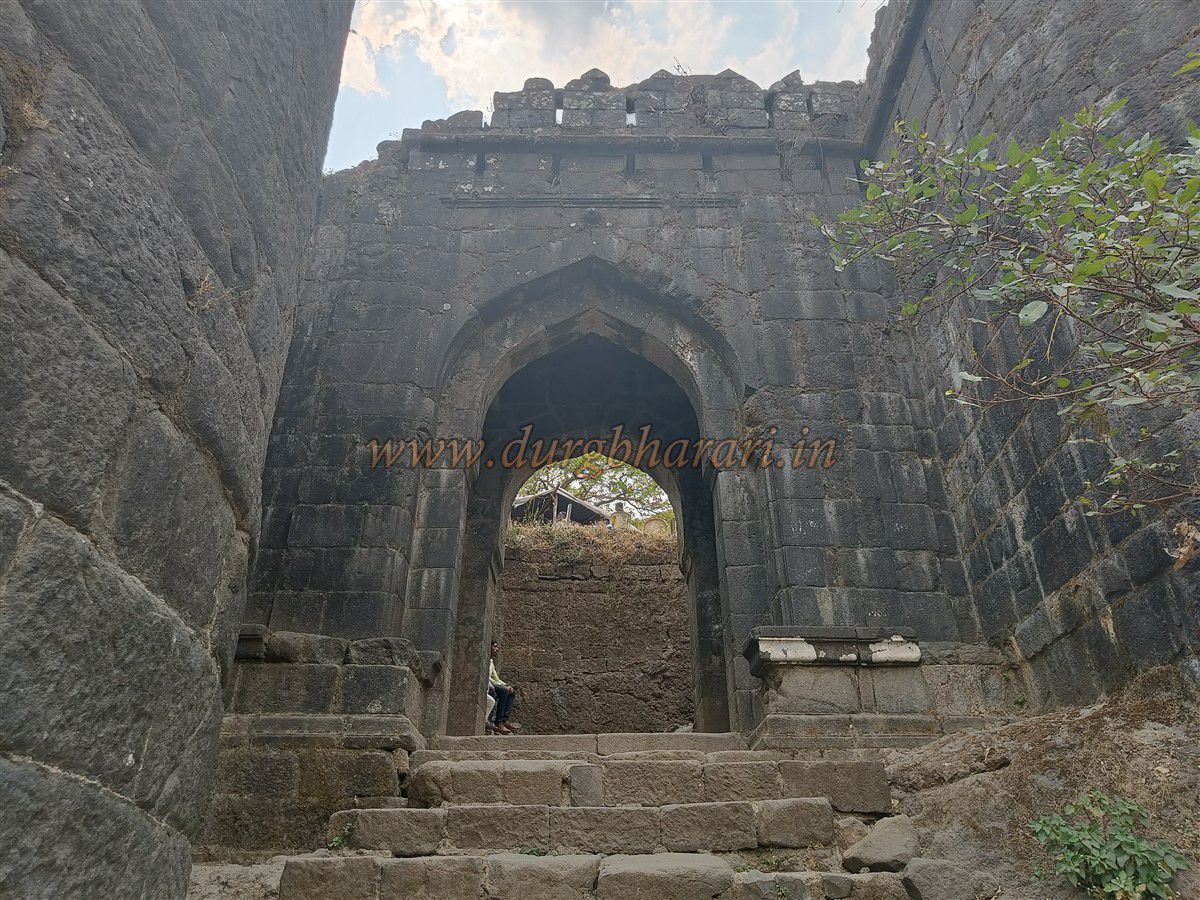
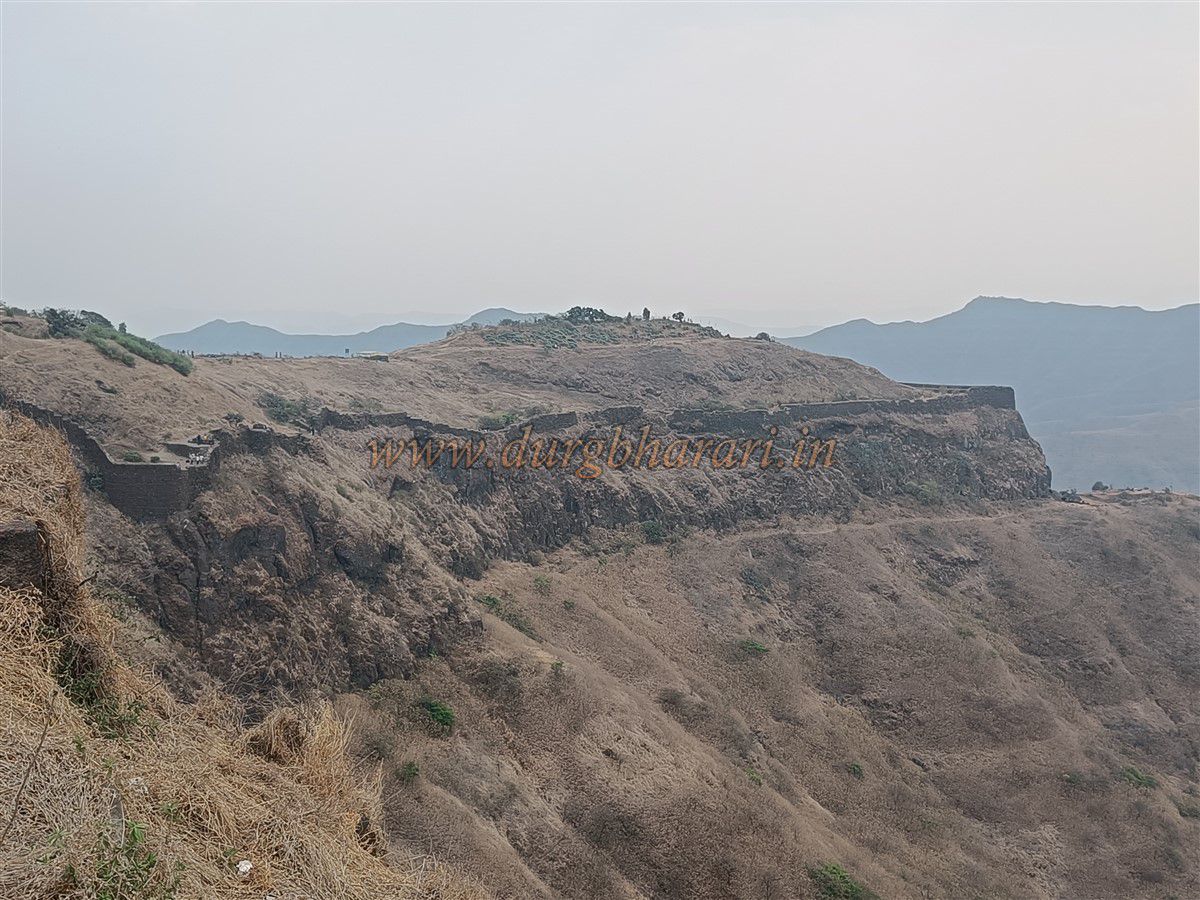
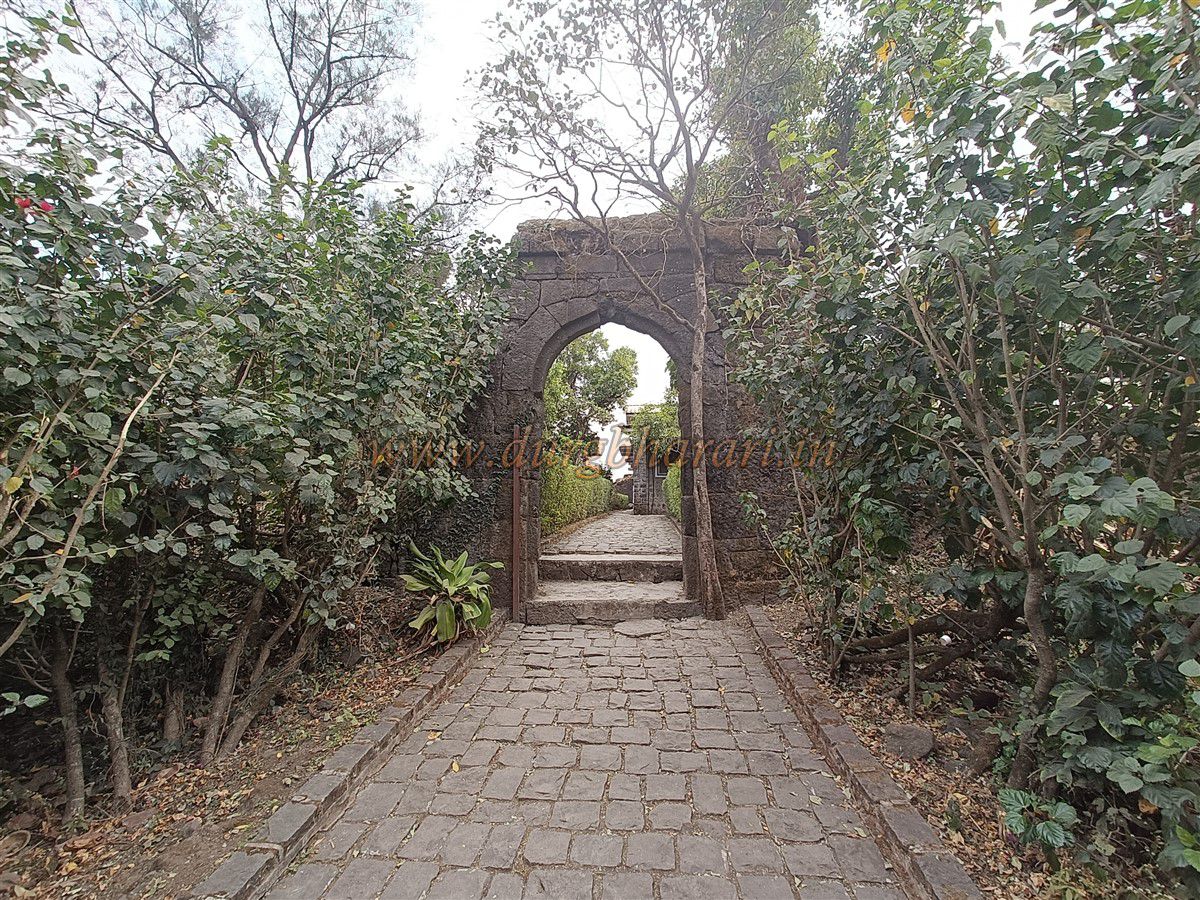
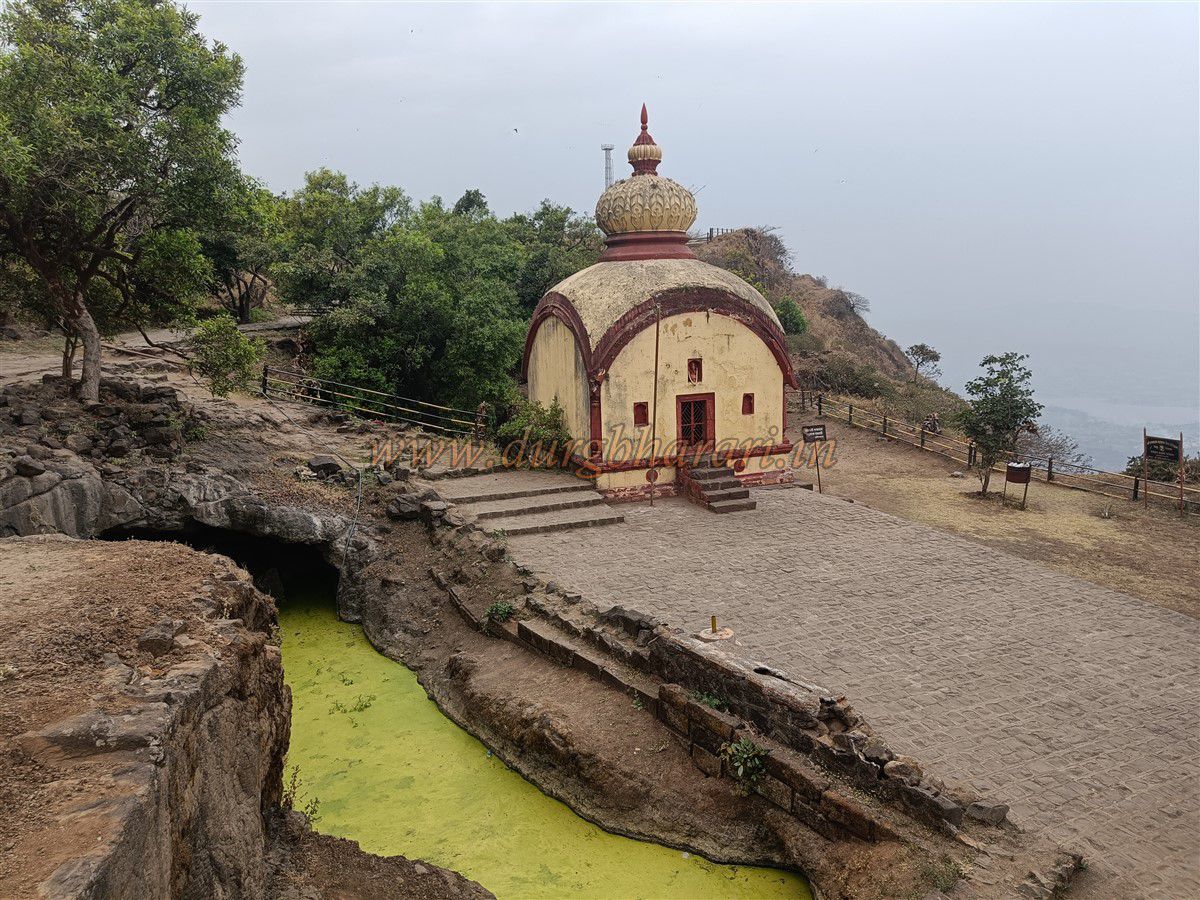
Upon reaching the parking area, the first thing one notices is the sheer Khadakada cliff, alongside which runs the fort’s imposing ramparts. As one walks towards the entrance, on the left, two partially buried caves can be seen in the cliff face. One of these caves contains water and is locally known as Surunga Pani (Mine Water). Entering through the Pune Gate requires passing through three successive gates. The first gate is built between two bastions along the cliff edge, and although weathered, it still displays carvings of two Sharabh (mythical creatures). Climbing about 20–25 steps from here brings you to the second gate. Just before this gate, on the left side of the cliff, is a rock-cut cistern, though its water has become stagnant and covered with algae. Looking back from this point reveals the fort wall extending down the slope towards the first gate, with a small postern gate visible within the rampart. This cliff section is slightly detached from the main fort and enclosed by its own independent fortifications. Before entering the main fort, one should first pass through this small gate to explore the Khadakada section. This area is not very large, containing two large dry rock-cut cisterns (likely quarries used for extracting stone), but no other significant remnants. For defensive purposes, the entire section is enclosed by ramparts and bastions. Above this cliff section, a spur from the main fort extends outwards, where a large bastion has been constructed to oversee the area. Higher up on the rampart is yet another small gate that leads to the upper section of the cliff. After exploring this portion, one returns to the second gate to proceed inward.
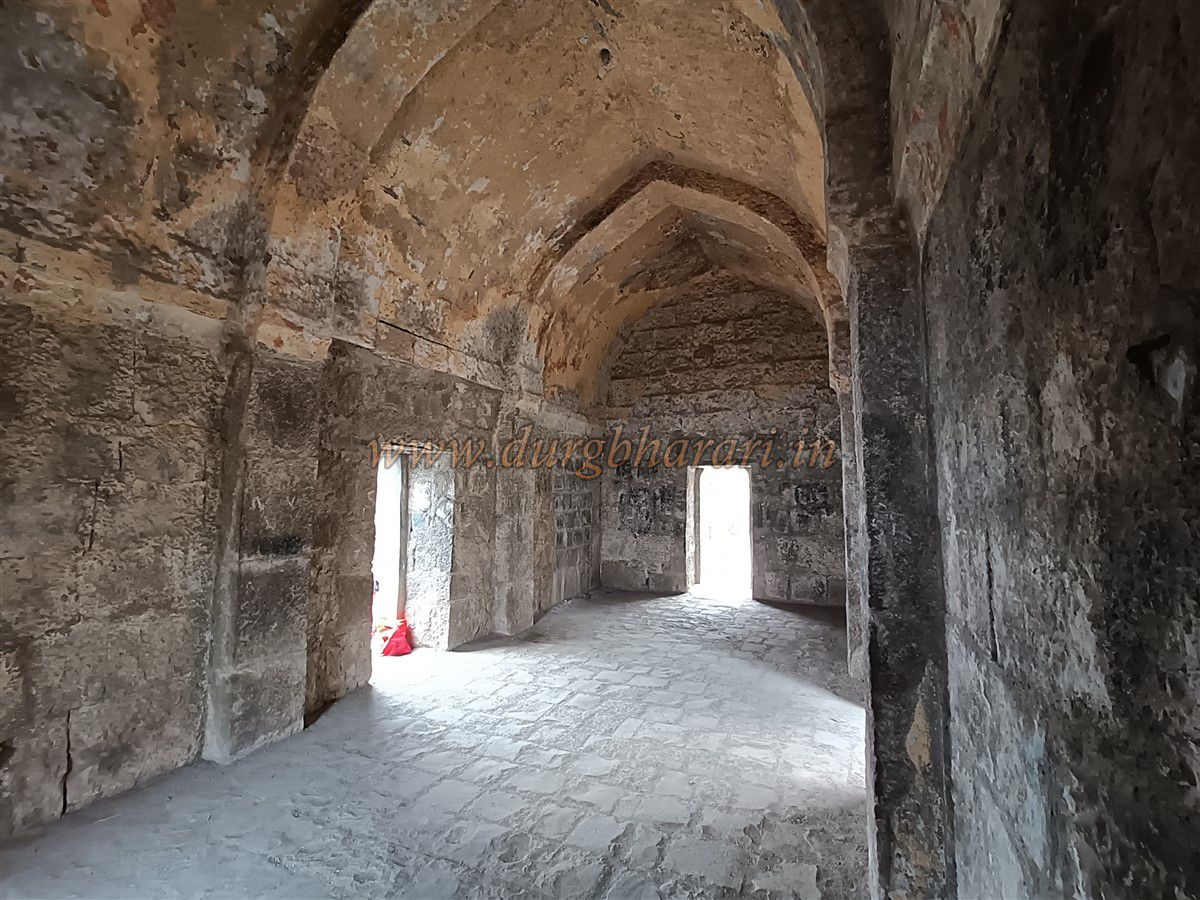
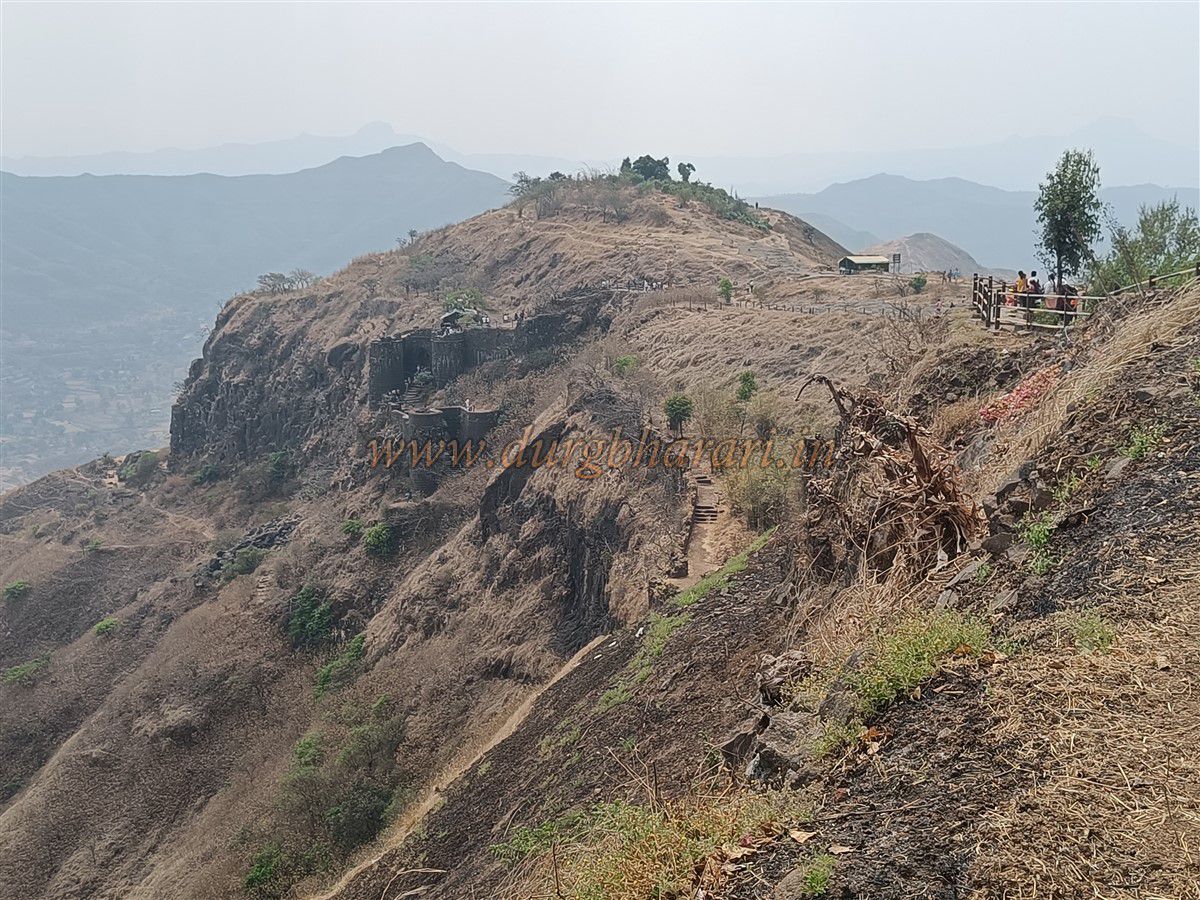
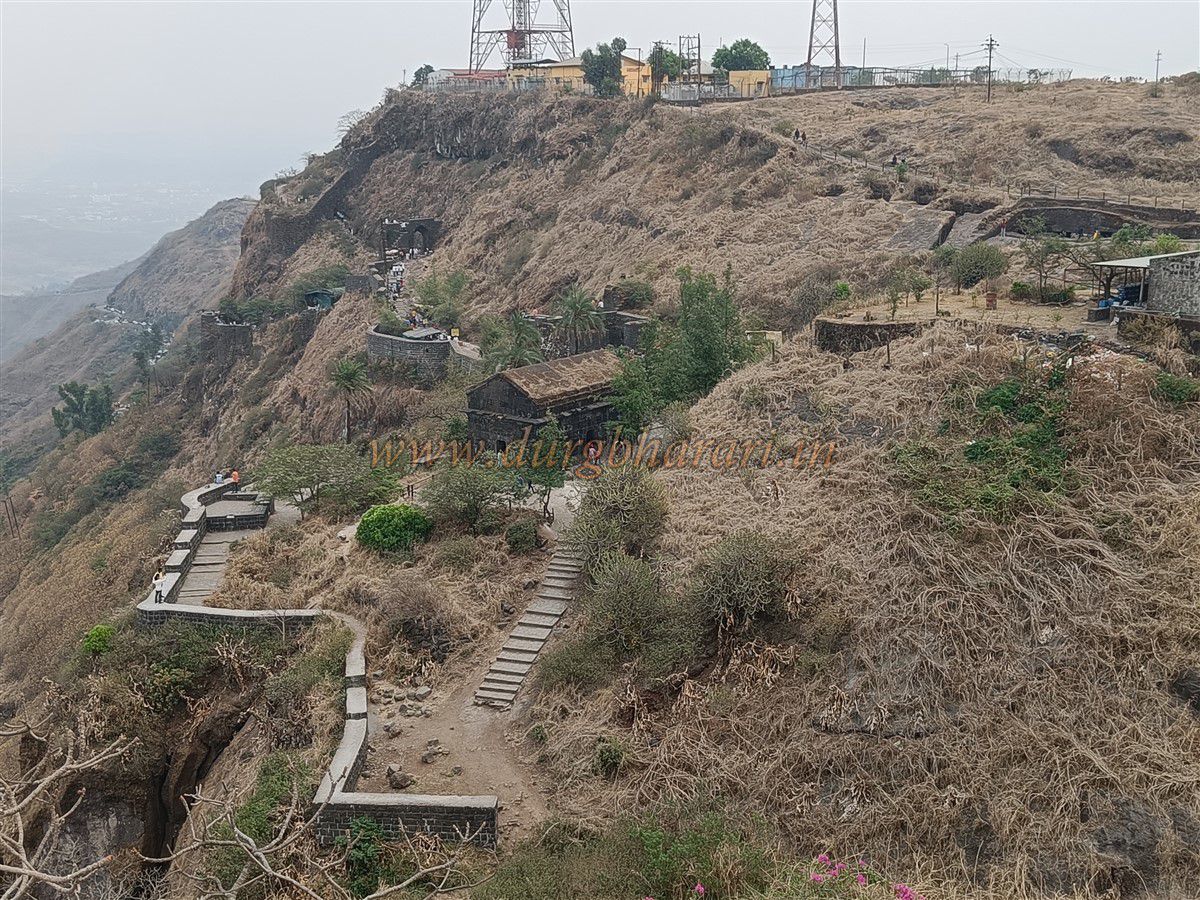
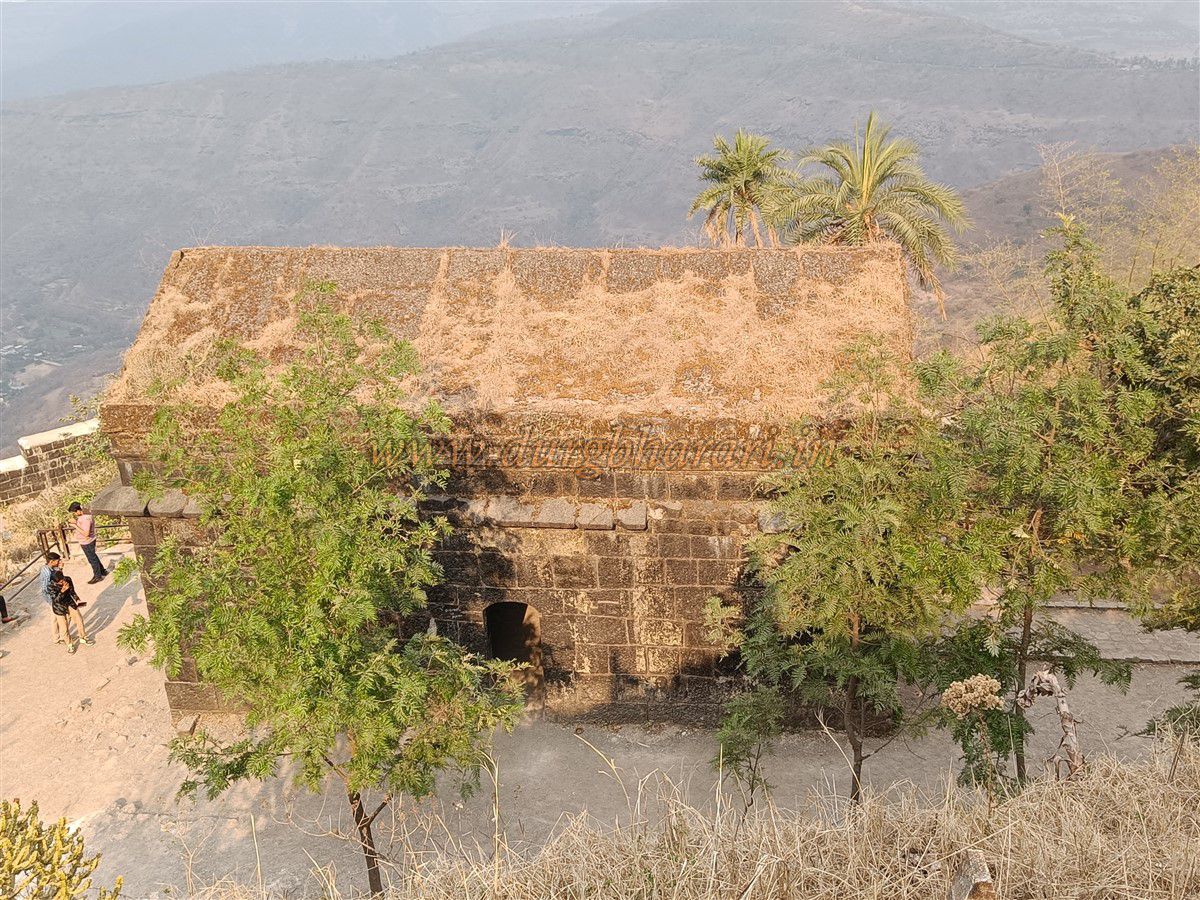
The second gate too is built between two bastions, but due to extensive repairs, no carvings remain visible on it. Steps are built here leading up to the bastion and gate structures. A short distance further stands the third gate, also between two bastions. The doorway here bears carvings of a lotus motif and a festoon, suggesting that this was the original main entrance in ancient times. All three gates are strategically constructed at points with a cliff on one side and a steep valley on the other. Guard rooms can be seen on either side of these gates. Passing through the third gate, one enters the main fort area. Immediately to the right, beside the descending rampart, stands a stone-built structure – the gunpowder storehouse. Remarkably well-preserved even today, this structure witnessed a tragic incident on September 11, 1751, when lightning struck, causing a massive explosion that destroyed the adjacent Fadnis’ residence and killed its occupants. Repairs to the storehouse and surrounding structures later cost 8,700 rupees. During the British period, this building was even briefly converted into a church. Near the storehouse, a stone channel carved into the wall drains water, and fragments of temple carvings can be seen embedded in it. After visiting this storehouse, one returns to the main pathway to continue exploring.
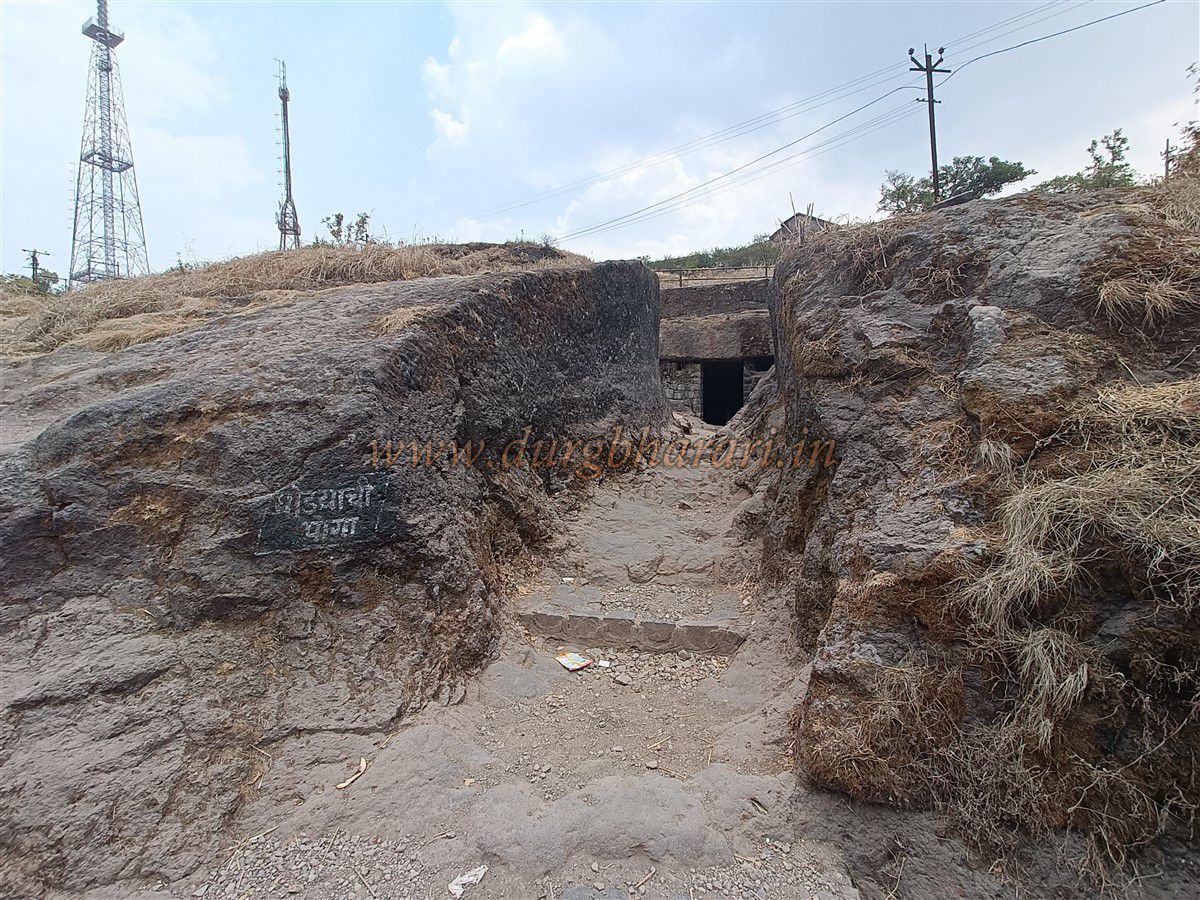
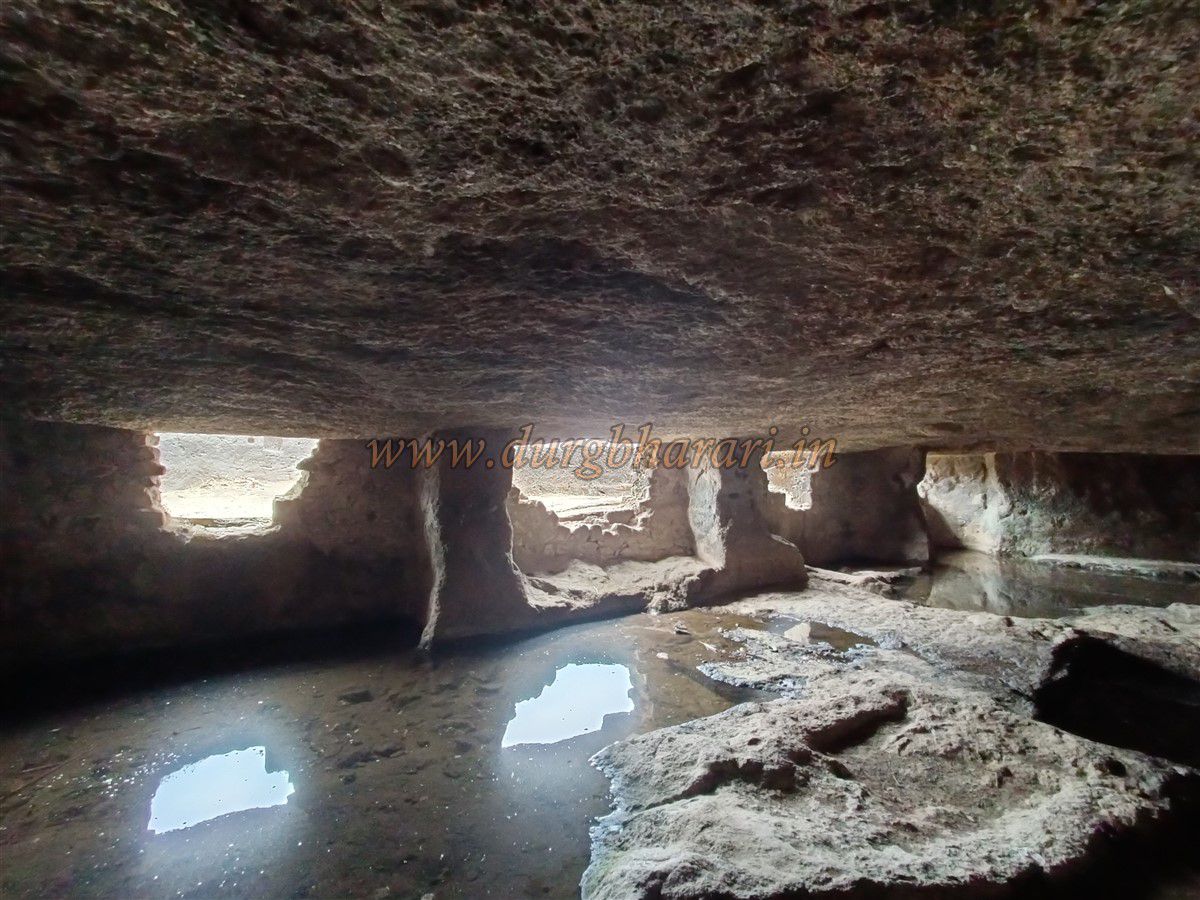
A little ahead, on the left, a signboard indicates “Horse Stables.” In reality, this is not a stable but a partially excavated ancient cave complex. Its use as a place to tie horses in later periods likely gave rise to the name. This rock-cut structure has pillars and a veranda, and due to its incomplete excavation, eight cisterns have formed where rainwater accumulates. Holes cut into the outer rock indicate where wooden pillars for a roof may have once been placed. In front of this cave is another cistern, and further ahead are three smaller unfinished caves, now converted into cisterns due to water accumulation.
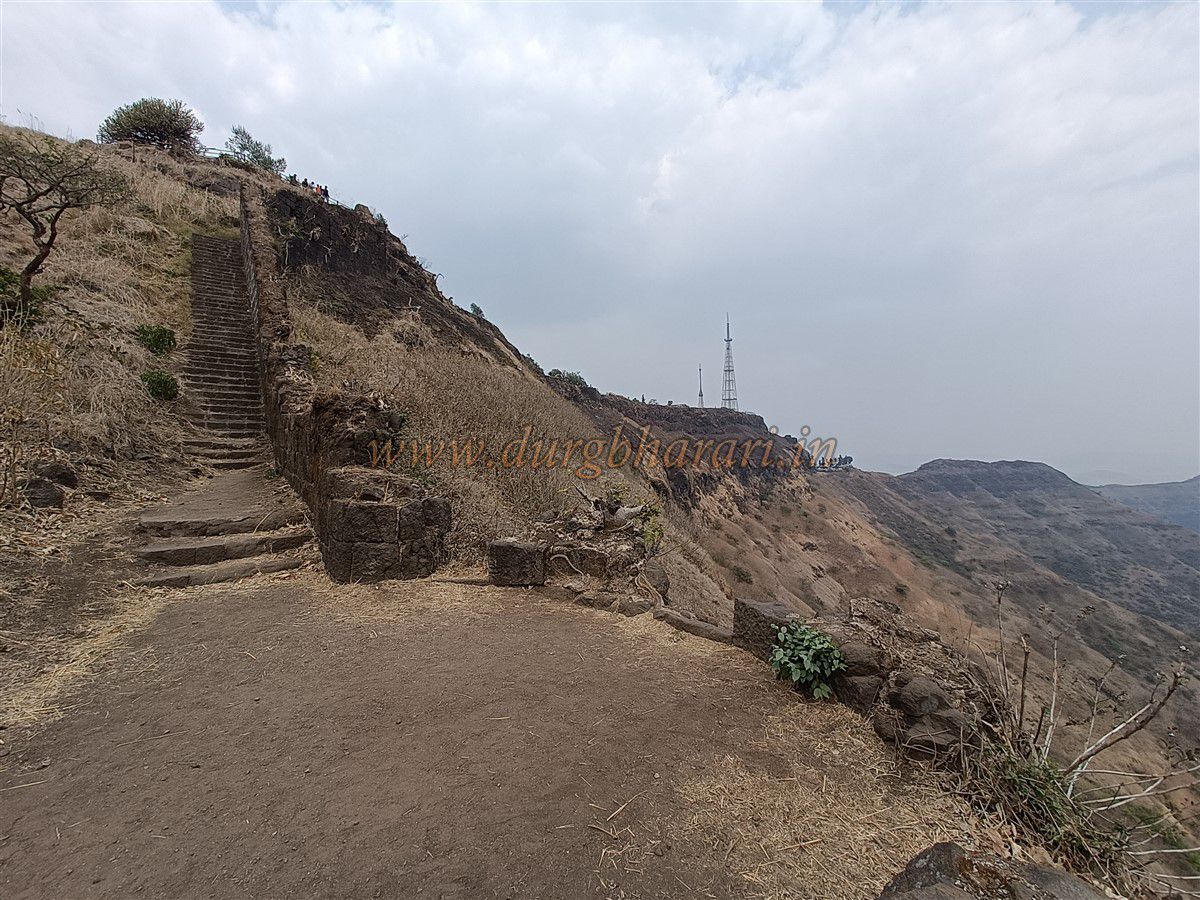
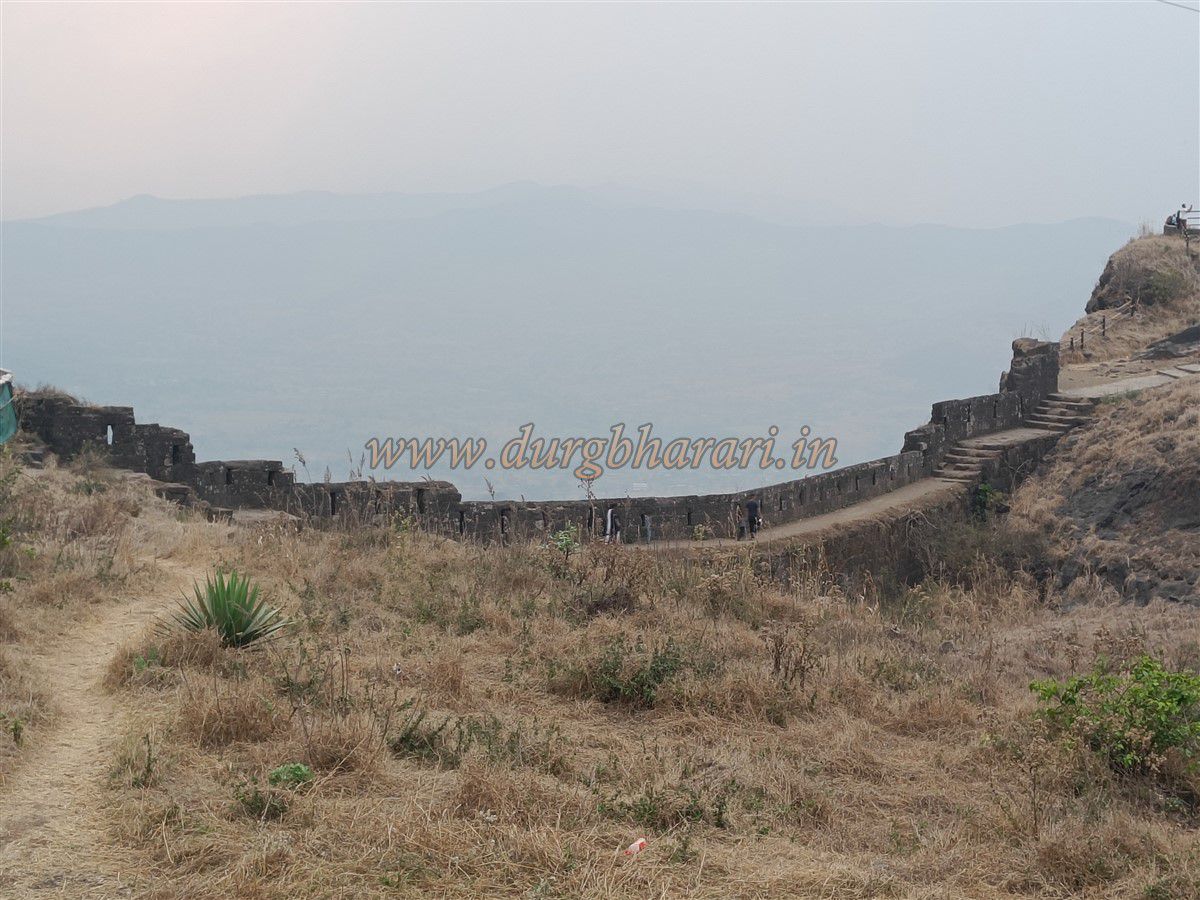
To truly experience Sinhagad, one should first take a full circuit walk along the ramparts to view the entire fort perimeter and then explore the interior structures. Heading from the caves towards the Khadakada side, passing the Doordarshan TV tower, one reaches a large bastion at the fort’s edge. This bastion is in a ruined state and awaits restoration, but offers a sweeping view of the Khadakada section and the parking area below. Following the rampart edge further, on the right, one reaches the remains of the fort commandant’s mansion. Portions of its surrounding walls and two arches still survive. Adjacent to this are two small domed shrines, each housing an idol of Hanuman. Walking along the ramparts, one eventually gets a distant view of the Kalyan Gate.
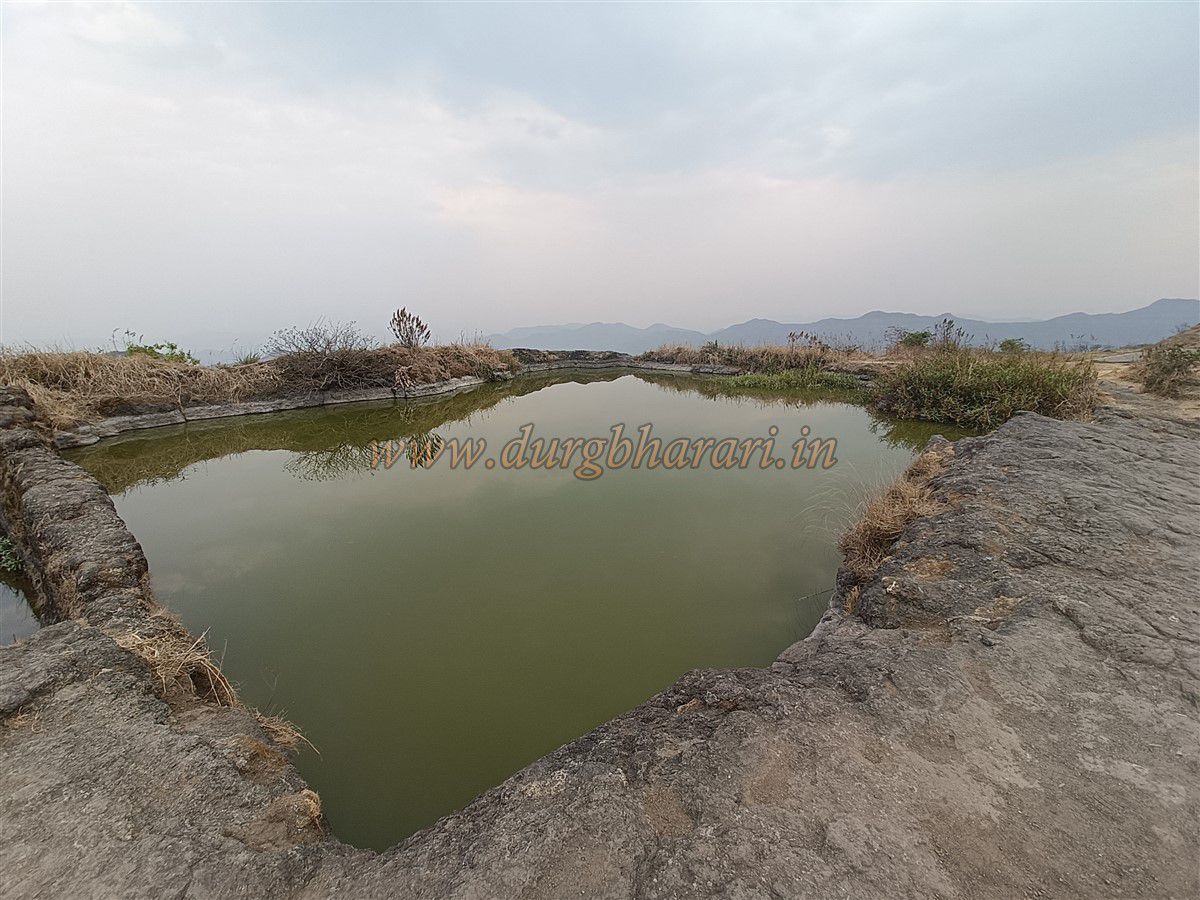
Further along the path, on the left, is a large rock-cut cistern, and beyond it, two more cisterns carved into the rock. The largest of these is known as Ram Talav (Ram Tank). Descending a set of steps from the rampart, one comes across a square-pillared cistern. Continuing to the right instead of climbing back up, one reaches the famous Dev Tank (Sacred Tank). In front of it stands a small domed structure containing an idol of Maruti with a Panvati (downturned trunk). Dev Tank has historically been, and still is, the fort’s primary source of drinking water. Its water remains fresh and available year-round and is renowned for its refreshing taste, often said to wash away all fatigue.
From here, one follows the path along the ramparts toward the Kalyan Gate. Along this route are two underground cisterns, one of which has a carved stone trough nearby. A beautifully designed water channel, resembling a miniature doorway, carries water through the ramparts – a fine example of the fort’s functional architecture. Continuing further, one arrives at the bastion of the Kalyan Gate, also known as the Konkan Gate. This is the second official entry point to the fort, used by those approaching from Kondhanpur.
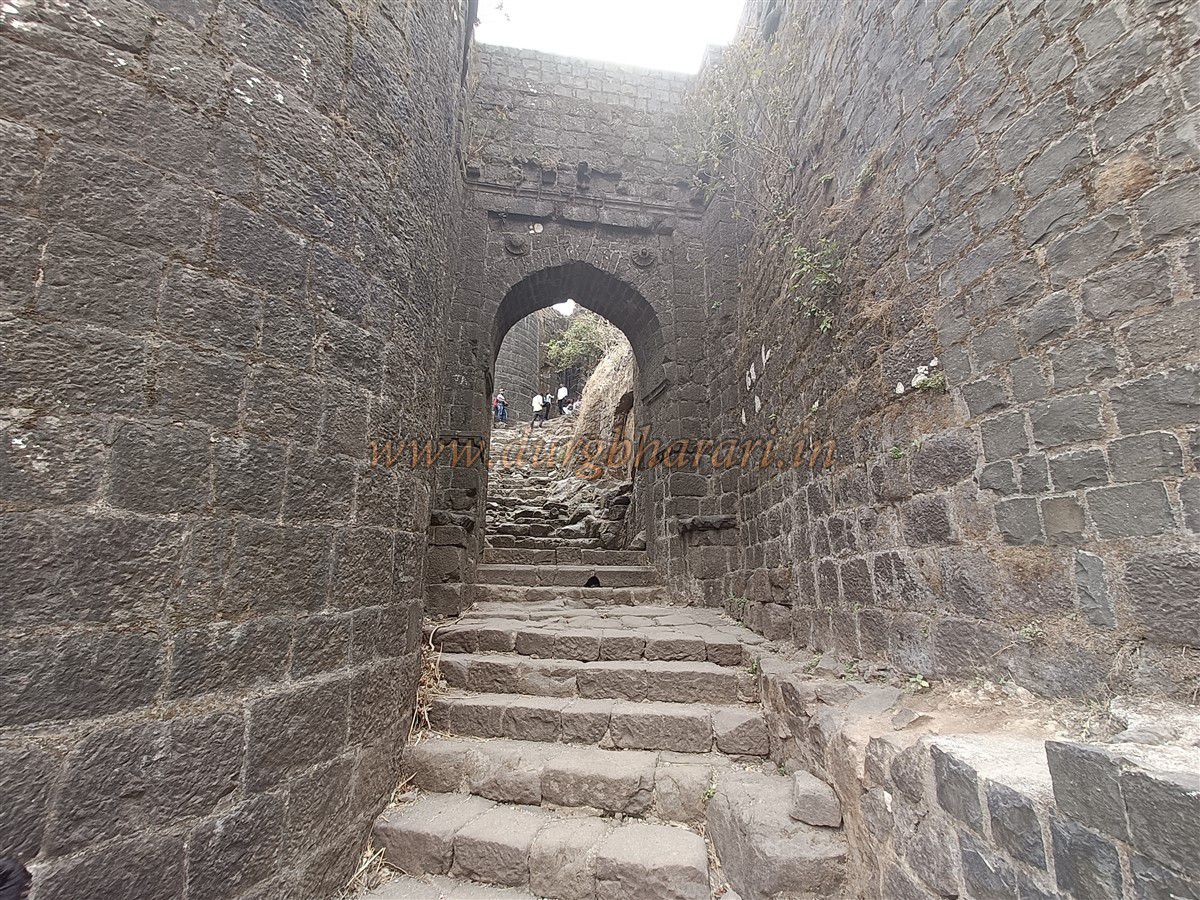
The Kalyan Gate complex consists of two successive gates between bastions. Climbing 20–25 steep steps from the first gate leads to the second, with the entire section enclosed by fortified walls arranged like a battle formation. The arch of the first gate bears carvings of two lotus flowers, though the festoon above them has been damaged. Inside the wall near the gate is a small guardroom. An inscription carved into the arch records that this gate was constructed or repaired during the tenure of Nanasaheb Peshwa, specifically mentioning the year Shalivahan Shaka 1672 and the name “Shrimant Balaji Bajirao Peshwa.” On one bastion is a carving of a boar, and on the opposite bastion, a relief of a mahout riding an elephant. The interior ramparts near the gate also contain quarters for soldiers. From this gate, a straight staircase leads into the fort interior, while a path along the ramparts leads to the next bastion.
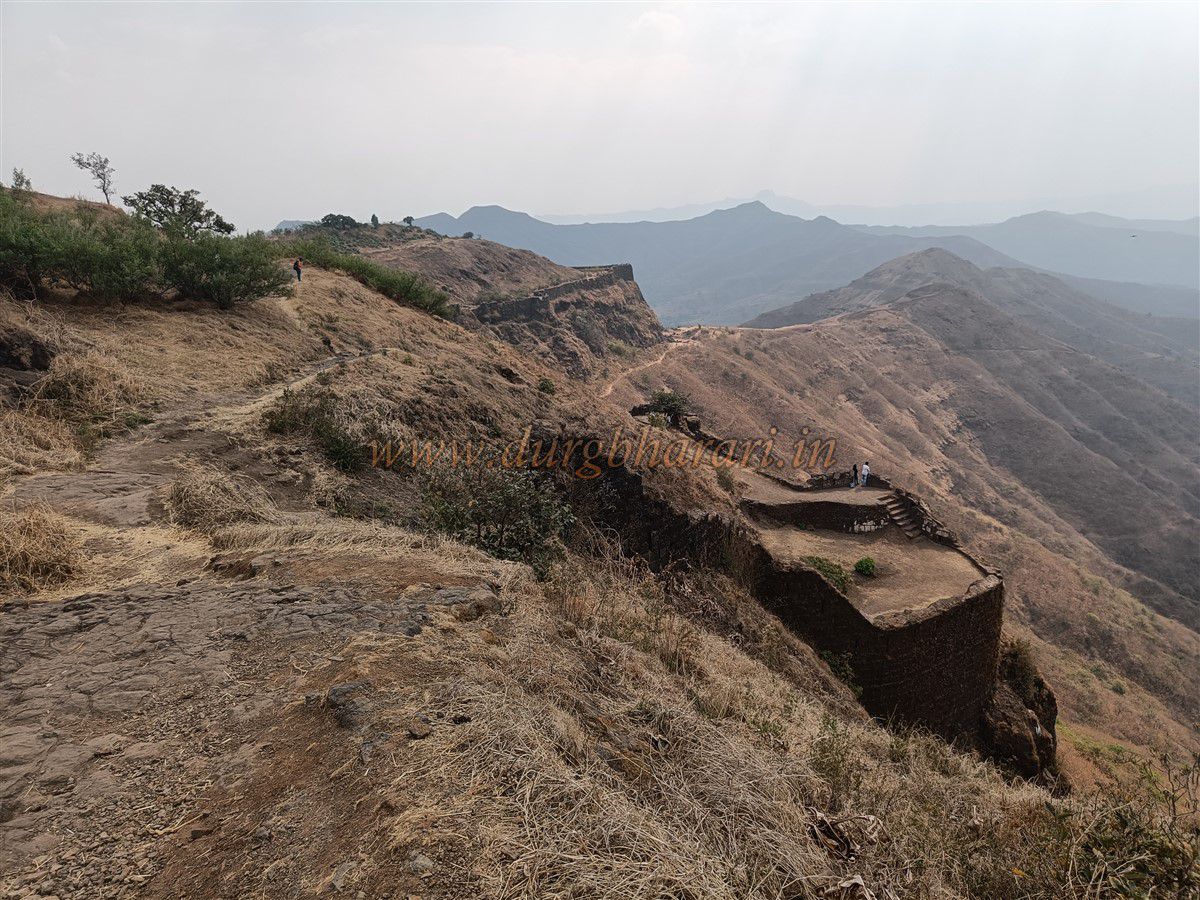
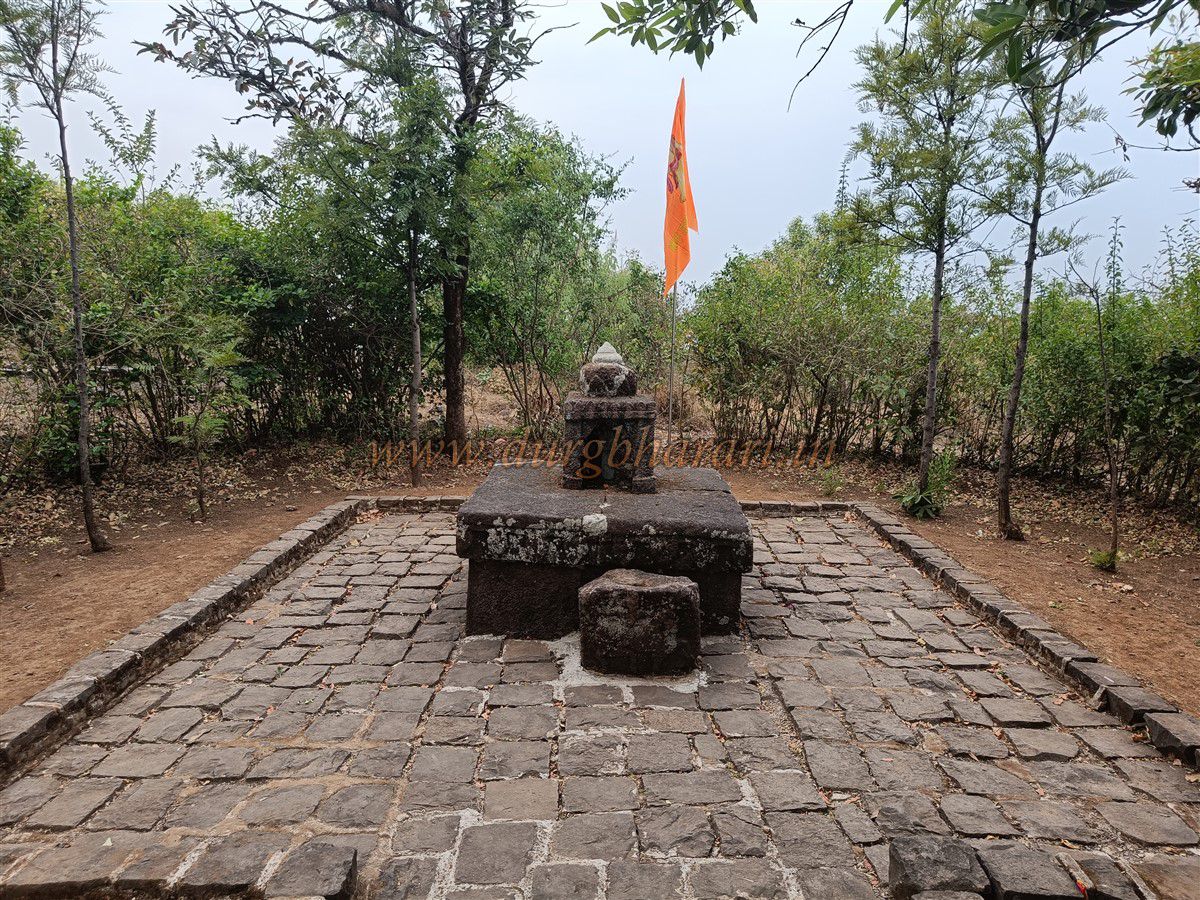
The bastion overlooking this approach is known as the Watch Bastion (Tehalni Buruj), built to monitor the Kalyan Gate route. Above this bastion, on a slope, is a rock-cut cistern that supplied water to the stationed guards. A trail from here climbs up a small hillock, atop which stands a modest platform marking the memorial of Udebhan Rathod, with scattered ruins partially hidden by vegetation. Descending from this hill brings one to the southern edge of the fort at the Zunjar Bastion. This spur was cut off from the adjoining ridge and secured with a bastion to control movement. Below this bastion, scattered across the spur, are the ruins of large structures and dwellings, known as Kalki Met.
The steps leading up to this bastion are buried under debris, with only a partially exposed latrine pit visible. Near this bastion is a shallow, dried-up tank. From here, a hidden escape route descends to the Kalki Met below. Beyond lies another large bastion constructed outside the main rampart. Further ahead, the rampart edge known historically as Dongiri Cliff is now popularly called Tanaji Kada (Tanaji’s Cliff) – the very spot where Tanaji Malusare and his 500 Mavalas scaled the fort during their daring assault.
Continuing along the path, one reaches Kalawantin Bastion. Just before this bastion is another secret path descending to the Amri Met outpost, though today it is mostly used only by locals. Proceeding onward, one comes across a small moss-covered pond, and beyond it, a bungalow. Near the cliff-edge rampart here are five underground rock-cut cisterns.
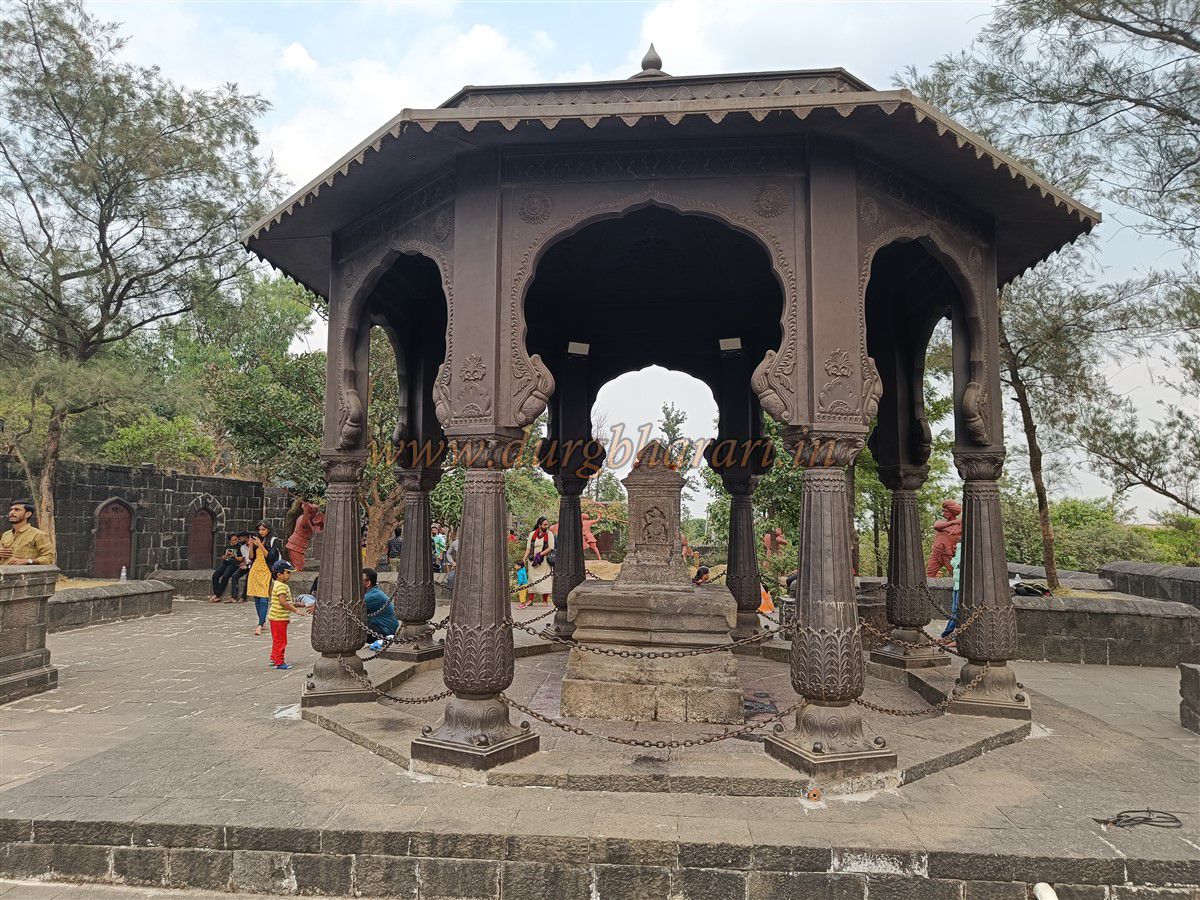
Moving along the edge brings one to the samadhi (memorial) of Chhatrapati Rajaram Maharaj. Behind the samadhi is a large cistern, along with the plinth and ruins of a mansion, likely belonging to a high-ranking noble based on the fine dressed stonework. Two more large tanks lie in front of the memorial. Architecturally, the samadhi is in the form of a Rajasthani-style Chatri, with a cenotaph inside. On the back of the cenotaph is a carving of the mythical double-headed Gandabherunda bird. Rajaram Maharaj, who fought the Mughals for 11 years, died here at Sinhagad on Saturday, March 2, 1700, at the age of 30. In his memory, his son, Chhatrapati Sambhaji II of Kolhapur, built this memorial in 1731. Above the samadhi, along the path, is a small shrine dedicated to Das Maruti.
From here, a paved path leads to the bungalow of Lokmanya Bal Gangadhar Tilak. In front of the bungalow stands Tilak’s statue, flanked by two cannons. Tilak purchased this bungalow in 1890 from Ramlal Nandaram Naik and often stayed here during summers. In 1915, it was at this very bungalow that Lokmanya Tilak met Mahatma Gandhi. Nearby are the ruins of another bungalow, within whose premises two more cannons are placed. From this spot, walking towards the rampart brings you to the bastion opposite the gunpowder storehouse seen earlier.
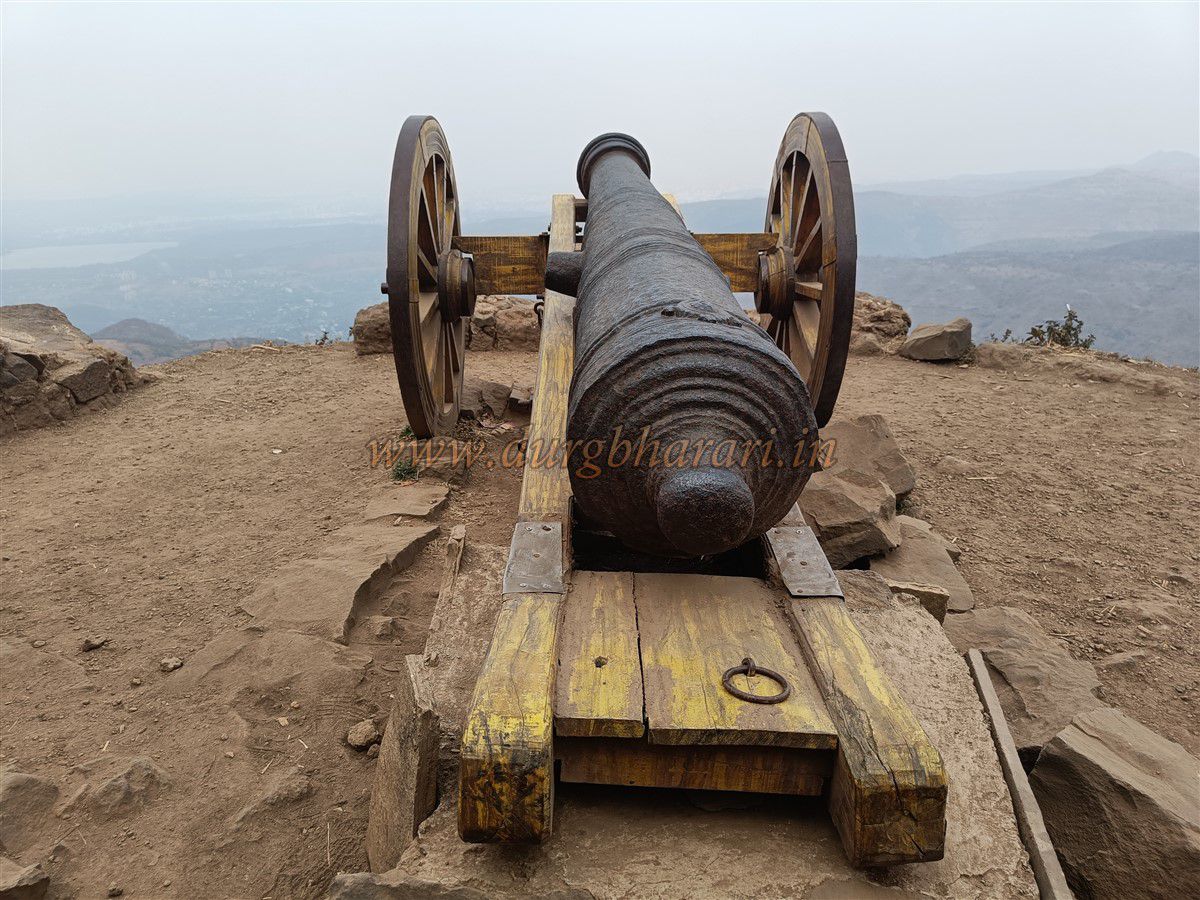
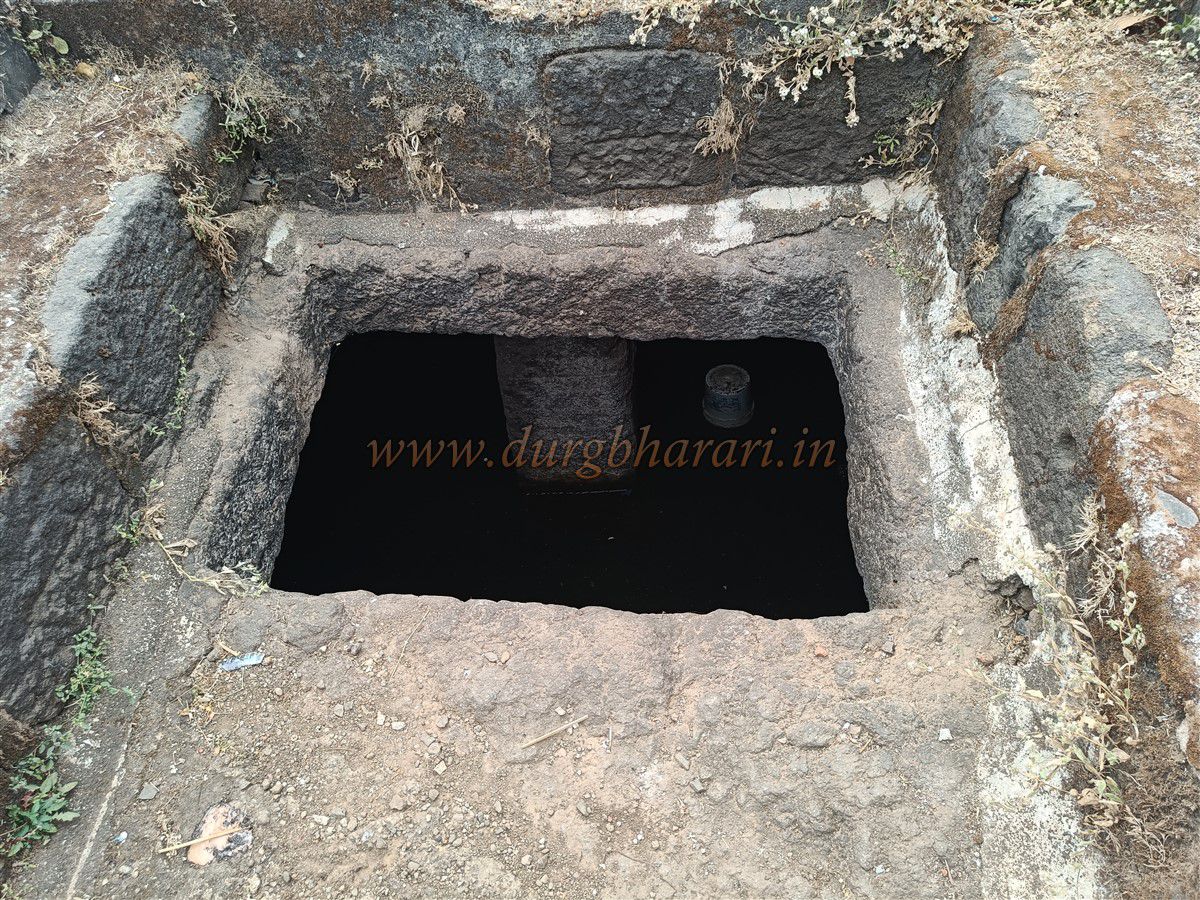
On this bastion, mounted on a cart, is a 6-foot cannon brought from Moradari village between Kondhanpur and Kalyan. The cannon bears the inscription “Gumabh” in Marathi and the number “248” in English. Descending the steps from this bastion and turning right (instead of returning to the storehouse), one comes across nearly 20–22 water tanks of various designs – keyhole-shaped wells, pillared tanks, built reservoirs, underground cisterns, and carved step-tanks. Due to neglect, none of these tanks currently provide potable water.
Nearby stands the ruined temple of Narasimha, seemingly counting its final days. Completing this section of the rampart circuit brings one back to the so-called Horse Stables. Across the path lies another dry quarry tank.
Continuing along the paved path, on the left, is a small Ganesh temple containing idols of both Ganesha and Hanuman. Behind the temple are two tanks, one of which is a pillared cistern. This cluster is known as Ganesh Tank. Further ahead lie scattered stones of old memorials, and on the left, the main entrance to the commandant’s mansion. On the path ahead, on a plinth, rests a cannon, and in front of it stands the memorial of Subhedar Tanaji Malusare.
This memorial has been restored, with a new canopy built over the original samadhi. Beside it, on another plinth, is a metal bust of Tanaji Malusare, and around the memorial are three hero stones (virgal). On February 4, 1672 (Magh Vadya Navami), Tanaji attained martyrdom in the fierce battle fought here. Every year, on this date, his memorial day is observed at the fort.
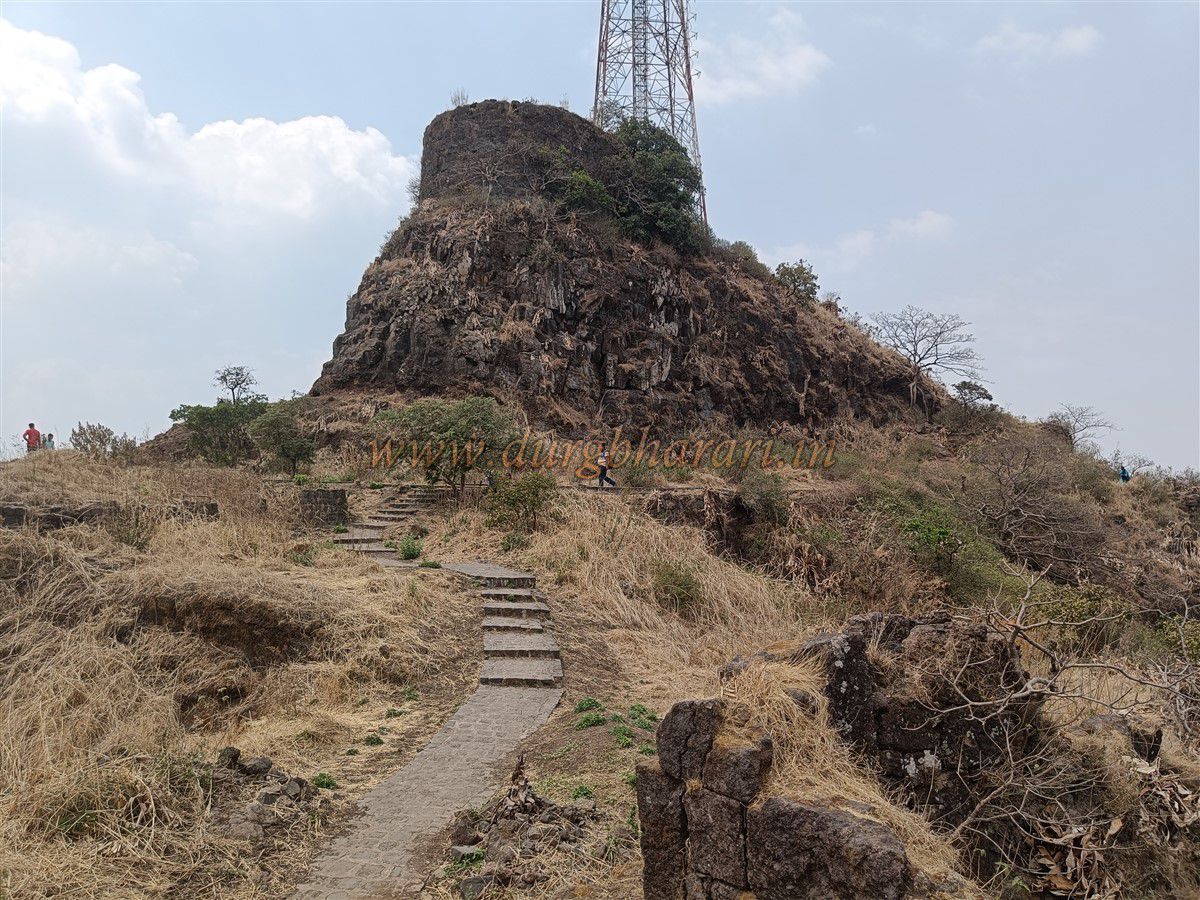
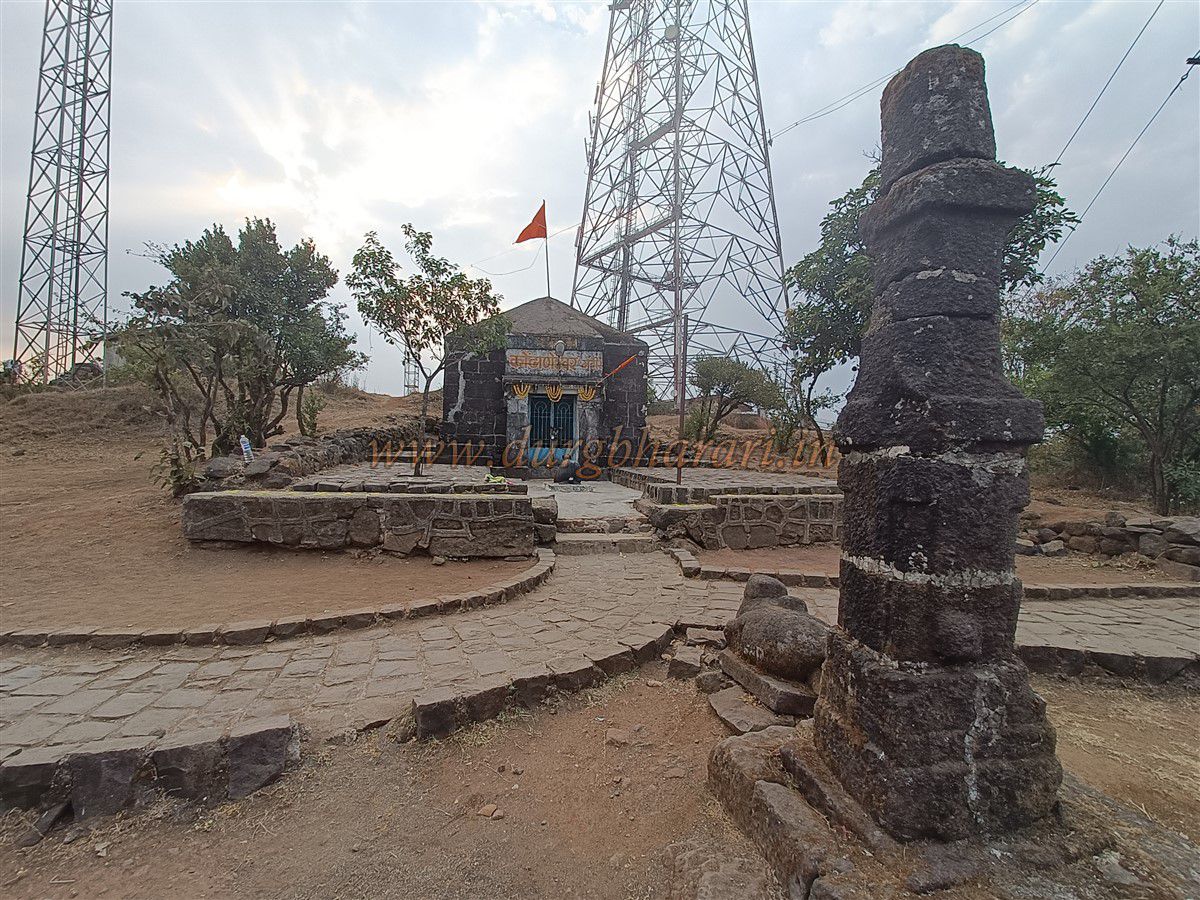
From here, steps climb up to the Kondhaneshwar Temple. This ancient shrine bears worn-out door jambs that hint at its antiquity. Inside are a Shiva lingam and a Ganesha idol, with a Nandi and a stone lamp tower (deepmala) in the courtyard. Behind the temple lies the highest point of the fort, the Gadmatha, at an elevation of 4,314 feet above sea level. From this vantage point, one can see the entire 70-acre expanse of the fort, and on clear days, even distant forts like Rajgad, Torna, Purandar, Lohagad, Visapur, Tung, and Tikona.
Descending from Kondhaneshwar, a path leads to the Amruteshwar Bhairav Temple. This shrine is enclosed by a wall, with its entrance gate still intact. At the center of the enclosure stands a restored south-facing temple of Bhairav, depicting the deity with a severed head in hand, a serpent around his crown and staff, and a dog licking the blood at his feet. Opposite the enclosure gate is a platform, possibly a samadhi or Nandi Mandap.
In front of the temple lies the large, built Hathi Talav (Elephant Tank), and further ahead is another carved reservoir. From here, a descending path leads back to Dev Tank, while the plateau trail continues toward the Zunzar Bastion. Along this path are red-ochre-smeared stones marking the site of a former Lakshmi temple. Further along, two open-air rock-cut tanks can be seen – one large and one medium-sized.
Since the remaining section has already been covered earlier, one may return via an alternate interior path for the descent. Along this route, two more reservoirs can be seen within the fort’s inner area.
Further along the path, on a built platform stands a small dome, within which is placed a sati-stone depicting a hand adorned with bangles. Adjacent to this platform is a sculpture of a warrior seated on a horse. Tourists, unaware of its true significance, often refer to this spot as “Tanaji’s Hand.” From here, the path joins the main trail leading to the gate. Approaching the Pune Gate marks the completion of our exploration of the fort.
It takes around 5–6 hours to thoroughly explore Sinhagad. At present, there are six cannons on the fort. The fort has a total of 37 bastions and more than 50 small and large water tanks. Although it cannot be stated with certainty when Sinhagad was originally built, the fort’s earlier name—Kaundinyadurg or Kondhana—derived from the sage Kaundinya, along with the presence of the ancient temple of Kaundinyeshwar, strongly suggests that the fort’s origins date back to antiquity, possibly around 2,000 years ago. The rock-cut caves known as the Horse Stables (Paga) and numerous pillar-supported water cisterns on the fort also stand as testimony to its ancient construction.
The first historical mention of this fort appears in the 14th century during the reign of Muhammad bin Tughlaq. The Persian poet Isami, in his work Futuh-us-Salatin or Shahnama-i-Hind (c. 1350), records that Muhammad bin Tughlaq captured the fort of “Kundhiyana” in 1328. At that time, the fort was under the control of a Mahadev Koli chieftain named Naga Nayak. To capture this fort, Tughlaq had to lay siege for eight months.
There are no records of the fort during the Bahmani period, suggesting it may have remained under the control of Mahadev Koli vassals. After the decline of the Bahmani Sultanate, in 1482 CE, the fort came under the control of Malik Ahmad, the founder of the Nizam Shahi dynasty. In 1553 CE, the name Kondhana appears in a list of 58 forts held by Burhan Nizam Shah. In 1554, a rebel noble of Burhan Nizam Shah named Nasir-ul-Mulk was imprisoned at Kondhana; after escaping, he was killed. Around 1635 CE, while Siddi Anwar was the fort commander of Kondhana, the combined forces of the Mughals and Adil Shah captured the fort and seized its treasury. During this battle, Kanhoji Baji Shilimkar was killed.
When Shahaji Raje was besieged at Mahuli, Nizam Shahi noble Mudhaji Mayde intercepted the supplies heading to the siege camp at Donje Ghat, capturing goods worth over one lakh rupees. In 1636 CE, Kondhana came under the jagir of Shahaji Raje, whose family resided on the fort for a time. During the Adil Shahi rule (1636–1647), Dadoji Konddev Malthankar served as the Adil Shahi Subhedar of this region, and thus Kondhana fell under his jurisdiction, although the actual fort commander was Siddi Ambar Wahab.
In 1647 CE, after the death of Dadoji Konddev, Adil Shah appointed Miya Rahim Muhammad, the thanedar of Shirwal, as the new commander and Subhedar of Kondhana. However, before he could take charge, Bapuji Mudgal Narhekar (Deshpande), on behalf of Shivaji Maharaj, persuaded the existing fort commander to hand over the fort, thus bringing Kondhana under Shivaji’s control.
In 1649 CE, to secure the release of Shahaji Raje, Shivaji returned the fort to Adil Shah. On 13 August 1657, Kondhana once again joined Swarajya, and Shivaji Maharaj renamed it Sinhagad. A letter published by historian G. H. Khare confirms that the name Sinhagad was in use before 1663.
A letter dated 3 April 1663 mentions that a “fitwa” (conspiracy) had occurred on the fort and that Tanaji Malusare, Kondhaji Naik, Kamalaji Naik, Darekar, Umaji Naik, and Gondaji Pandhre were dispatched to investigate. The letter states:
"Masrool Hazarati, Rajmanya Rajashree Shrimant Moropant Peshwa and Rajashree Neelsonde and Mujoomdar, though an agreement had been made to march against Namdar Khan in Konkan, urgent news has come from Sinhagad that some conspiracy has taken place on the fort. Therefore, the plan to march to Konkan is temporarily halted. You must immediately ride with military forces and go to Sinhagad, conduct thorough inquiries on the fort, and report the details of those involved in the conspiracy. Masrool Tanaji Naik, Kondhaji Naik, Kamalaji Naik, Darekar, Umaji Naik, and Gondaji Pandhare must also accompany you, remain vigilant on Sinhagad, and keep the suspected traitors under strict watch. Written on the 4th of Ramadan."
This letter shows that the name Sinhagad was in use at least seven years before the famous Battle of Sinhagad.
In 1663, after attacking Shasta Khan, Shivaji Maharaj took shelter at Sinhagad. In November 1663, Mughal commander Jaswant Singh Rathod laid siege to the fort but, harassed by continuous Maratha attacks, lifted the siege on 14 April 1664. On 30 May 1664, Shivaji Maharaj himself visited the fort for inspection. On 1 May 1665, Mughal commander Daud Khan attacked the fort from Shivapur.
Following the Treaty of Purandar on 14 June 1665, the fort was handed over to the Mughals, who appointed the fierce Rajput Udebhan Rathod as its commander. On 21 September 1665, Mirza Raja Jai Singh camped at the fort.
After escaping from Agra, Shivaji Maharaj maintained peace for a while and then began reclaiming the forts lost in the Treaty of Purandar. The responsibility of capturing Sinhagad fell on Subhedar Tanaji Malusare. On the night of Magh Vadya Navami, 4 February 1670, Tanaji launched his daring assault on the fort, where he attained martyrdom. The 1670 Battle of Sinhagad and Tanaji Malusare valour are among the most glorious chapters of Maratha history.
During the reign of Sambhaji Maharaj, Moro Bhaskar served as the fort’s manager. While Aurangzeb waged his 27-year war in the Deccan, Sinhagad changed hands between the Mughals and Marathas eight times. In 1684, the Mughals captured the fort, but in 1686, the Marathas recaptured it.
On 12 July 1689, Santaji Ghorpade attacked Aurangzeb’s camp at Vadhu and successfully retreated to Sinhagad. At this time, Sidhoji Prataprao Gujar was the fort’s Havaldar. Soon after, the Mughals regained control. In 1692, Shankaraji Narayan’s forces failed in their attempt to capture the fort.
On 1 July 1693, Maratha warriors Nawji Balkawade and Vithoji Karke repeated Tanaji’s feat and captured the fort. A letter from Shankaraji Narayan, dated 1693, to Kakaji Narayan Deshadhikari of Maval taluka (Lohagad region) confirms this event.
During the Mughal invasion of Satara, Chhatrapati Rajaram sought refuge at Sinhagad, where he died on 3 March 1700.
Two years later, on 27 December 1702, Aurangzeb’s forces laid siege to the fort. Mughal commander Tarbiyat Khan began constructing batteries to bombard the fort, but Maratha leaders Balaji Vishwanath Bhat, Subedar of Pune, and Senapati Dhanaji Jadhav launched repeated raids on the Mughal camps.
Safi Mustaid Khan writes that the fort was so impregnable that only divine intervention could capture it. At this time, Tryambak Shivdev and Sidhoji Jadhav commanded the fort. When they refused to surrender, Aurangzeb finally used diplomacy, bribing them with 50,000 rupees through Somaji Vishwanath Purandare. On 14 April 1703, Aurangzeb took possession of the fort and renamed it “Bakshida-Bakhsh” (Divine Gift). On 18 April, Aurangzeb himself visited the fort in a palanquin.
When Aurangzeb left for Gulbarga to lay siege to Wakinkheda, the Marathas recaptured Sinhagad in April 1705. Tryambak Shivdev and Ramji Phatak led the assault, capturing the fort commander devising. However, the fort did not remain in Maratha hands for long. In 1706, Mughal commander Zulfikar Khan retook the fort, but in 1707, the Marathas recaptured it once again. Pantaji Shivdev played a key role in this battle.
In total, the fort changed hands eight times during Aurangzeb’s 27-year campaign—reflecting the fierce contest between the Mughals and Marathas over this crucial stronghold.
Later, during the internal conflicts among the Marathas, Shankaraji Narayan aligned with Chhatrapati Shahu, and the fort remained under the control of the Maratha secretariat until 1750. Thereafter, the Peshwa took control of Sinhagad, giving Tung and Tikona forts and the Shirwal region to the secretariat in exchange.
During the Peshwa period, the fort served as a safe refuge for the Peshwa treasury and their family members in times of crisis.
On 5 November 1817, after the Maratha defeat at the Battle of Khadki, Captain Turner of Brigadier Smith’s detachment attacked Sinhagad but was forced to retreat. After the British captured Pune following the Battle of Yerwada, Peshwa Bajirao II moved his treasury and valuables to Sinhagad.
In 1818, British forces from Satara arrived in the Sinhagad area, initiating negotiations. On 2 March 1818, British officer Pritzler bombarded the fort with 3,678 cannonballs, forcing the garrison to surrender.
At that time, the British captured 67 cannons, a stockpile of ammunition, jewellery, precious items, and cash—amounting to a treasure worth 50 lakhs.
The fort remained under British control until India’s independence.
© Suresh Nimbalkar
GALLERY