AYODHYA RAMMANDIR
TYPE : RAMMANDIR
DISTRICT : UTTAR PRADESH (AYODHYA)
Maryada Purushottam Shri Ram is a figure of deep faith for millions of Hindus around the world. According to Hindu beliefs, Shri Ram is considered an incarnation of Lord Vishnu. As per the ancient Indian epic Ramayana, Lord Ram was born in Ayodhya, and hence Ayodhya is revered as his birthplace. In the 15th century, the Mughals demolished a Hindu temple at this sacred site and built the Babri Masjid.
During the reconstruction of the Ram Mandir, excavations revealed a Shivling, broken idols, and temple pillars—evidence of a pre-existing temple. In commemoration of Ram's birth, the idol of child Ram (Ram Lalla), an incarnation of Vishnu, has been enshrined in the temple. The poet Tulsidas referred to this form as Ram Lalla, and the idol established in 1949 has also been referred to by the locals as Ram Lalla.
...
With the installation of a new idol in the sanctum sanctorum (Garbhagriha), the 1949 idol will now be used as the festival idol (Utsav Murti).
Lord Ram is one of the most revered Hindu deities, considered the complete incarnation (Purnavatar) of Vishnu. He holds great significance in Hindu culture and religion. It is said that he possessed sixteen ideal virtues, which is why Hindus regard him as Purushottam, the embodiment of dharma, and Adi Purush (the first man).
As per the epic Ramayana, Ram was born in Ayodhya, which is one of the seven holiest cities for Hindus. Three locations in Ayodhya are considered especially sacred: the birthplace (Janmasthan), Swarg Dwar (gateway to heaven), and Yagyasthal (sacrificial ground).
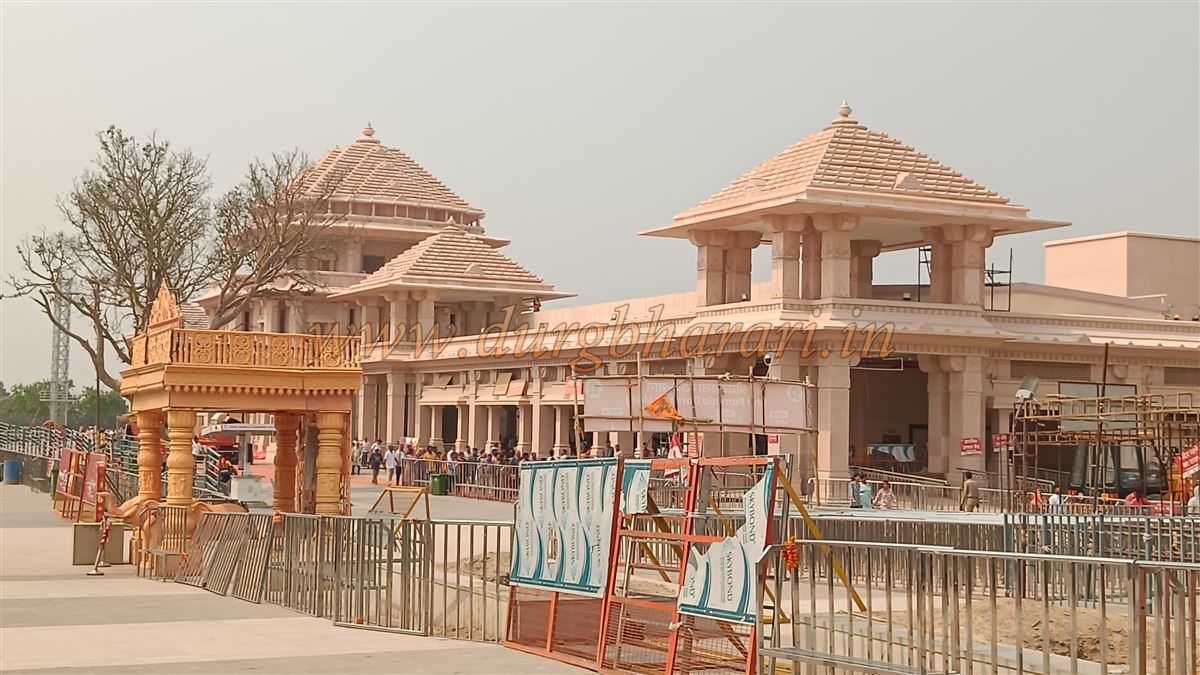
The original design for the Ram Mandir was created in 1988 by the Sompura family of Ahmedabad. In 2020, they revised the design in accordance with Hindu scriptures, Vastu Shastra, and Shilpa Shastra. The temple will be 250 feet wide, 380 feet long, and 161 feet high. It is the third-largest Hindu temple in the world and follows the Nagara style of architecture typical in North India.
The main structure is built on a three-story high platform. The temple features five mandapas: Nritya Mandap (dance pavilion), Rang Mandap (color pavilion), Sabha Mandap (assembly hall), Prarthana Mandap (prayer hall), and Kirtan Mandap (devotional music hall). On the first floor, the Ram Darbar consists of five chambers. These pavilions have shikharas (temple spires) in Nagara style.
The temple houses beautifully carved idols of deities, and temples at the corners are dedicated to Surya (Sun god), Bhagwati (Goddess), Ganesha, and Shiva. To the north and south are temples of Annapurna and Hanuman. The temple has 366 intricately carved pillars, each featuring 16 idols including forms of Shiva, the Dashavataras of Vishnu, the 64 Yoginis, and Saraswati. The temple’s steps are 16 feet wide. As per Vastu Shastra, the sanctum sanctorum is octagonal. The temple complex also includes shrines dedicated to Surya, Ganesha, Shiva, Durga, Vishnu, and Brahma.
In 1528, Mughal general Mir Baqi, on orders from Babur, constructed the Babri Masjid at Ram’s birthplace. The earliest record of this mosque is found in a 1767 Latin book Descriptio Indiae by Jesuit missionary Joseph Tiefenthaler, who noted that locals believed the mosque was built after demolishing Ramkot temple and Ram’s birthplace.
The ASI (Archaeological Survey of India) report of 2003, which revealed non-Islamic structures beneath the mosque, was accepted by the courts. However, the Supreme Court of India concluded that while the underlying structure was non-Islamic, there was no evidence that it was demolished to build the Babri Masjid. The court acknowledged the uncontested belief of Hindus that this was Ram's birthplace, supported by substantial evidence.
Ram Mandir Timeline:
• 1526 – Mughal ruler Babur arrives in India.
• 1528 – Mir Baqi builds the Babri Masjid at Ram’s birthplace.
• 1853 – First religious clash over Ram Janmabhoomi after the Mughal Empire weakened.
• 1858 – First FIR is filed regarding hawan and worship at the site.
• 1885 – Raghubar Das of Nirmohi Akhara files a petition to build a temple adjacent to the mosque.
• 22 Dec 1949 – Idols of Ram appear under the mosque dome; Hindus begin worship.
• 16 Jan 1950 – Gopal Singh Visharad files the first legal case for worship rights.
• 5 Dec 1950 – Mahant Ramchandra Paramhans files a similar case.
• 3 Mar 1951 – Court orders that Muslims must not obstruct Hindu worship.
• 17 Dec 1959 – Six members of Nirmohi Akhara claim the site.
• 18 Dec 1961 – Sunni Waqf Board files suit claiming ownership of the land.
• 1978 – ASI finds evidence of a temple during excavations; archaeologist K.K. Mohammed supports the claim.
• 1982 – VHP begins campaign for unlocking the site.
• 8 Apr 1984 – Hindu saints and leaders decide to launch a movement.
• 1 Feb 1986 – Court orders opening of locks for Hindu worship; Muslims form Babri Masjid Action Committee.
• Jan 1989 – VHP begins Shila Pujan across villages during Kumbh Mela.
• 1 July 1989 – Fifth case filed in the name of “Bhagwan Ram Lalla Virajman”.
• 9 Nov 1989 – Temple’s Bhoomipujan (groundbreaking) announced by PM Rajiv Gandhi.
• 6 Dec 1992 – Babri Masjid demolished by Karsevaks; temporary Ram temple built the same day.
• 7 Dec 1992 – Over 30 Hindu temples attacked in Pakistan and more in Bangladesh.
• 8 Dec 1992 – Curfew imposed; plea filed in court for allowing Prasad.
• 1 Jan 1993 – Permission granted for darshan and puja.
• 7 Jan 1993 – Central government acquires 67 acres of surrounding land.
• Apr 2002 – Allahabad High Court begins hearing on land ownership.
• 5 Mar 2003 – ASI directed to excavate; in Aug 2003, ASI confirms existence of temple.
• 5 July 2005 – Five terrorists attack temporary Ram Mandir; all neutralized by CRPF.
• 30 Sep 2010 – Allahabad High Court divides land into three parts: Sunni Waqf Board, Nirmohi Akhara, and Ram Lalla.
• 21 Mar 2017 – SC proposes out-of-court mediation.
• 8 Feb 2018 – SC begins hearing civil appeals.
• 27 Sep 2018 – SC refuses to send matter to a constitutional bench.
• 8 Jan 2019 – SC forms 5-judge bench led by CJI Ranjan Gogoi.
• 6 Aug 2019 – Daily hearings begin.
• 16 Oct 2019 – Hearings conclude after 40 days.
• 9 Nov 2019 – Historic SC verdict: Entire 2.77-acre land goes to Ram Lalla; Muslims to receive 5-acre land elsewhere.
• 5 Feb 2020 – PM Narendra Modi announces Shri Ram Janmabhoomi Teerth Kshetra Trust.
• 5 Aug 2020 – Grand Bhoomipujan for temple construction in Ayodhya; PM Modi attends.
• Jan 2023 – Two ancient Shaligram stones from Nepal’s Gandaki River brought to carve Ram Lalla idol.
• 22 Jan 2024 – Inauguration of Ram Mandir and Pran Pratishtha of deity idols.
© Suresh Nimbalkar
GALLERY